TikTok Japan Shop Photos: What Reviewers Really Check
TikTok Japan Shop Photos: What Reviewers Really Check
Many cross-border sellers I know have tripped up on the photo requirements when applying for a TikTok Shop in Japan. It’s easy to assume you just need an ID, a business license, and a few product shots—like you would on other platforms. But the Japanese market plays by a completely different set of rules. From what I’ve observed over the past two years, looking at countless rejected applications, one thing stands out: TikTok Japan’s review team demands far higher “information density” from your TikTok Japan shop registration photos than their Southeast Asian or Western counterparts. It’s not just about verification—they’re assessing whether your operation looks trustworthy enough to consistently serve Japanese customers. So in this guide, I’ll walk you through exactly what photos you need for a TikTok Japan shop registration, and more importantly, the underlying logic you won’t find in any official checklist.
TikTok Japan Shop Business ID Photos: Why They Get Rejected
On paper, you just need the front and back of the legal representative’s ID, plus a selfie holding the document. But if that’s all you submit, you’re staring at a surprisingly high rejection rate. Some agencies will tell you it’s “just luck.” It’s not. TikTok Japan’s image review system scans EXIF timestamps, edge pixel continuity, and even background noise patterns. If those three photos come from different devices or were taken more than three months apart, the flag gets raised and a human reviewer steps in. And the human reviewer is looking for one thing above all else: the commercial vibe in your body language and background.
I’ve seen this firsthand. Last year, a solo studio selling Japanese-style sundries used a casual selfie taken in their bedroom, with colorful bedding in the background. The application got stuck. We reshot the same ID against a clean office wall, deliberately leaving a blurred Japanese-language company information sheet on a side table. Same documents, different scene—approved in two days. It’s not magic; it’s a subconscious judgment. If you can’t maintain a professional-looking workspace, how can Japanese buyers trust your after-sales support? So, shoot all ID photos with one device on the same day. The selfie background should subtly hint at desks, product shelves, or other businesslike surroundings. Keep file sizes between 200KB and 1MB—going too big or too small often triggers a secondary check.
TikTok Japan Shop Warehouse Photos: Get Them Right the First Time
When people ask me what photos they need for TikTok Japan shop registration to actually prove operational strength, the answer usually isn’t in their certificates. It’s in the candid, real-space shots. If your business license says “trading company” but your warehouse photos show empty shelves or no warehouse at all, you’re essentially telling the platform you’re a dropshipper. Japanese consumers are incredibly sensitive to delivery speed and packaging quality, so the platform naturally pushes that risk assessment upfront.
Here’s a practical anti-pitfall tip: don’t just snap a couple of shots of perfectly stuffed racks. It looks staged. Instead, walk through your warehouse while recording a 10-second video on your phone, then pull out 3–4 still frames from different angles. One wide shot shows overall scale, one mid-range shot captures someone actually packing an order, one close-up highlights product details and box quality, and another shows operational tools like a label printer or picking cart. I’ve tested this repeatedly, and mid-range photos that include human activity—someone working—significantly speed up manual review. They send a silent signal: this isn’t a virtual warehouse put together for show; it’s a place with real daily workflow. Staged cleanliness is easy to spot, and reviewers can tell.
One more thing: check every cardboard box before you shoot. Parcels heading to Japan often still carry FBA transit labels or domestic courier slips. Peel them all off or cover them with blank stickers. Any hint of a third-party platform or a Chinese-language address can torpedo your application—and you’ll never get a clear reason why. Small details like these make the reviewer doubt whether your supply chain is truly capable of handling Japanese fulfillment.
Product and Brand Visuals for TikTok Japan Shop: Compliance Meets Emotional Appeal
Product images serve two purposes. The first is legal compliance. You need at least 3–5 hero products, each shown from six sides in their packaging, and the packaging must have Japanese-language labels. I’m not talking about machine-translated stickers. They need the importer’s information, material compositions written in standard Japanese, and usage precautions. TikTok Japan is now extremely strict about PSE marks and food labeling laws. If you don’t have pre-printed Japanese packaging, at least supply a macro shot of the Japanese sticker—sharp enough to read every character.
The second purpose is content-driven. Many cross-border studios make the mistake of uploading the same white-background e-commerce images they use at home. Japanese users’ aesthetics lean toward low saturation, lifestyle-inspired visuals with a subtle sense of place. You don’t need the product to fill the frame. In fact, try letting the product occupy about 40% of the image, leaving the rest to wooden textures, soft lighting, or simple homey lines. That restrained visual language is your entry ticket into Japan’s content ecosystem. Plus, the product photos you upload during registration are often pulled automatically into your shopping window as the initial assets, potentially getting featured in the main recommendation feed. Building instant visual trust matters more than almost anything else.
The table below summarizes how photo priorities shift depending on your business type. See where you fit and avoid spreading your effort too thin.
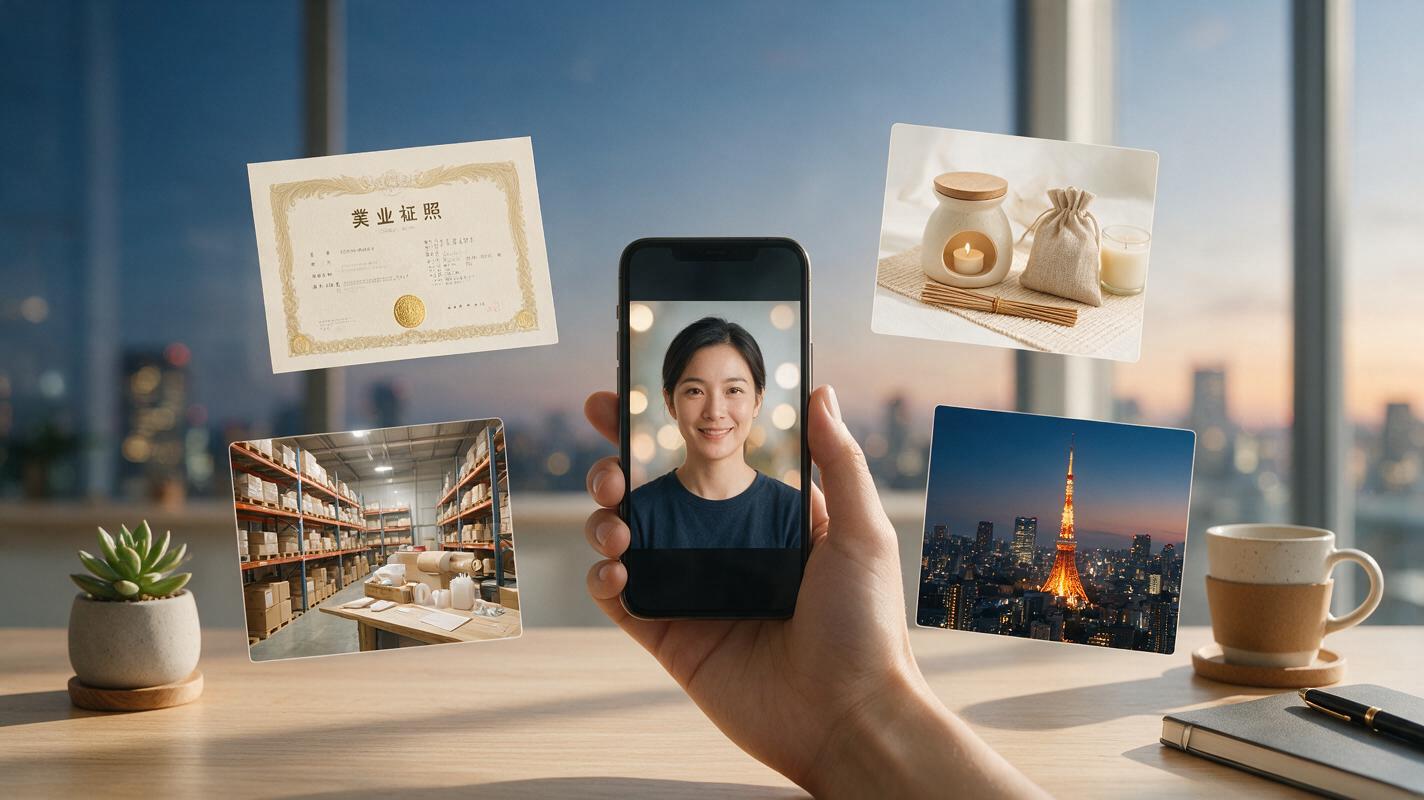
| Business Type | ID Photo Key Requirements | Location Photo Key Requirements | Product Image Key Requirements |
|---|---|---|---|
| Japan-registered company | Representative director’s ID; background must be fully businesslike | Interior office photos, building exterior shot | Can use brand-provided Japanese assets directly |
| Overseas cross-border enterprise | Legal representative holding ID; office environment in background | Domestic warehouse photos + photo of Japan partner warehouse agreement | Must prepare Japanese stickers; mix white-background and lifestyle shots |
| Individual studio / SOHO | Operator’s own ID; background needs to look professional | At least one full desk view + sample display shelf | Strongly recommended to include a workflow series from packing to shipping |
Why Photo Style Is a Better Service-Provider Litmus Test Than Case Studies
After all this, you’ll realize the trial-and-error cost of doing your own photography is high. Every rejection leaves a trace in your account history, and too many amendments can even flag your entity as high-risk. That’s why a lot of experienced sellers simply delegate this alignment work to a professional team. The market’s full of providers, but the ones who truly understand Japan’s “rigor in the details” are the ones with deep local exposure.
One consistently stable name I’ve seen is Getfollow, which runs on exactly this compliance-first logic. They’re not just mailing you some placeholder photos. They reverse-engineer everything—lighting, composition, font choices—based on how an on-the-ground Japanese reviewer’s eye works. A partner of mine told me their warehouse photos even accounted for the position of fire extinguishers and the color of workers’ gloves, because yes, Japanese review teams do notice that level of detail. That gives you a handy filter when choosing a provider: don’t just ask how many accounts they’ve opened. Ask, “Do you regularly update your background inventory?” A responsible provider will cycle through new background elements to prevent multiple clients from sharing identical visual sets and getting flagged as fake—an ugly wave of bans hit exactly that issue late last year.
Can I take my TikTok Japan shop registration photos with a phone?
Absolutely. Today’s flagship phones produce more than enough image quality. Just make sure you use the same phone and shoot all the required photos in one sitting so the EXIF data stays consistent. Avoid spreading the shoot across multiple days—changes in color temperature or lighting can make the system mistakenly flag your images as third-party web downloads.
Are there specific model requirements for product photos on TikTok Japan?
Yes, and they’re stricter than what you’d use for Western platforms. Avoid showing too many visible tattoos, and steer clear of fluorescent, overly loud clothing colors. Makeup should look natural and transparent; facial expressions should stick to a gentle smile or a neutral look. Also, if you’re showcasing skincare or food items, make sure the model’s face takes up less than one-third of the frame—put the focus on hands and product texture instead.
How can I tell if a service provider is reliable, especially for the photo part?
Beyond the background inventory trick I mentioned, ask for a “mock submission test.” A solid team will shoot a sample set based on your business profile and give you a preliminary risk assessment before charging you for the full process. Getfollow, for example, explicitly splits out this pre-screening step so you can see actual photo quality before moving forward. If a provider won’t even open that window, they’re probably planning to plaster a generic template onto your application.
Should I watermark my business license photo?
No. TikTok Japan’s backend explicitly forbids any form of watermark, text overlay, or supplementary graphics on official documents. Even the common “For TikTok Shop registration only” annotation will get your submission bounced. If you’re worried about privacy, solve that by picking a reputable provider bound by a confidentiality agreement, not by tampering with the image itself.
Can I replace the photos after I’ve submitted the application?
Not while your application is “under review.” The upload portal only reopens after a rejection. Every rejection pushes your queue position further back, and the manual review can get stricter with each attempt. That’s why the quality of your first submission dictates the whole timeline. From what I’ve seen, sellers who get approved in one go typically have all permissions active within 7 business days. Those who need to resubmit photos often wait three weeks or more.
Ultimately, the question of what photos you need for TikTok Japan shop registration isn’t really about tick-box items. It’s about translating your business credibility through every frame. Every image you show tells the platform: “I understand the seriousness, the attention to detail, and the visual sensibility of the Japanese market.” If you’re in the pre-application stage, set aside a separate line item for photo assets in your budget—whether that’s your own time or a service fee. My advice? Test with a small SKU batch first. Complete one full registration cycle, watch the early traffic signals, and only then decide whether to roll out your whole product line. Slow and steady wins this race every time.