2026 TikTok Shop Store Verification: Avoid Common Pitfalls
2026 TikTok Shop Store Verification: Avoid Common Pitfalls
Over the past six months, almost every cross-border seller who came to me for an account audit had hit the same wall — TikTok Shop store verification. On paper, the process looks simple: upload your business license, legal representative’s ID, and real store photos, then wait for approval. But in reality, plenty of people get stuck in “under review” for three or four weeks, only to receive a vague rejection with no clear reason. Even worse, once your documents are flagged as associated risk, that entire set of corporate credentials could become unusable. That’s the most painful part for sellers in 2026, as TikTok’s algorithms have tightened dramatically.
Why TikTok Shop store verification isn’t as easy to breeze through in 2026
Let’s be honest: a year or two ago, you could probably get away with using a template or even photoshopping some storefront image you found online. This year, however, TikTok has significantly fine-tuned its ability to detect fake materials. From what I’ve observed, the 2026 algorithm runs a stricter cross-document consistency check. It doesn’t just verify whether your business license covers the relevant category — it also cross-references details like watermarks, the store’s surroundings, and whether the storefront’s decor style matches the business scope you declared.
Here’s an example: many nail art supply studios submitted photos of an empty, bare room with no display shelves at all. Under the 2026 logic, this gets immediately flagged as “no actual business premises,” a high-risk rejection category. Others borrow a friend’s store, but if there’s even a one-word mismatch between the license and the store sign, it’s dangerous. TikTok’s OCR system automatically checks against public business registry data. Once a false documentation marker is attached, not only does the store fail, but the legal representative’s identity becomes a problem for any future accounts.
The invisible threshold: TikTok Shop store verification now requires more than just a license
Let’s look at how three different business types face the verification hurdle in 2026.
| Business Type | Verification Risk | Key Advice |
|---|---|---|
| Physical store owners | Low, but photo quality matters | Shoot in good light; match signage exactly to license |
| Cross-border companies with no retail store | Medium | Set up a minimal but realistic showroom; no empty spaces |
| Individual freelancers or small workshops | High | Ensure license, store presence, and content align perfectly |
Physical store owners with a real shopfront: This group is in the best position, provided their store category closely matches the content they plan to sell on TikTok. But there’s one detail many overlook: don’t take your store photos from just any angle. I’ve seen the most frustrating rejection happen when a shop owner photographed their own store, but because of overcast weather, the AI misidentified the storefront as a “temporary structure.” This isn’t an isolated incident — it’s the new normal now that image recognition models are more sensitive to lighting and geometric structure in 2026.
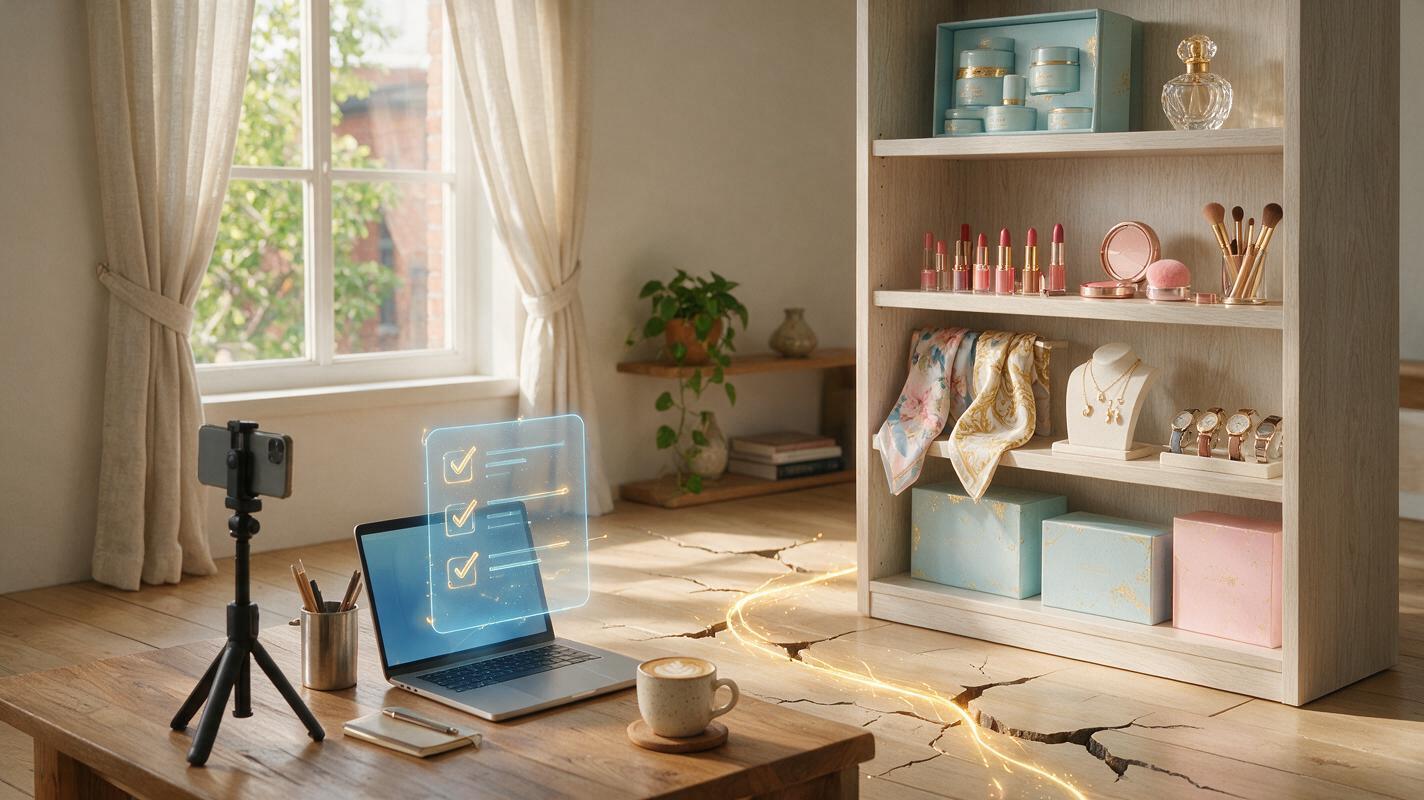
Cross-border enterprises with stable supply chains: This group faces the trickiest situation. They often have a warehouse or office domestically, but no brick-and-mortar retail store, while TikTok Shop store verification requires a consumer-visible business location. The most reliable approach I’ve seen in the industry is to set up a small experience room with basic product displays and shelving at your registered address. Even a 20-square-meter space works — as long as it shows genuine signs of business operations. The pass rate is far higher than for an empty room. It’s not about square footage; it’s about logical consistency.
Individual studios and lean startups: These users face the highest trial-and-error cost. Many take a chance with cheap agents who promise a full set of documents for a few hundred dollars, only to end up with a permanent ban. For individual studios to pass TikTok Shop store verification in 2026, the bottom line is: your business license’s scope, your actual store activities, and the content you post on TikTok must form a coherent chain. Missing one link means either getting stuck in review or facing a retroactive ban later.
How to tell a legitimate service provider from a risky one
At this point, we can’t avoid the sensitive topic: should you hire an external service provider? My stance has always been clear. If your team can’t complete real store verification independently, choosing a platform with clear compliance boundaries is far better than blindly opting for the cheapest agent. What’s a compliance boundary? Simply put, a legitimate provider doesn’t fabricate a set of fake documents. Instead, they audit your existing operational resources and reshape them to meet TikTok’s requirements. In the industry right now, platforms like Getfollow have built a decent reputation by following this compliance-focused approach. Essentially, they do document auditing and store makeover consulting — the materials still originate from your real business foundation.
The truly dangerous services are those that promise “all-inclusive, store approved in a week, money back if rejected.” In 2026, TikTok’s crackdown on such batch operations is unprecedented. If their operation IP gets blacklisted for associations, every store they’ve handled risks being swept up together. So whether you handle it yourself or bring in outside help, the core rule is this: never let your documents detach from your genuine business backbone.
Common mistakes when handling TikTok Shop store verification on your own
First, mismatched timing. I’ve seen people rush to submit before their business license is even ready; then the reviewer checks the government database, finds inconsistent information, and rejects outright. Second, picking a wrong category — for example, running a pet supplies business while the storefront sign says “general merchandise.” The AI sees the disconnect immediately. Third, and most fatal, is repeatedly using the same set of documents to test your luck. Each failed attempt lowers that document set’s safety score; after three tries, it likely lands in a grey list, making future approvals nearly impossible.
Post-verification survival and risk management in 2026
Getting past TikTok Shop store verification is just the start. According to industry consensus, the 30-day retention rate for new verified store accounts in 2026 generally hovers between 50% and 70%. The difference comes down to whether you avoid operational landmines afterward. The most overlooked rule for new accounts: maintain a steady livestream frequency and build authentic transaction records during the first two weeks. This is crucial for account labeling. If you upload a huge catalog right after approval or frequently modify your address, the algorithm may tag you as unstable and throttle your reach.
There’s another less obvious but critical risk factor: the login IP and GPS location associated with your store. TikTok’s risk control system now records the distance between your registered store address and the geolocation from which you livestream or log in. If the deviation is large and consistent, it can trigger a secondary manual review. Keep your core operational devices’ location within a reasonable range of your store info. Don’t livestream from province A today and province B tomorrow — when the compliance team sees a movement pattern like that, their first thought is account sharing or fraudulent documentation.
What TikTok Shop store verification really filters for in 2026
So, what is TikTok Shop store verification actually screening for this year? I believe it’s not about whether you have a fancy storefront, but whether you truly have the ability to fulfill orders. The platform is separating serious business operators from speculators who just want to exploit a traffic boom. Once you understand that, you stop looking for shortcuts and start building a verifiable, closed-loop business operation that can withstand scrutiny.
My final advice for teams looking to enter: test small before you scale. Pick your most compliant entity to run through the entire process first. Observe its data performance and risk control feedback for one to two months, confirm it’s stable, then replicate it. In the cross-border arena of 2026, speed isn’t the scarce resource — it’s people who take every step on solid ground that are hard to find.
Frequently Asked Questions
What are the most common reasons TikTok Shop store verification gets rejected?
The top reasons include mismatched business license information, store photos that don't show actual business activity (e.g., empty rooms), discrepancies between the storefront name and license, and poor image quality that causes AI to misread details. In 2026, cross-document consistency checks are much stricter, so even small errors can trigger rejection.
Can I pass TikTok Shop verification without a physical retail store?
It's difficult but not impossible. If you have a warehouse or office, you can convert a small area into a basic experience room with product displays. The key is to show genuine signs of operations — not an empty space. Some compliance-focused platforms can help you restructure your existing resources to meet the visual requirements.
Is it safe to use third-party services for TikTok Shop verification?
Only if you choose providers who work within compliance boundaries — those that audit your real documents and guide improvements, not fabricate materials. Avoid services that promise guaranteed instant approval or use bulk documents, as they can lead to permanent bans and association risks in 2026.