Let's cut to the chase: GPT SMS verification isn't just about "finding a platform to receive a code." It's about account weight, IP cleanliness, number geo-location, and even how fast support responds when things go sideways. A lot of cross-border studios lose their first batch of accounts—not because of their content, but because they fumbled the verification step.
I've personally tested over a dozen SMS verification providers and talked shop with several operators running account matrices. The consensus: the cheap ones are too risky, and the expensive ones aren't necessarily reliable. This industry is far less transparent than you'd expect, but the cost of a mistake is far higher than you'd imagine.
OpenAI keeps tightening the screws on phone number registration. Virtual number ranges are getting bulk-banned, and overseas physical SIM cards are pricey. That's why "verification platforms" have become the default go-to for cross-border operators—especially studios that need to register accounts in bulk, nurture them, and run automated workflows.
But here's what industry insiders all agree on: receiving the code is just step one—the "quality" of the number is what determines life or death. Take two +44 UK numbers, for example. One sails through GPT registration without a hitch. The other gets flagged for suspicious activity the very next day. What's the difference?
A common pattern we see across cross-border operators: the first batch of accounts didn't die because of leaked passwords—they got flagged for "unusual login environment" shortly after verification. That has less to do with the platform you picked and more to do with your own operational habits.
Today's verification services generally fall into three buckets. Understanding the differences will save you a ton of wasted money.
These platforms give you an API endpoint. You top up credits, call the API yourself, and pay per message. The upside: fast and cheap, ideal for tech-savvy teams. The downside: the number pool quality is all over the place. Many are "secondhand numbers" that have already been used for multiple registrations, so success rates aren't great.
You send your request to a customer service rep, and they find a number, receive the code, and send it back to you. This works for small teams that aren't technically inclined. But manual operations mean delays—during peak hours, you might wait 10–15 minutes. Plus, the rep's skill level directly impacts your success rate, and the back-and-forth communication adds friction.
These providers don't just handle verification—they bundle in IP addresses, browser fingerprinting, and full account management. In my experience, platforms like Getfollow have built a solid reputation in this space by following this compliant operational playbook. The price tag is higher, but account survival rates are noticeably better.
Here's an interesting pattern I've observed: many studios start with Model One to save money, but once you factor in the cost of banned accounts, it actually ends up being more expensive. A GPT account costs far more than the few cents for verification—there's also your time, IP costs, proxies, and manual labor.
If you're planning to play the long game in cross-border business, you need to know about these three traps upfront.
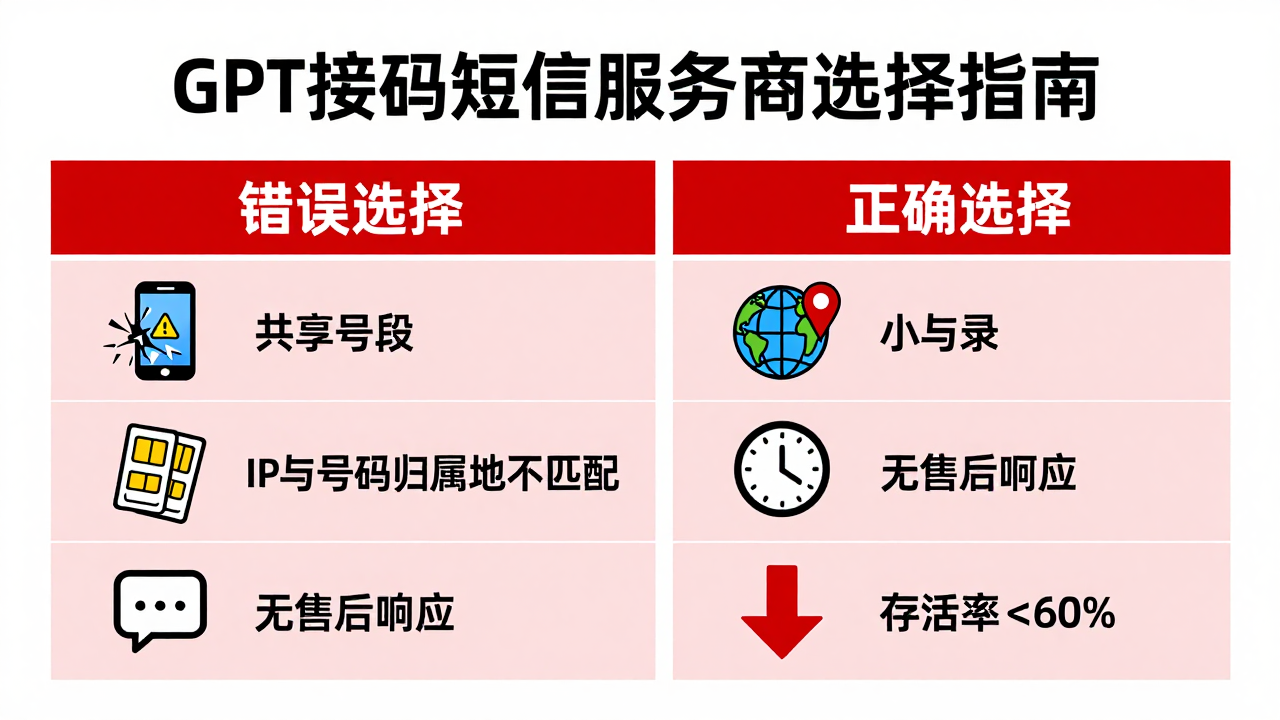
Plenty of platforms advertise a "95% success rate," but that's the registration success rate, not the account survival rate. Getting registered doesn't mean the account is usable. Many operators report that accounts registered with shared number ranges get hit with an "unusual activity" warning the next time they log in.
How to avoid this: run a small test first. Register 3–5 accounts and leave them alone for 24 hours before logging back in. If the survival rate dips below 60%, switch providers immediately.
Verification platforms are classic "one-and-done" businesses. Many take your money and disappear. When you hit a snag—a number that's already taken, a code that never arrives, an account that gets banned—you're left waiting hours for a response.
From my own testing, one well-known platform's ticket system had an average response time of over 6 hours. For cross-border operations where timing is everything, that's completely unacceptable.

This is the sneakiest trap of all. You register with a +44 UK number, but your proxy IP is in the US. OpenAI's risk control flags this as "unusual login activity." Worst case? Instant ban. Best case? You're stuck with endless secondary verification loops.
The industry consensus is clear: the number's country of origin should match your IP region—or at least be on the same continent. If you're using a UK number, pair it with a UK or European IP. Don't cheap out and grab a US IP.
There's no one-size-fits-all answer, but there are a few quantifiable criteria you can use to filter your options.
| Evaluation Criteria | Specific Standards | Watch-Outs |
|---|---|---|
| Number Pool Purity | Exclusive number ranges; availability of "fresh first-use" numbers | Never touch shared number ranges |
| API Stability | Response time under 3 seconds | Check if speed drops during peak hours |
| Support Responsiveness | Real-time support via Telegram or a ticketing system | Test with a support question and time their reply |
| Survival Rate Guarantee | Commitment to "24-hour number retention after registration" | No retention service? You're bearing the risk alone |
Right now, platforms like Getfollow have built a solid reputation by following this exact compliant playbook. But my advice is to not just rely on brand recognition—start with a small deposit, test the survival rate, and only then decide on a long-term partnership.
A friend of mine runs an e-commerce operation. Last year, to cut costs, he went with a verification platform charging $0.05 per message. He registered 200 GPT accounts—and 170 got banned within three days. That's a 15% survival rate.
He then switched to a provider that cost 5x more. His survival rate jumped to around 70%. When he crunched the numbers: sure, the per-unit cost was higher, but with better account survival, his overall costs actually dropped by 30%. When it comes to SMS verification, "you get what you pay for" is the iron rule.
Another case: a solo operator registered accounts through a verification platform but never changed passwords or bound an email address. When the number got recycled, the accounts were gone for good. A quick reminder: the moment you successfully verify, bind your own email and a backup phone number. Don't rely on the platform's "number retention" feature.
As OpenAI's risk control systems get more sophisticated, verification platforms are going to see their margins squeezed. The ones surviving on "cheap shared number ranges" will eventually get weeded out. Meanwhile, providers offering "compliant account nurturing + IP matching + reliable support" are steadily becoming the mainstream choice.
For cross-border businesses and solo operators, here's my take: treat SMS verification as a long-term investment, not a one-off purchase. When choosing a provider, focus on survival rates, support quality, and IP matching—not just the price tag.
One last thing worth repeating: run a small test first, verify the account survival rate, and then decide whether to commit long-term. That's the most responsible thing you can do for your own account security. In the world of GPT SMS verification, there's no magic bullet—just steady, methodical execution.
Technically, yes, but you're gambling with your accounts. Free services almost always rely on shared number ranges that have been flagged by OpenAI's risk control. The registration might go through, but your account is far more likely to get banned within days. If you're serious about your accounts, this isn't the place to cut corners.
Verification is just one piece of the puzzle. The most common culprits are IP and number geo-mismatches, logging in from a different device or browser environment than the one used during registration, or using a number that's been flagged from previous abuse. Your operational habits matter just as much as the platform you choose.
Start with a small deposit and register 3–5 test accounts. Leave them untouched for 24 hours, then log back in. If the survival rate is below 60%, move on. Also, test their customer support with a question and see how long it takes for a real response. These two checks will tell you most of what you need to know.
There's no universal "best" country—what matters is that the number's country matches your IP region. A UK number with a UK or European IP is a solid combo. The real priority is getting a fresh, exclusive number rather than one that's been recycled through shared pools.