Receive SMS Verification Codes in 2026: The Complete Guide
Receive SMS Verification Codes in 2026: The Complete Guide
Let's start with the verdict: in 2026, if you run a cross-border business, stop defaulting to the cheapest shared SMS pools. To receive SMS verification codes reliably, the baseline setup is a dedicated number you can renew, on a service that supports repeat messages. That's what keeps accounts alive past the six-month mark. Below, I'll break down the costs, retention logic, and risks behind the three main service models—so your budget goes toward growth, not toward rebuilding accounts every few weeks.
The Three Main Ways to Receive SMS Verification Codes
Plenty of newcomers assume this is as simple as downloading an app and topping up a few dollars. The market has moved on. By 2026, the industry has split into clear tiers, and I group providers into three models based on how they deliver numbers. Each one carries a completely different cost structure and risk exposure.
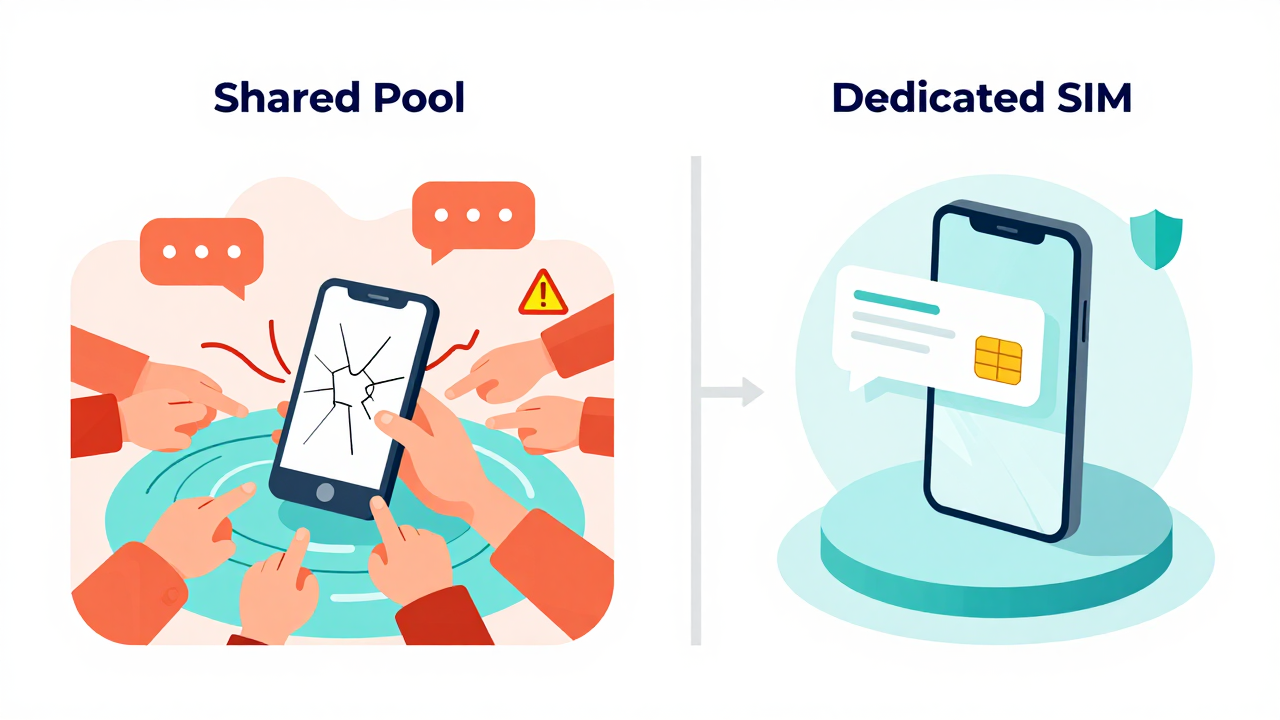
- Shared SMS pools: Pick a country and platform inside the app, pay anywhere from a few cents to under half a dollar per code, and the number is discarded after one use. A textbook shared resource.
- Dedicated physical SIM cards: A vendor rents you a real SIM card on a monthly basis—one person, one number—built for long-term, repeated receiving.
- API virtual number platforms: Developer-focused number pools with webhook callbacks, made for bulk registration and automated workflows.
Here's a detail most outsiders miss: numbers inside shared pools rotate. That +1 number registering your social account today can be handed to a different user tomorrow—to register on the very same platform. This rotation is the root of the "number contamination" problem we'll unpack next.
Why Shared SMS Pools Keep Failing in 2026: A Cautionary Tale
Early in 2026, I helped a solo e-commerce studio run a post-mortem on a wave of store bans. Every small team should hear how it went down.
They had squeezed costs by batch-registering an entire store matrix through one shared pool's +1 numbers. Two quiet months followed. Then, in month three, the platform purged "accounts linked by number"—and overnight, 47 stores were down to 6. The post-mortem told the story: those numbers had been reused an average of 200+ times inside the pool and had long been flagged as high-risk by the platform's fraud systems.
The sneakier trap is number recycling. When a number lapses on its keep-alive fee, many vendors run it through a 30–90 day cooling period, then release it back onto the market. The next buyer can then use an SMS verification code to reset the password on whatever account you tied to that number. The rent you saved? It can cost you the whole account, with interest.
SMS Verification Code Providers Compared: The 2026 Edition
Industry consensus for 2026: the divide is widening. Usable inventory in low-cost pools keeps shrinking, while compliance-oriented API platforms keep gaining ground. The table below pulls together feedback from multiple operators in this space.
| Dimension | Shared SMS Pools | Dedicated Physical SIMs | API Virtual Number Platforms |
|---|---|---|---|
| Cost per code | A few cents to ~$0.40 per message | Roughly $4–$11 per number, monthly | Priced per number or per code; mid-to-high |
| Number exclusivity | None—shared and rotated in the pool | Yes—one person, one number | Plan-dependent; dedicated numbers can be locked |
| Repeat receiving | Mostly unsupported | Supported | Partial support—confirm before ordering |
| Typical risks | Number contamination, linked-account bans | Vendors vanishing, number recycling | Platform policy shifts |
| Typical players | Various SMS-receiving apps | Offline SIM vendors, studio channels | API platforms such as Getfollow |
| Best fit | One-off feature testing | Long-term, high-value accounts | Bulk registration and automation |
So how do you read this table? From my experience: match the model to your use case first, then compare providers within that model. Running bulk registrations for an account matrix? Focus on an API platform's pool size and webhook stability. Nurturing high-value accounts? Focus on renewal terms and the SIM vendor's reputation. Choose the wrong model, and even the best provider can't rescue you.
Four Questions to Ask Any Provider Before You Pay
Whichever model you pick, getting straight answers to these four questions before checkout will spare you most of the common disputes in the 2026 market.
- Rental terms and keep-alive fees: Is the number renewed monthly or bought outright? How soon does it enter the recycling process after a missed payment?
- Repeat receiving rules: When the platform sends a code on day 7 or day 30 after signup, will it still arrive?
- Number type: Physical SIM, virtual number, or landline forward? Some platforms run stricter fraud rules on virtual ranges.
- After-sales policy: Are you billed for codes that never arrive? Is there a replacement or refund path when a number dies?
My own testing routine, for reference: buy one or two numbers and run the full loop—register, leave the account idle for 7 days, log back in, then trigger one more verification at the 30-day mark. Only if codes arrive at every step do I consider a bulk order. It's slow, but it filters out most junk numbers that work at signup and die during the nurturing phase.
Reality Check: SMS Verification Codes Are Never Risk-Free
Time for some straight talk: there's inherent uncertainty in receiving SMS verification codes. Industry-wide retention in 2026 generally sits between 50% and 70%. Translation: even with the right provider, a slice of your numbers will die within six months—carrier recycling, platform risk controls, the usual suspects.
Watch the compliance lines, too. Some platforms explicitly ban virtual-number signups in their terms of service, and risk screening is tightest in finance and payments. For accounts tied to fund withdrawals, a dead number with no backup verification path can leave your money frozen indefinitely. Those accounts deserve a dedicated physical SIM you can renew long-term.
Frequently Asked Questions
Will an account registered with a virtual number always get banned?
Not always—but the risk runs genuinely higher than with a local physical number. Ban odds hinge on how "clean" the number is (its registration history) and whether the account behaves like a normal user afterward. In user feedback, dedicated numbers paired with natural activity consistently show far better survival rates.
How do I pick a trustworthy SMS verification code provider?
Look at three things. One, the number source: favor dedicated, renewable pools and avoid shared pools that won't disclose reuse rates. Two, track record and support responsiveness—"do you refund codes that never arrive?" is the fastest litmus test there is. Three, complete API documentation plus real human support. Platforms like Getfollow, which run on dedicated inventory with transparent billing, make a solid benchmark when you compare prices—but still run a small test before committing.
Can I keep a virtual number long-term? What happens if it stops receiving codes?
Dedicated numbers and locked API numbers, yes—provided you keep the renewal fees current. Shared-pool numbers, essentially never. Once a number dies, you still have a recovery path if the account carries a linked email or authenticator app; otherwise, the loss is yours to absorb. That's exactly why high-value accounts should always have an extra email layer attached.
Do accounts registered with virtual numbers work differently in practice?
Day to day, barely. The gaps show up in risk-sensitive moments: password changes, logins from new locations, fund withdrawals—some platforms scrutinize virtual ranges harder in those situations. If real money flows through the account, a physical SIM or a long-term renewable dedicated number is the safer call.
The Bottom Line: Test Small First, Then Commit Long-Term
The 2026 market for receiving SMS verification codes left the "cheapest option wins" era far behind. Number quality, retention, and after-sales support now decide how long your account matrix survives. My advice hasn't changed: no matter how polished a provider's case studies look, buy a few numbers, run the full 30-day test, and let the data decide whether a long-term partnership makes sense. That's the approach that protects both your wallet and your accounts.