SMS Verification PHP Scripts: 2026 Deployment Guide and Compliance Risk Assessment for Cross-Border Operations
SMS Verification PHP Scripts: 2026 Deployment Guide and Compliance Risk Assessment for Cross-Border Operations
SMS verification PHP scripts remain a widely used technical solution for cross-border account registration and bulk verification scenarios in 2026. These tools handle verification code reception and forwarding, but before deployment, you need to carefully evaluate number resource compliance and API stability. Here's what matters across three key areas: selection standards, deployment costs, and alternative approaches.
Core Features and Use Cases for SMS Verification PHP Scripts
A typical SMS verification PHP script consists of three main components: a number pool management module, an SMS gateway integration layer, and an API interface. The number pool supports both virtual operator number segments and physical SIM cards. The gateway layer normalizes protocol differences across various SMS providers, while the API interface lets upstream business systems call the service programmatically.
In 2026, cross-border businesses still rely on SMS verification PHP scripts for tasks like overseas e-commerce platform registration, social media account verification, and IM tool binding. That said, this approach only suits non-critical workflows—your core account infrastructure should never depend on temporary numbers.
From my experience, solo operators and small studios primarily turn to SMS verification PHP scripts to cut multi-account operating costs. Take cross-border e-commerce as an example: receiving a single registration verification code through official channels costs roughly $0.07–$0.28 per message, while a self-hosted system can bring that down to $0.01–$0.04 per message. But this cost advantage only holds when your number pool stays consistently supplied—once that supply chain breaks, the savings evaporate fast.
Here's a cautionary tale: a Shenzhen cross-border team purchased an open-source SMS verification PHP script in early 2026. It ran smoothly at first, but after a platform upgraded its risk controls in March, over 60% of their number pool got flagged as high-risk, and batch-registered accounts were frozen within 48 hours. The team had to fall back on official API channels, and the money they'd saved upfront was far less than what they spent on appeals and rebuilding accounts.
How to Evaluate and Select the Right SMS Verification PHP Script
When choosing an SMS verification PHP script, assess it across three dimensions: code quality, number resources, and API compatibility. For code quality, check whether it supports concurrent multi-threaded reception, includes automatic retry mechanisms, and maintains complete logging. For number resources, verify the update frequency and number segment distribution. API compatibility determines how easily you can integrate with third-party systems later.
Industry consensus in 2026 is clear: a solid SMS verification PHP script should support at least three major SMS gateway protocols and expose a standard REST API. It should also include automatic number pool cleaning that periodically removes numbers already flagged by platform risk controls. These two capabilities directly determine long-term usability.
The table below compares three common deployment approaches to help you decide:
| Comparison Dimension | Open-Source Free Script | Commercial Licensed Script | Managed API Service |
|---|---|---|---|
| Initial Cost | $0 (self-hosted) | $40–$280/year | Pay-per-use, $0.03–$0.14/message |
| Number Quality | Depends on your own channels; average stability | Provided by vendor; moderate quality | Centrally maintained; higher quality |
| Maintenance Effort | High (you handle gateway failures) | Medium (limited vendor support) | Low (fully managed) |
| Compliance Risk | High (uncontrolled number sources) | Medium (depends on vendor credentials) | Medium (assess platform rules yourself) |
| Best For | Technical individual developers | Small teams with customization needs | Cross-border businesses prioritizing stability |
Here's the thing: in 2026, the value proposition of self-hosted SMS verification PHP scripts is shrinking under two pressures—increasingly sophisticated risk control models on overseas platforms, and stricter regulatory scrutiny of number sourcing. If your operation is small and your team can handle maintenance, an open-source solution can still work as a transitional option. But if your core accounts depend on this system, seriously consider a managed API service instead.
Three Major Deployment Risks and How to Mitigate Them
Risk one: number resource compliance. Multiple countries tightened real-name registration requirements for virtual numbers in 2026. If your script connects to a number pool containing unverified or questionable numbers, you could face legal exposure. Mitigation: demand compliance documentation from your number supplier before deployment and audit number sources regularly.
Risk two: platform-linked bans. Accounts registered through the same SMS reception system can get flagged and banned in batches due to shared number segments or device fingerprints. Mitigation: build in random delays, randomized User-Agent strings, and other human-behavior simulation modules at the script level.
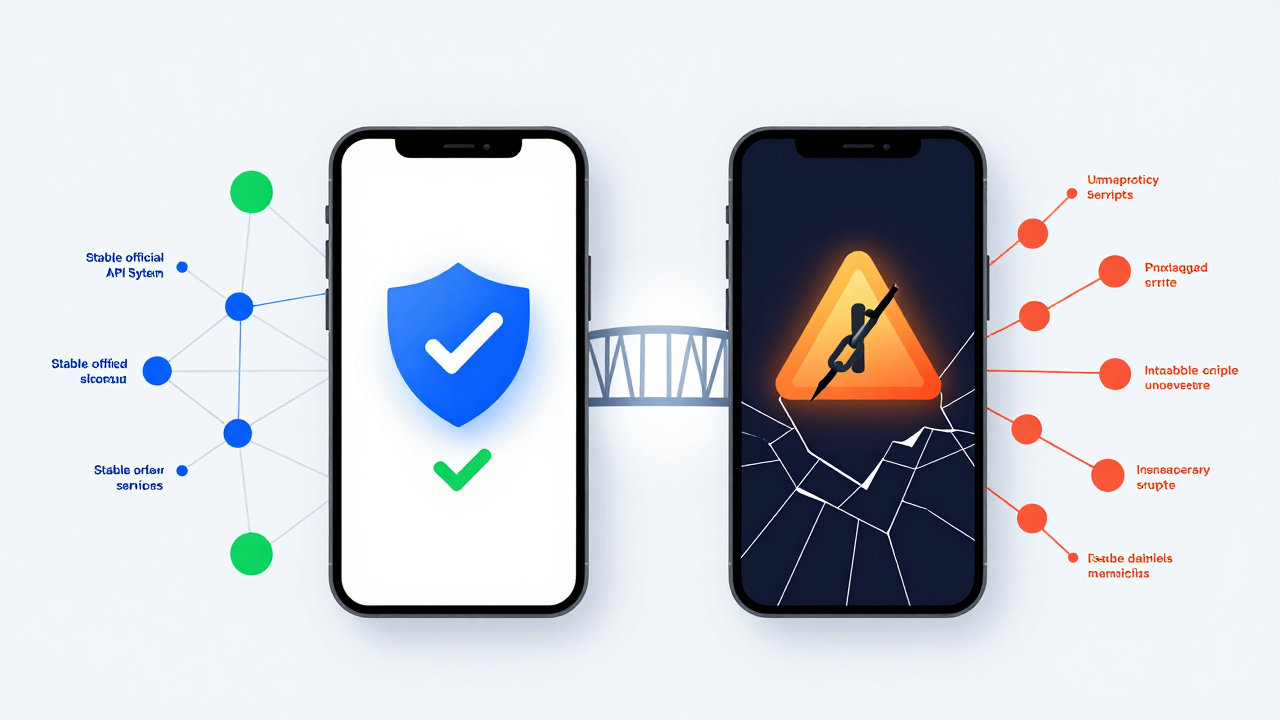
Risk three: API instability and data security. Some open-source scripts carry unpatched vulnerabilities that could leak verification code data. Mitigation: change default credentials immediately after deployment and enforce HTTPS encryption for all data in transit.
What we've seen in practice through 2026 is that deployment risks for SMS verification PHP scripts concentrate in two areas: number resource quality and platform risk-control evasion. For teams without dedicated technical operations staff, using a mature managed API service often beats building your own system—both for risk control and total cost of ownership.
Alternatives to SMS Verification PHP Scripts and Long-Term Trends
In 2026, the main alternatives to self-hosted SMS verification PHP scripts fall into three categories: direct official API integration, virtual phone number services (like Google Voice), and managed SMS reception platforms. Official API integration suits scenarios where account security is paramount—it's the most expensive but also the most stable. Virtual phone numbers work for low-frequency verification needs but have limited country coverage. Managed reception platforms strike the best balance between cost and reliability for most businesses.
Looking ahead, overseas platforms will only get better at identifying temporary numbers. The window where SMS verification PHP scripts make sense is narrowing. Cross-border businesses should build a layered verification strategy: official channels for core accounts, SMS reception systems for non-critical scenarios, and at least one backup verification path ready to go at all times.
FAQ: SMS Verification PHP Scripts—Common Questions
Are SMS verification PHP scripts legal?
The scripts themselves are legal tools—what matters is how you use them. Receiving verification codes for your own legitimate business operations is a normal technical application. But using them to mass-register fake accounts or bypass platform rules can violate terms of service and potentially run afoul of regulations. In 2026, regulators in several countries stepped up scrutiny of bulk registration practices.
Which countries' verification codes can these scripts receive?
That depends entirely on your number pool's coverage. Mainstream scripts can integrate with number resources across 50–100 countries, but numbers from the US and Europe are generally more reliable than those from Southeast Asia or Africa. Before committing, confirm the country distribution and update frequency of your number pool.
How much do SMS verification PHP scripts cost?
Open-source options are free, but you'll cover server and number procurement costs yourself. Commercial licenses run from $40 to $280 per year, while managed API services charge per message. Calculate total cost against your actual volume—self-hosting gets cheaper at scale but demands more maintenance effort.
How do I pick a reliable SMS reception provider?
In 2026, focus on three metrics: number pool size and refresh rate, API response time, and support quality. Run a small-scale test first and confirm a usable number rate above 85% before scaling up. Some managed services offer multi-country number pools with solid API documentation, which works well for teams that need fast integration—but always compare multiple providers against your specific requirements.
Can SMS verification PHP scripts be customized?
Most open-source scripts support secondary development. Common extensions include integrating custom SMS gateways, adding automatic number pool cleaning logic, and building admin dashboard interfaces. Just know that customization requires PHP and API integration experience, so assess your team's technical capacity before you commit.
Bottom line: deploying an SMS verification PHP script in 2026 means balancing cost, stability, and compliance risk. For technically capable teams, open-source solutions still offer a cost edge. For cross-border businesses that need reliability, a managed API service is the safer starting point. Whichever route you take, build in number pool quality monitoring and risk alert mechanisms from day one—your business continuity depends on it.