Reliable TikTok Account Sellers: A Checklist to Self-Audit
Reliable TikTok Account Sellers: A Checklist to Self-Audit
Recently, I reviewed a case with a client operating in the Southeast Asian market. Last year, they spent nearly $50,000 on over 30 "mature" TikTok accounts from two different vendors for matrix-based commerce. The result? Within three months, less than a third were still generating steady orders. Most were either throttled or banned outright for "association" or "inauthentic activity." They told me the biggest feeling wasn't the financial loss, but a sense of being kept in the dark, never knowing exactly where the problem lay.
This scenario is all too common in the cross-border e-commerce circle. The accounts themselves might be fine, but your method of purchase and your choice of seller determine whether these accounts become assets or liabilities. So, stop just asking "How much per account?" and instead, use the checklist below to scrutinize potential sellers like you would in an interview. This is far more crucial than rushing to place an order.
Part 1: The Three Fundamental Questions Beyond "The Account Itself"
Many buyers fixate on follower counts, video numbers, or even past content—these are important, but a seller's "internal capabilities" are the root of whether an account will survive long-term.
First, clarify the account's "birth certificate." A reliable seller can clearly explain each account's registration method, phone number (or email) status, and the initial device/IP information used for login. If the seller is vague or gives a non-answer like "through our own channels," the risk is high. This directly impacts the account's susceptibility to platform risk controls—many bans trace back to untraceable registration data, marking accounts as mass-produced spam.
Second, probe the boundaries of their "after-sales service." This is where the biggest tricks are hidden. Many sellers promise "after-sales included," but you need to drill down to pixel-level details: For how long? 7 days or 30? What exactly is "included"? Does it cover replacement for bans? What about throttling? Is the replacement an identical account or just a "white-label" filler? How is liability determined? Will they cover a ban caused by your own policy-violating content? The industry consensus is that a professional service provider will offer a clear service agreement outlining responsibilities and liabilities, not just verbal promises. You should insist on getting everything in writing.
Finally, test their "emergency response." You can simulate a scenario, such as asking, "If an account prompts for verification the day after purchase, how do you typically handle it?" Observe whether their response is professional and follows a standardized process. Sellers who tell you to "try verifying it yourself" or react sluggishly are not ones you can rely on when a real crisis hits.
Part 2: The Vetting Checklist — Five Positive Signals and Three Red Flags
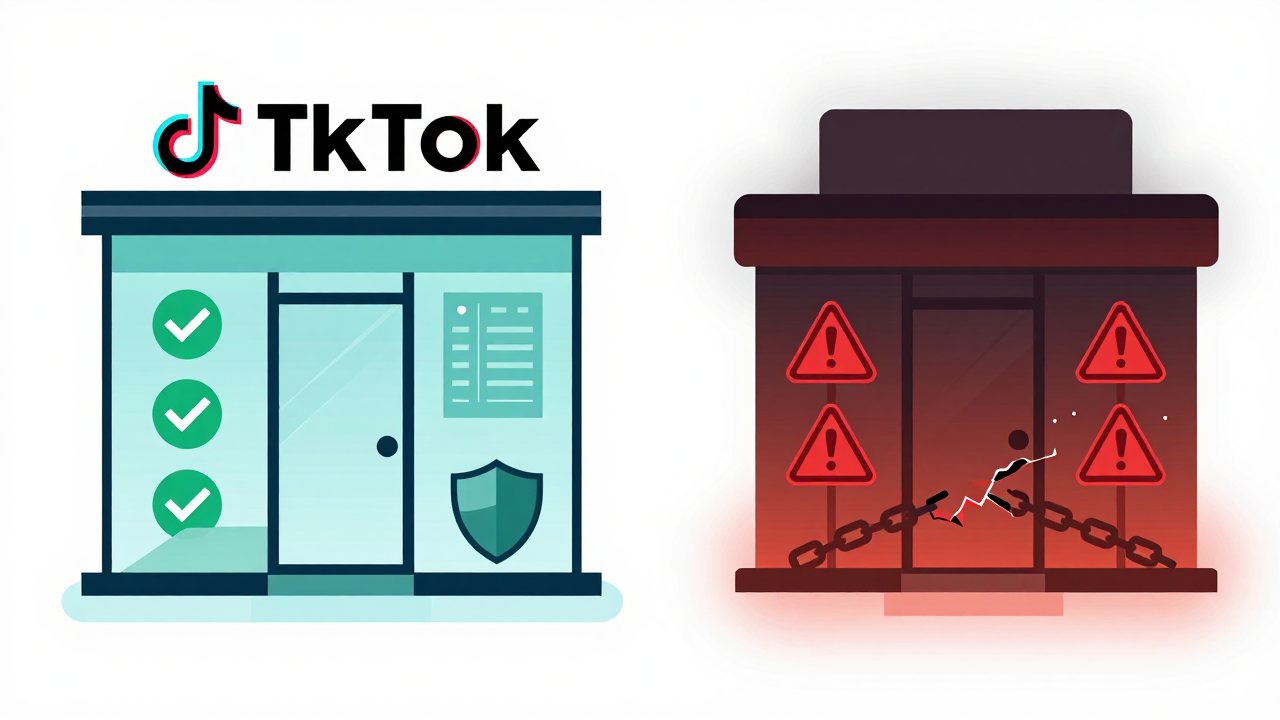
Based on observations across multiple channels and discussions with sellers in the industry, I've compiled a practical checklist for self-assessment.
Five Positive Signals (Recommended to Bookmark)
- Evidence of "White-Hat" Account Farming: A trustworthy seller can demonstrate their process for TikTok matrix farming, such as logs showing simulated real user behavior using specific tools, or graphs of data fluctuations during the farming period. They understand that account weight requires time to cultivate, not shortcuts.
- High Data Transparency: They are willing to provide not just follower counts but also screenshots of recent (e.g., within 7 days) average video views, like/comment engagement rates. If they hide even these basic metrics, the account quality is likely questionable.
- Support for Small-Batch Testing: Yes, it's exactly what you think—"test with a small batch before a long-term partnership." A confident seller isn't afraid of your test. They typically offer test packages with a low minimum order (e.g., 5-10 accounts), allowing you to verify the real quality of the accounts and their service process. This is the most effective step in mitigating risk.
- Compliant Payment and Delivery Methods: They use corporate accounts or reputable third-party payment platforms and provide a formal purchase agreement or service contract. Steer clear of sellers who only accept cryptocurrency or private transfers and refuse to provide any official documentation.
- Proactive Risk Disclosure and Solutions: They will honestly tell you that purchasing accounts inherently carries platform policy risks and may advise you on how to safely "take over" the account (e.g., changing profile information gradually, simulating normal user behavior during the transition period), rather than guaranteeing "absolute safety."
Three Dangerous Red Flags (Be Immediately Wary if Encountered)
- Unrealistically Low and Vague Pricing: Accounts priced far below the market average are most likely "black-hat" or problematic accounts. If a seller cannot clearly explain the price composition (e.g., why a 100k-follower account is cheaper than a 50k-follower one), it's probably a trap.
- Refusal to Disclose Any Technical Details: They are evasive or use "trade secrets" to fudge answers to your questions about the registration environment, farming methods, or IP management. These sellers are often just "account brokers" with no real control over the accounts themselves.
- Overpromises like "Guaranteed Viral Orders" or "Guaranteed No Bans": Any seller who guarantees transactional results without considering account operation content or advertising strategy is either naive or malicious. Accounts are just tools; their effectiveness depends on how they are used.
Industry Observation: When Tools Meet Professional Services
In today's market, sellers who merely "sell accounts" are becoming fewer. More service providers are shifting towards offering bundled solutions of "accounts + operational tools/services." This is an interesting trend. For instance, analyzing some service models reveals they function like Getfollow's account mall, which not only provides various overseas social media accounts but, more importantly, decouples and standardizes account transactions with underlying farming tools and even subsequent traffic growth services. Buyers can choose to purchase "raw" accounts for self-managed cultivation or "semi-finished" accounts bundled with operational services. The advantage of this model is that it makes the transaction process more transparent and controllable, reducing disputes arising from bundled services.
Regardless of the seller model, the core remains unchanged: you are not buying a digital asset but a "digital organism" that requires ongoing maintenance. Its farming environment (such as devices, IPs) and subsequent content operations are the next steps that determine its commercial value. Many cross-border practitioners provide feedback that buying accounts is only the first step. The real challenge is how to make these overseas accounts safely "survive" and generate value. Therefore, prioritizing sellers who offer clear guidance on using farming tools or an ecosystem of services is like adding an extra layer of insurance to your investment.
Finally, and Most Importantly: The Buyer's Responsibility
Even the most reliable seller cannot 100% mitigate the risk of changes in platform policies. Ultimately, the right to use the account and the associated responsibility lie with you. After completing the transaction, you must:
- Immediately Change All Security Information: Password, linked email, phone number, two-factor authentication. This is the first step to truly reclaiming control.
- Conduct a "Warm-Up" Transition: Do not immediately change all profile information or post a large volume of marketing content. Mimic the behavior of a new user taking over an account—slowly add new information, browse videos, and like posts like a regular user.
- Build a Localized Operations Team or Use Reliable Tools: In the long run, relying on purchased accounts is a short-sighted fix. Building your own content capabilities or leveraging professional TK matrix farming tools and operational strategies to incubate high-weight, original accounts from scratch is the real competitive moat.
Ultimately, the purpose of this checklist is not to help you find a "perfect seller" but to help you find a "reliable partner" and to clearly understand your own role and responsibilities in this transaction. Before you act, add a bit more skepticism and a bit less impulsiveness, and your cross-border journey might just avoid a major pitfall.
FAQ: Common Questions About Buying TikTok Accounts
Q1: What is the single most important factor when buying TikTok accounts?
A: The seller's transparency regarding the account's history and their clear after-sales agreement. You need to know exactly how the account was created, how it was farmed, and what specific guarantees are written in the contract you sign.
Q2: Can I buy accounts with high followers and expect immediate sales?
A: This is a common pitfall. High-follower accounts from unvetted sellers are often low-quality or compromised. Successful conversion depends on the account's niche relevance, audience engagement, and your own content/ads strategy—not just the follower number. Always test a small batch first.
Q3: How do I safely take over a purchased TikTok account?
A: Follow a careful "warm-up" process. Gradually change passwords and linked info over several days, mimic normal user behavior (browsing, liking) for a week, and slowly introduce your own content. Avoid sudden, drastic changes that trigger platform alarms.
Q4: Are accounts sold with "guarantees" actually reliable?
A: Be extremely cautious. No one can guarantee results on a platform with evolving policies. Legitimate sellers will guarantee the account's initial quality and provide a replacement period for bans that occur through no fault of your own, but they won't promise specific business outcomes like sales.