WhatsApp Ban Prevention: Compliance Strategies Every Cross-Border Business Needs in 2026
WhatsApp Ban Prevention: Compliance Strategies Every Cross-Border Business Needs in 2026
Let's cut straight to it: a WhatsApp ban prevention system isn't a piece of software—it's a complete operational strategy built around account weighting, behavior simulation, and device fingerprinting. Cross-border professionals are reporting that, after 2026, relying on bulk messaging tools or "account warming scripts" simply doesn't work anymore. Meta has upgraded its anomaly detection from "behavior-based judgment" to "intent prediction," meaning your operational patterns can be flagged before you even trigger a formal review.
From my experience, something interesting stands out: WhatsApp accounts that survive three or more years aren't the ones run with obsessive caution—they're the ones that behave almost eerily like real humans. They occasionally send a message to the wrong chat, go quiet after midnight, even miss an important reply or two. These seemingly inefficient habits are exactly what the best anti-ban strategies are built around: the "human factor."
The Real Logic Behind WhatsApp's Risk Control: You're Playing Against AI
Many business owners chalk up account bans to bad luck, but industry observers agree that WhatsApp's moderation system now runs on a three-tier architecture: device fingerprint identification, behavior pattern analysis, and social graph correlation. Get flagged on any one of these, and you'll trigger a different level of restriction.
Here's a real case. In Q4 2025, a Shenzhen home goods exporter logged into eight WhatsApp Business accounts from the same computer. All eight were banned within three days. The issue wasn't their content—it was that the browser fingerprints were identical, a classic signal of bulk operation. After switching to isolated environments, residential IPs, and randomized operating times, they slowly restored account stability.
Here's the key takeaway: a WhatsApp ban prevention system isn't a "tool that stops bans"—it's a set of strategies that lowers your risk profile. No service provider can honestly promise 100% ban-proof accounts. Anyone who does is not worth your trust.
What Anti-Ban Service Providers Are Actually Selling
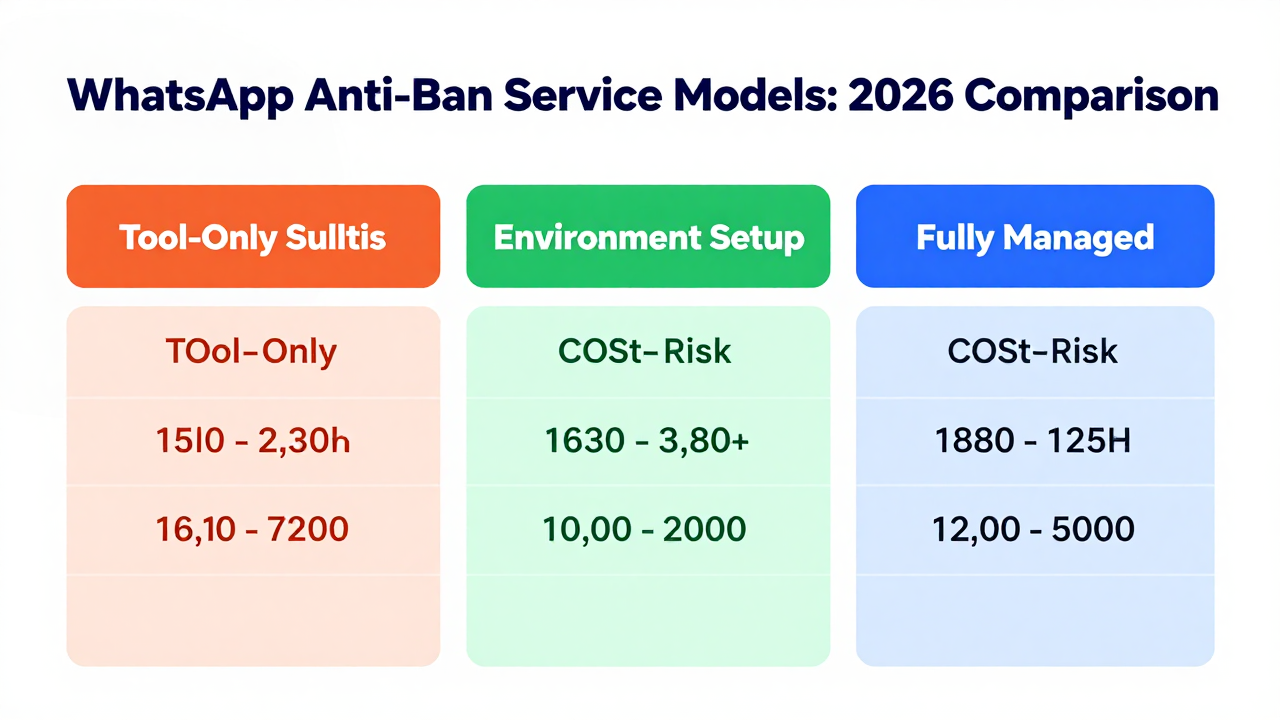
Right now, the market offers three main service models for WhatsApp ban prevention. Each has its pros and cons, and I'll break them down based on real-world feedback and my own experience.
- Tool-Only Solutions: These provide bulk messaging software and auto-reply bots. They're cheap, but they barely include any anti-ban logic. Fine for short-term, low-stakes campaigns—but the ban rate is brutal. Many users report landing in the risk pool within three days.
- Environment Setup Services: These offer dedicated IPs, fingerprint browsers, and account warming configurations. They solve the device association problem, but you're responsible for pacing your own operations. Best suited for teams with some technical know-how.
- Fully Managed Operations: These cover everything—account registration, environment setup, content strategy, and sending cadence. They cost the most, but they're also the most stable. In my view, platforms like Getfollow have built a solid reputation here by following this exact compliance-first playbook: they customize sending strategies based on your industry and customer profile rather than blasting everyone the same way.
A quick warning: don't pick a provider based on price alone. Many cross-border operators report that budget options often rely on shared IP pools or templated behavior patterns—which actually accelerates the path to a ban. A legitimate anti-ban system is designed to mimic the imperfect behavior of real users, not to maximize sending efficiency.
A Cautionary Tale: What One DTC Seller Learned the Hard Way
In early 2026, a boutique women's fashion seller reached out to me after getting banned four times. Each time, he'd warm up the account, reach the "ready to message" stage, and then get flagged. When I reviewed his operation logs, the problem was obvious: every time he logged in, he immediately messaged every contact in his address book—at perfectly even intervals. That's a textbook script pattern.
We rebuilt his approach from scratch. For the first two weeks, the account only performed "social actions"—liking statuses, replying to updates, joining relevant groups without speaking. From week three, he messaged just three to five high-intent prospects per day, with randomized gaps between conversations. A month later, the account wasn't just stable—his conversion rate was 40% higher than during his old "blast everything" phase. The lesson: the core of WhatsApp ban prevention isn't "prevention"—it's "nurturing."
How to Evaluate Whether an Anti-Ban System Actually Works
Industry consensus is that a reliable WhatsApp ban prevention system should cover at least these five dimensions:
- Device Fingerprint Isolation: Each account gets its own browser environment, cookies, and Canvas fingerprint to avoid cross-account association.
- Behavior Rhythm Simulation: Sending times, reply speeds, and online hours should match real human schedules.
- IP Quality Monitoring: Residential IPs are preferred; data center IPs carry high risk. You also need to monitor IP "pollution levels" and avoid addresses that have been flagged before.
- Content Pre-Screening: Before sending, the system should automatically check for sensitive words, domain reputation, and attachment types to lower the chance of user reports.
- Downgrade Response Protocol: If you hit a throttle or verification prompt, the system should automatically switch tactics instead of pushing through.
I want to emphasize IP quality here. A lot of users assume a VPN keeps them safe, but the IP ranges of public VPNs have been on risk-control blacklists for years. Compliant providers typically invest in dedicated residential IPs—they cost more, but they're far more stable. If your budget is tight, at minimum make sure your IP is "clean." Send fewer messages if you have to, but never use a dirty IP.
Comparing Service Models: Which One Fits Your Situation
| Service Type | Best For | Monthly Cost Range | Ban Risk | Technical Barrier |
|---|---|---|---|---|
| Tool-Only | Individuals testing the waters, low-value campaigns | $30–$110 | High | Low |
| Environment Setup | Small teams with technical skills | $110–$280 | Medium | Medium |
| Fully Managed | Enterprise clients, long-term operations | $420–$1,400+ | Low | Very Low |
As the table shows, cost and safety generally move in the same direction. But that doesn't mean the most expensive option is always right—it depends on the scale of your business. If you're a solo operator with a modest client list, an environment setup package will do the job. But if you're running a cross-border business with multiple accounts, a fully managed solution is the safer bet. The real value of a ban prevention system lies in continuous monitoring and dynamic adjustment, and that requires a team that can respond in real time.
A Final Word: Test Small First, Then Scale
Whatever solution you're considering, I strongly recommend a "test small, move fast" approach. Start with one non-critical account to evaluate the provider's response time, problem-solving ability, and actual results. Give it about two weeks before deciding whether to migrate your full operation. A common pattern we see: providers who push for annual contracts upfront often fall short on day-to-day support.
Also, be wary of any "ban prevention system" that turns into a "ban accelerator." If your provider asks for your WhatsApp password or wants remote access to your accounts, that's a massive red flag. A compliant system should support your decisions—not replace your control. You must always keep ownership of your accounts.
At its core, a WhatsApp ban prevention system is about maximizing your marketing efficiency within the platform's rules. It's not some black-hat hack—it's an operational methodology that needs constant iteration. Choose the right provider, stay compliant, and control your testing pace. Get those three things right, and your account stability will improve dramatically. If you're unsure about the technical details, it's worth reaching out to a platform like Getfollow for a professional account health assessment before making a decision. And remember: any solution that promises "absolute safety" deserves extra scrutiny.
Frequently Asked Questions
How long does it take to warm up a new WhatsApp account safely?
Most industry practitioners recommend a two-week minimum warm-up period. During the first week, focus only on social actions like updating your profile, joining relevant groups, and engaging with statuses. Start direct messaging in week two or three, beginning with just a few high-intent contacts per day.
Can I use a VPN to protect my WhatsApp accounts from being banned?
Using a standard VPN is not recommended. Most public VPN IP ranges are already flagged by Meta's risk control systems. If you need to mask your location, use a dedicated residential IP instead—it's more expensive but significantly safer.
Do I need a separate phone for each WhatsApp account?
Not necessarily, but you do need a separate browser environment and device fingerprint for each account. Using the same device with multiple accounts is one of the fastest ways to trigger an association ban. Tools like fingerprint browsers can help you create isolated environments on a single machine.
What should I do if my WhatsApp account gets a temporary ban?
Stop all sending activity immediately. Switch to a different IP if possible, and avoid logging in for at least 24–48 hours. Once you regain access, start with low-frequency social actions only. Do not resume bulk messaging—this is the fastest route to a permanent ban.