Enterprise WhatsApp Management: The Cross-Border Business Skill You Can't Afford to Skip
Enterprise WhatsApp Management: The Cross-Border Business Skill You Can't Afford to Skip
After years in the cross-border space, I've become increasingly convinced of one thing: WhatsApp is no longer just that "hey, are you there?" messaging app. Especially when your contact list balloons from a few dozen to a few thousand, and inquiries, after-sales requests, and repeat orders all pile up on a single phone screen, enterprise WhatsApp management stops being an option and becomes a matter of survival. Let's skip the fluff and get straight into what I've seen on the ground—and the mistakes I've made along the way.
Why Personal WhatsApp Can't Handle Your Business Volume
When you're running a small studio, using personal WhatsApp to add clients and send quotes works fine. But the moment your volume picks up, problems start surfacing fast. The three most common ones:
- Messages slip through the cracks. A client sends "Can we negotiate the price?" at 2 AM. By the time you see it in the morning, the momentum is gone.
- Team collaboration becomes a nightmare. Customer service, sales, and operations each log into the same number on separate phones. Conversations don't sync, and tracking who owns which client turns into a mess.
- Data doesn't accumulate. Where a client came from, what they viewed, what they purchased—it all lives in someone's head. When that person leaves, the thread goes cold.
If you've been in cross-border trade for a while, these pain points probably sound painfully familiar. The bottom line is this: personal WhatsApp is designed for one-on-one conversations, but business demands one-to-many management. That's exactly why enterprise WhatsApp management has become such a hot topic in China's going-global circles over the past couple of years.
What Enterprise WhatsApp Management Actually Covers
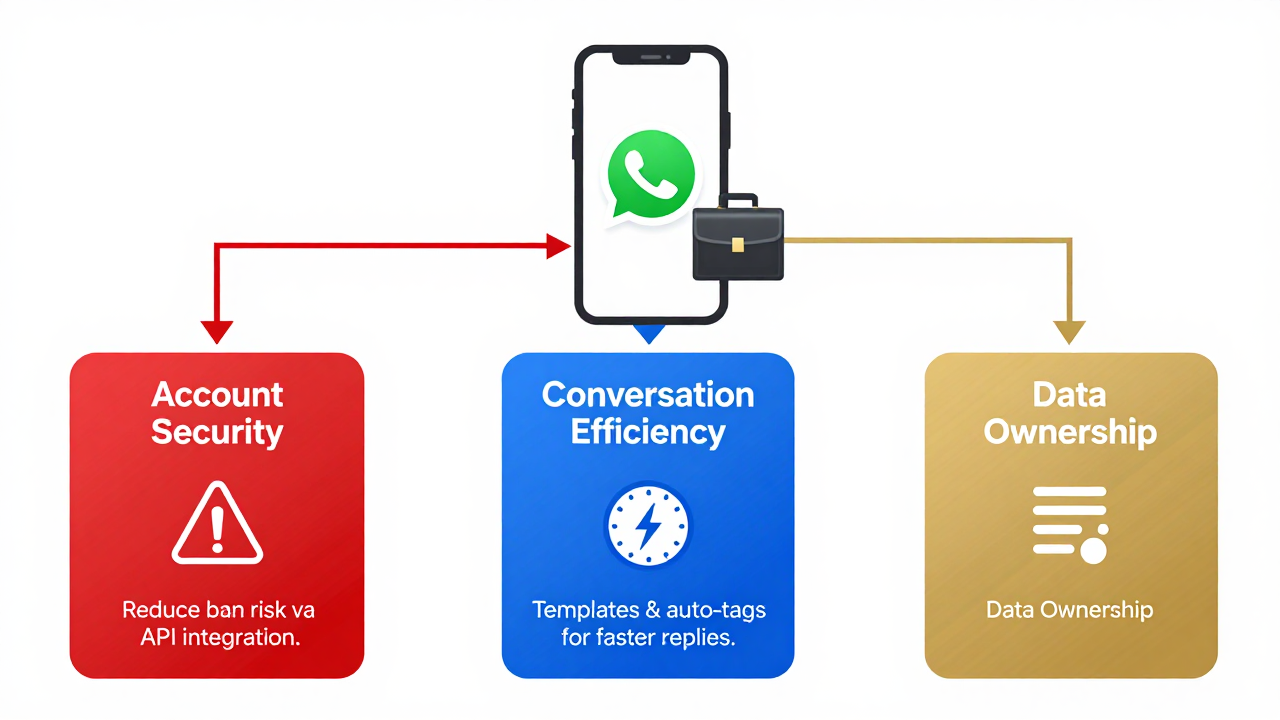
In my view, it comes down to three pillars: account security, conversation efficiency, and data ownership. Miss any one of them, and you'll run into trouble down the line.
Account Security Is the Foundation—Don't Wait Until You're Banned to Care
Anyone in this industry knows how aggressively WhatsApp cracks down on marketing behavior. New numbers getting flagged, old numbers suddenly hitting restrictions—it happens every single day. The first priority of enterprise-level management is reducing account risk through compliant API integration or stable multi-instance setups. The safer approach most teams adopt is separating outbound outreach from daily conversations, using different channels so bulk messaging doesn't drag down your main account.
Conversation Speed Drives Conversion—Don't Keep Clients Waiting
Cross-border business runs on time zones. Your clients are in the US or Europe; you're in Asia—hours apart. If every reply has to wait until both sides are online, you've already lost the order. What enterprise tools bring to the table is templating: saved responses, product catalogs, quote sheets—one click and they're out the door. They also auto-tag leads from different channels, so the sales rep knows exactly where a contact came from and where the conversation left off.
Data Is the Hidden Goldmine—Don't Let Client Info Rot in Someone's Phone
Plenty of teams have been operating for two or three years with all their client resources sitting on personal devices. An employee leaves, and the clients go with them—it happens all the time. Enterprise WhatsApp management centralizes every conversation record, client profile, and follow-up status into a backend system. Even if your team changes, the client assets stay with the company. For teams serious about long-term branding, this matters more than anything else.
How to Vet a WhatsApp Management Provider: A Practical Checklist
There's no shortage of companies offering WhatsApp management services these days, but the quality varies wildly. I've worked with quite a few teams and helped friends run selection evaluations. Here are the screening criteria I've found most useful. If you're currently shopping around, run every candidate through these four checks.
- Ask about the underlying tech: API or simulation. API integration is stable and compliant but costs more. Simulated login is cheaper but carries a much higher ban risk. You can usually get a straight answer just by asking customer support. If they dodge the question, cross them off the list.
- Check data ownership terms. Does the contract explicitly state that client data belongs to you? If the wording is vague, be careful. Some platforms use your client data for their own secondary marketing—that's a trap you don't want to fall into.
- Test their support response time. WhatsApp's rules change frequently. Whether a provider can adapt quickly determines how long your accounts survive. I'd suggest testing their customer service response speed during the evaluation phase itself.
- Ask for real case studies. Don't trust flashy screenshots on their website. Ask for client references in your industry and do some independent digging. Platforms like Getfollow have built a solid reputation in the space by following this compliant operational playbook—use them as a benchmark when comparing options.
One more thing: enterprise WhatsApp management isn't a "buy the software and you're done" deal. You need a provider that offers ongoing strategic support—things like how to phrase bulk messages to avoid trigger words, or how to build up a new number's trust score. That kind of experience is worth more than the tool itself. A lot of cross-border operators will tell you the same thing: choosing a provider is really about choosing a partner who understands the game, not just someone selling software.
The Current State of the Industry: Lots of Noise, Plenty of Traps
Honestly, this space is a mixed bag. Some providers promise the moon but can't even guarantee message delivery rates. Others lure you in with low prices, then jack up fees once you've uploaded your client data. From my observation, the providers that survive past the two-year mark are the ones built on word of mouth and renewals. The ones that rely on aggressive advertising? They tend to fizzle out.
And don't overlook compliance. WhatsApp is tightening its crackdown on third-party tools. Those that play fast and loose with "unlimited bulk messaging" are going to get burned eventually. When you're vetting providers, ask them specifically how they handle risk control. If all they can say is "our tech is really strong," chances are they haven't been through real combat.
Going back to where we started: enterprise WhatsApp management is something you want to set up sooner rather than later. Waiting until your client volume explodes means dealing with painful migration costs—and the inquiries you lose in the meantime could easily pay for years of service. If you're currently stuck in that "personal version isn't enough, but I don't know how to choose an enterprise solution" phase, run the four-point checklist above across the market, then have deep conversations with two or three candidates. Remember: tools are static, but the people using them aren't. Finding a provider who'll roll up their sleeves and solve real problems with you is worth more than any feature list.
Frequently Asked Questions About Enterprise WhatsApp Management
What's the difference between WhatsApp Business API and regular WhatsApp Business?
The WhatsApp Business API is the official enterprise-grade solution that supports automation, team collaboration, and integration with CRM systems. The regular WhatsApp Business app is designed for small operations—it offers basic features like quick replies and labels but caps out quickly when you're handling high volumes or multiple team members.
Is it safe to use third-party WhatsApp management tools?
It depends on the provider. Tools that use official API integration are generally safe. Tools that rely on unauthorized simulation or web-based workarounds carry a real risk of account bans. Always ask about the underlying technology and how the provider handles WhatsApp's evolving compliance requirements.
How much does enterprise WhatsApp management cost?
Pricing varies significantly based on features, message volume, and the number of team seats. API-based solutions typically charge a monthly platform fee plus per-message costs. Simulated-login tools are cheaper upfront but come with higher risk. Expect to pay more for compliance and stability—it's usually worth the premium.
Can I migrate my existing WhatsApp contacts to an enterprise system?
Yes, most reputable providers offer migration support. You'll typically export your contacts and chat history, then import them into the new system. Just make sure the provider clarifies data ownership in your contract before you hand over your client list.
What happens to my client data if I stop using the service?
This depends entirely on your contract. Reputable providers will give you a full data export so you retain ownership. Less scrupulous ones may hold your data hostage or continue using it for their own purposes. This is exactly why the data ownership clause should be reviewed carefully before signing.