Compliant WhatsApp Business Solutions: Don't Let Your "Efficiency Tool" Become a Ban Accelerator
Compliant WhatsApp Business Solutions: Don't Let Your "Efficiency Tool" Become a Ban Accelerator
Here's an uncomfortable truth: starting in the second half of 2025, WhatsApp significantly ramped up enforcement against non-official API usage. Many cross-border sellers report that their old "bulk messaging tools" suddenly triggered mass account bans—sometimes taking down their primary accounts with them. This isn't an isolated incident; it's the inevitable outcome of tighter platform risk controls. So when we talk about compliant WhatsApp Business solutions, we're not really comparing software—we're choosing a path that keeps you in business for the long haul.
First Things First: Do You Need a "Tool" or a "Compliant Identity"?
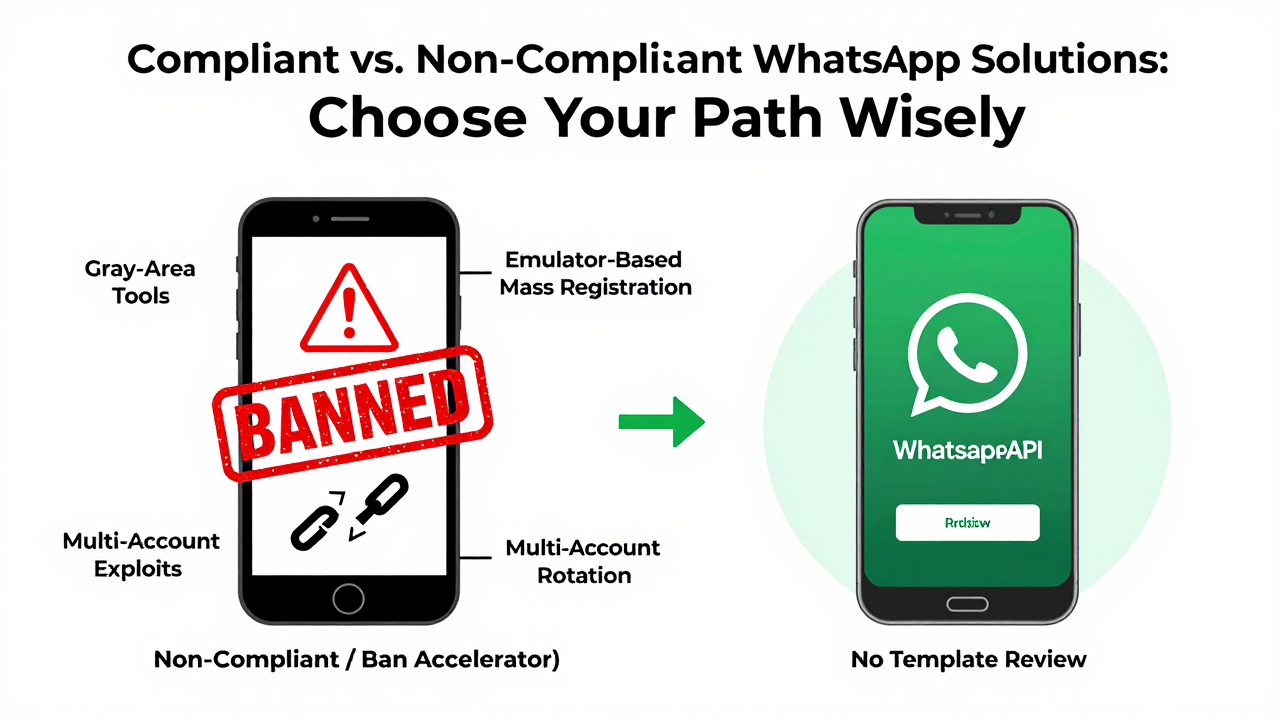
Many solo operators ask, "Which bulk messaging app won't get me banned?" That's the wrong question entirely. WhatsApp bans accounts based on behavior patterns, not the software itself. The platform only offers two official paths: the WhatsApp Business App (free but heavily restricted) and the WhatsApp Business Platform (official API, metered per conversation). Every third-party tool claiming "stable bulk sending" either relies on emulator-based mass registration or protocol exploits—all operating in a gray zone.
From my experience testing several systems, a pattern emerges: if a tool requires you to hand over multiple account credentials or insists on "account warming," it's almost certainly a compliance risk. A genuinely compliant system only needs you to authorize the official API—the data pipeline stays transparent. That difference determines whether your customer assets stay in your hands or get wiped out overnight.
Three Non-Negotiable Criteria for Compliant Systems
First, verify official API integration. This is the baseline for compliance—no exceptions. Second, confirm message templates go through official review. Many systems advertise "template-free approval," which usually means they're circumventing review through technical tricks. If WhatsApp spot-checks you, the result is throttling at best, a permanent ban at worst. Third, check data storage location and privacy policies. Both GDPR and China's Personal Information Protection Law impose clear requirements on cross-border data transfers. If a system can't produce basic security certifications, walk away.
Industry consensus: compliant systems cost 30–50% more per message than gray-area tools, but they buy you account security and customer trust. Cross-border sellers consistently report that after switching to the official API, their reply rates and repeat purchase rates actually improved—because the official API supports rich media and interactive buttons, delivering a far better experience than plain-text blasts.
Service Provider Models: SaaS Subscriptions, Private Deployment, and Managed Services
Three service models dominate the market today. SaaS subscriptions suit small and mid-sized sellers—monthly fees, plug-and-play, but your data sits with the provider. Private deployment works for companies with in-house tech teams—full data control, but significant upfront investment. Managed services fit teams that want zero hands-on involvement, but make sure the provider actually understands your business context.
Take Getfollow, a platform with a solid industry reputation. They combine official API integration with a SaaS management dashboard, focusing on conversation management and segmented customer outreach rather than raw send volume. That approach is worth copying—compliant systems aren't about sending more; they're about sending smarter.
Real-World Cautionary Tale: A $4,000 Annual System Nearly Destroyed a Customer Base
A friend running a DTC store bought a "high-value" bulk messaging system in late 2024—$4,000 a year, promising 100,000 messages daily with zero bans. Two weeks in, his primary account got permanently banned, wiping out three years of accumulated customer data. He then switched to a compliant API solution. Costs doubled, but he never faced another ban. The lesson: in the WhatsApp ecosystem, your account assets are worth far more than any tool's price tag.
One more detail people overlook: many systems claim "multi-account rotation," but the official API doesn't allow a single business to bind multiple accounts simultaneously. Anything pushing a "multi-account matrix" is skating on thin ice. The compliant approach is one verified Business Profile per company, managing all conversations through the official API.
How to Vet a Service Provider: Three Things to Check
First, will they sign an SLA? Reputable providers commit to API uptime and response times in writing—no vague promises. Second, can they produce verifiable customer references? Don't settle for screenshots on their website. Ask for contacts in your industry and reach out directly. Third, does their support team understand your business? Many providers can recite technical specs but know nothing about e-commerce marketing cadence, timezone management, or multilingual customer service. Those partnerships get exhausting fast.
One more warning: don't fall for "unlimited templates" or "review-free channels." WhatsApp's template review process is getting stricter by the month. Any provider claiming to bypass it is gambling with your account. Choose a provider with transparent review workflows, even if approvals take a bit longer—peace of mind is worth it.
Final Advice: Test Small First, Then Commit Long-Term
Whatever system you're considering, run a small-scale test for one to two weeks and track four metrics: delivery rate, read rate, reply rate, and ban rate. If a system can't survive its own trial period, move on to the next option. Compliance isn't an expense—it's an investment that protects the customer relationships and brand reputation you've worked hard to build.
On the topic of compliant WhatsApp Business solutions, my core advice is simple: put compliance before features, and long-term stability before short-term gains. Not many providers in this space satisfy both criteria, but the ones that do are worth the search. In cross-border business, surviving longer beats sprinting faster—every time.
Frequently Asked Questions
What's the difference between WhatsApp Business App and WhatsApp Business API?
The Business App is free and designed for small operations—one device, manual messaging, limited automation. The Business API is a paid, official platform for medium to large operations that need automation, team collaboration, and integration with CRM or e-commerce systems. The API requires business verification and charges per conversation.
Can I use third-party bulk messaging tools without getting banned?
Technically, some tools work for a while, but they operate in violation of WhatsApp's Terms of Service. As platform enforcement tightens, the risk of account bans increases significantly. If your account holds valuable customer data and business history, the risk isn't worth it. The official API is the only sustainable path.
How much does a compliant WhatsApp Business API solution cost?
Pricing varies by provider and message volume. WhatsApp charges per conversation (not per message), typically ranging from $0.005 to $0.09 depending on country and conversation type. On top of that, SaaS platforms usually charge a monthly subscription fee. Expect total costs to run 30–50% higher than gray-area tools, but with dramatically lower risk.
What should I check before signing a contract with a WhatsApp API provider?
Verify three things: official BSP (Business Solution Provider) status or partnership with Meta, a clear SLA with uptime guarantees, and verifiable customer references in your industry. Also confirm their data storage practices align with GDPR or local regulations, and ask about their template approval process—transparency here is a good sign.