WhatsApp Bulk Messaging Anti-Ban Guide: What Actually Works in 2025
WhatsApp Bulk Messaging Anti-Ban Guide: What Actually Works in 2025
If you've been in cross-border trade for more than a few months, you've probably seen the same panic in every WeChat group: "My WhatsApp got banned again." For anyone doing bulk outreach, it feels like a rite of passage. But here's the thing—most people start by asking, "Is there software that guarantees zero bans?" That's the wrong question entirely. Let's skip the fluff and get straight into practical WhatsApp bulk messaging anti-ban strategies that have been battle-tested across the industry.
The Core Truth: Why WhatsApp Actually Bans Accounts
Here's what many cross-border sellers get wrong—they assume bans are purely volume-based. They're not. WhatsApp's detection system evaluates your entire behavioral footprint: account age, IP cleanliness, where your contacts came from, how similar your messages look to spam templates, and even the hardware environment of your phone.
These are the most common ban triggers we see across the industry:
- New accounts jumping straight into mass messaging before building any account weight
- Near-identical message templates that trip the bulk-marketing algorithm
- Multiple accounts logged in on the same IP, triggering关联 detection
- High complaint rates from recipients marking you as spam
- Erratic sending patterns with huge bursts in short windows
Once you understand these triggers, it becomes obvious why those "unlimited sending" tools die within days. They solve for delivery speed but completely ignore account safety. A real WhatsApp bulk messaging anti-ban solution isn't a single tool—it's a layered strategy.
Three Proven Anti-Ban Playbooks That Actually Hold Up
Let's get one thing straight: no method on earth guarantees 100% ban-free sending. But with the right operational approach, you can absolutely bring your ban rate down to a manageable level. These three approaches are what most serious外贸 teams are running right now.
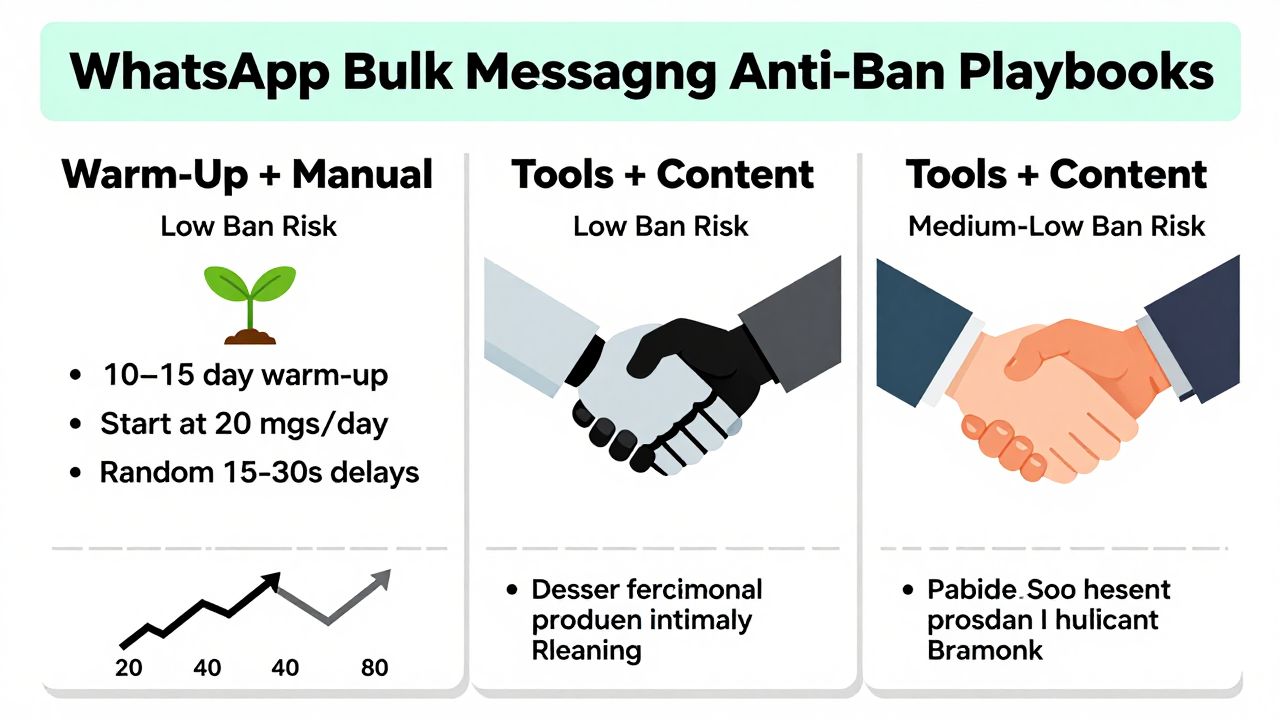
Playbook 1: Warm-Up First, Manual Outreach Second
This is the least glamorous but most dependable route. When you get a new account, resist every urge to start blasting. Spend at least 10–15 days warming it up. Complete your profile photo and bio, add a few real contacts and actually chat with them, join two or three groups and participate normally, post a couple of status updates. Make the account look like a human being who lives on the app.
During this warm-up window, do not touch bulk sending at all. After that, start with tiny test batches—20 messages on day one, 40 on day two, and scale gradually. Keep a random 15–30 second delay between sends instead of a fixed rhythm. This phase is all about letting the system get comfortable with your behavioral patterns.
Playbook 2: Smart Tools + Smarter Content
Once your account is stable, you can bring in legitimate service providers to scale up. Platforms like Getfollow have built a solid reputation in the industry by following exactly this compliant logic—they don't promise "unlimited sends." Instead, they control delivery pacing, simulate human operation patterns, and rotate accounts automatically to spread risk.
While the tool handles the mechanics, your content needs an upgrade. Most bulk messages read as obvious ads with zero personalization. Small tweaks make a massive difference: open with "Hi [name]" instead of "Dear Sir," reference something specific about their business, and include a product image rather than a wall of text. These details dramatically reduce the likelihood of being reported.
Playbook 3: Multi-Account Matrix with Traffic Distribution
If you're serious about bulk outreach, one or two accounts won't cut it. Teams that have been at this for a while typically maintain 5–10 accounts as a matrix. Assign each account a different product line or geographic market, and cap daily sends at 80–120 messages per account.
Here's a pro tip: never log into multiple accounts from the same device. Use a fingerprint browser with dedicated IPs so each account gets its own clean environment. That way, even if one account gets flagged, the rest of your matrix stays untouched.
Here's how the three approaches stack up:
| Approach | Investment | Ban Risk | Best For |
|---|---|---|---|
| Warm-up + Manual | Low (but time-heavy) | Low | Solo operators starting out |
| Tools + Content Optimization | Medium | Medium-Low | Steady inquiry flow needed |
| Multi-Account Matrix | High (devices + IPs) | Very Low | Team-based operations |
These aren't mutually exclusive. Most teams start with Playbook 1 to build account health, switch to Playbook 2 once things stabilize, and expand into Playbook 3 when volume demands it. Flexible layering is the right way to approach any WhatsApp bulk messaging anti-ban solution.
The Ugly Truth: Why Most Anti-Ban Tools on the Market Are Garbage
Let's be honest—this industry is a minefield. Search for "WhatsApp bulk sender" and eight out of ten results are white-labeled junk. Some claim "cloud-based sending that never bans," but they're really just running your accounts on servers in batches until they all get flagged. Others use modified WhatsApp clients that are instantly recognizable to the platform.
We've heard from countless cross-border sellers who dropped a few thousand yuan on bulk-sending software, watched their accounts die within a week, and got zero support when they reached out. That's the classic sell-and-disappear model. A legitimate provider will ask about your current account situation, sending volume, and target market before recommending anything. If they push you to pay upfront without understanding your setup, walk away.
From my observation, WhatsApp's enforcement has tightened significantly since late 2024. What used to result in feature restrictions now gets you a straight-up ban. Anyone still using outdated blast methods is essentially operating with no safety net.
Beyond Anti-Ban: What You Need to Know for Actual Conversions
Avoiding bans is just the starting line. What matters more is what happens after your messages go out. Many people assume "sent" means "seen," but that's a costly misconception.
First, delivery doesn't equal read. Plenty of users in international markets have notifications disabled. The sweet spot for bulk outreach is between 10 AM and 3 PM on local business days—that's when open rates peak.
Second, plan your follow-up sequence. Send the product intro first. If no reply by day two, follow up with a relevant industry insight. By day four, send a limited-time offer. If three rounds don't get a response, move on. Don't fixate on one lead when your time is better spent on prospects who are actually engaging.
Third, respect compliance boundaries. WhatsApp's official business policy requires recipients to opt in before receiving marketing messages. While many operators bend this rule in practice, avoid sending content that's obviously illegal—counterfeit goods, medical devices, financial services. These categories get reported at astronomical rates, and bans are practically guaranteed.
How to Pick a Service Provider Worth Your Money
If you're considering third-party tools, ask yourself a few hard questions: Will they let you run a small-scale test first? Do they publish clear sending frequency limits? How fast does their support actually respond?
Any provider that leads with "unlimited sends" or "zero bans" is an instant red flag. I've seen people in industry groups share their experience with Getfollow, noting that their support team proactively reminds you to control pacing and adjusts recommendations based on your vertical. That level of service is genuinely rare. It's just one reference point—do your own comparison, but hold every candidate to that standard.
One principle to remember regardless of who you pick: tools are amplifiers, not substitutes. Your product and your content are what actually move the needle. Even the most reliable tool won't generate inquiries if what you're sending doesn't resonate with your audience.
So here's the bottom line on WhatsApp bulk messaging anti-ban solutions: warm-up is the foundation, pacing is the key, tools are the support, and content is the soul. Get all four right and your ban rate will drop naturally. Stop chasing shortcuts—in this game, playing the long game is the fastest route to sustainable results.
Frequently Asked Questions
How long should I warm up a new WhatsApp account before bulk messaging?
Industry consensus points to a minimum of 10–15 days of active, human-like usage. Complete your profile, engage in real conversations, join groups, and post status updates. Starting bulk sends before this window is the fastest way to get flagged.
What's the safest daily sending volume for WhatsApp bulk messages?
For a well-aged account, 80–120 messages per day is the commonly cited safe range. Newer accounts should start much lower—around 20 messages—and scale up gradually over several days. Always keep random delays between sends.
Can I use the same phone for multiple WhatsApp accounts?
Technically yes, but it's risky. WhatsApp tracks device fingerprints, and multiple accounts on one device can trigger关联 detection. Use a fingerprint browser with dedicated IPs for each account to maintain isolation.
Are third-party bulk sending tools safe to use?
Some are, but most aren't. Avoid tools that promise unlimited sends or zero bans—they're either lying or using modified clients that get flagged quickly. Look for providers that emphasize sending rhythm control, human-like behavior simulation, and account rotation. Always test on a low-value account first.
What content types get WhatsApp accounts banned the fastest?
Anything in regulated categories—counterfeit goods, medical devices, financial services—gets reported at extremely high rates. Also avoid messages that are pure ads with no personalization. Adding recipient names, contextual references, and visual content significantly reduces complaint rates.