Free SMS Verification for Apple in 2026: A Cross-Border Business Guide to Avoiding the Pitfalls
Free SMS Verification for Apple in 2026: A Cross-Border Business Guide to Avoiding the Pitfalls
After years of working in cross-border e-commerce, I've watched too many operators stumble at the very first hurdle: account registration. In the Apple ecosystem, one bad verification decision can mean anything from a missed code to a permanently flagged account — and all your early-stage effort goes down the drain. Let's skip the fluff and talk about what free SMS verification for Apple actually looks like in 2026, and how to navigate it without getting burned.
The Free Verification Trap: What the 2026 Landscape Really Looks Like
Most solo operators start the same way: type "free SMS verification for Apple" into a search engine and click the first link. Totally understandable — every dollar counts when you're bootstrapping. But here's the industry reality: the free verification market in 2026 is no longer the wild west it was a few years ago.
From my observation, free verification platforms on the market today fall into three categories. First, pure web-based shared number pools where anyone can read incoming texts. Second, ad-supported apps that trade your privacy for free service. Third, the so-called "data farms" that collect numbers under the guise of free access. None of these genuinely solve what cross-border businesses actually need: stability and security.
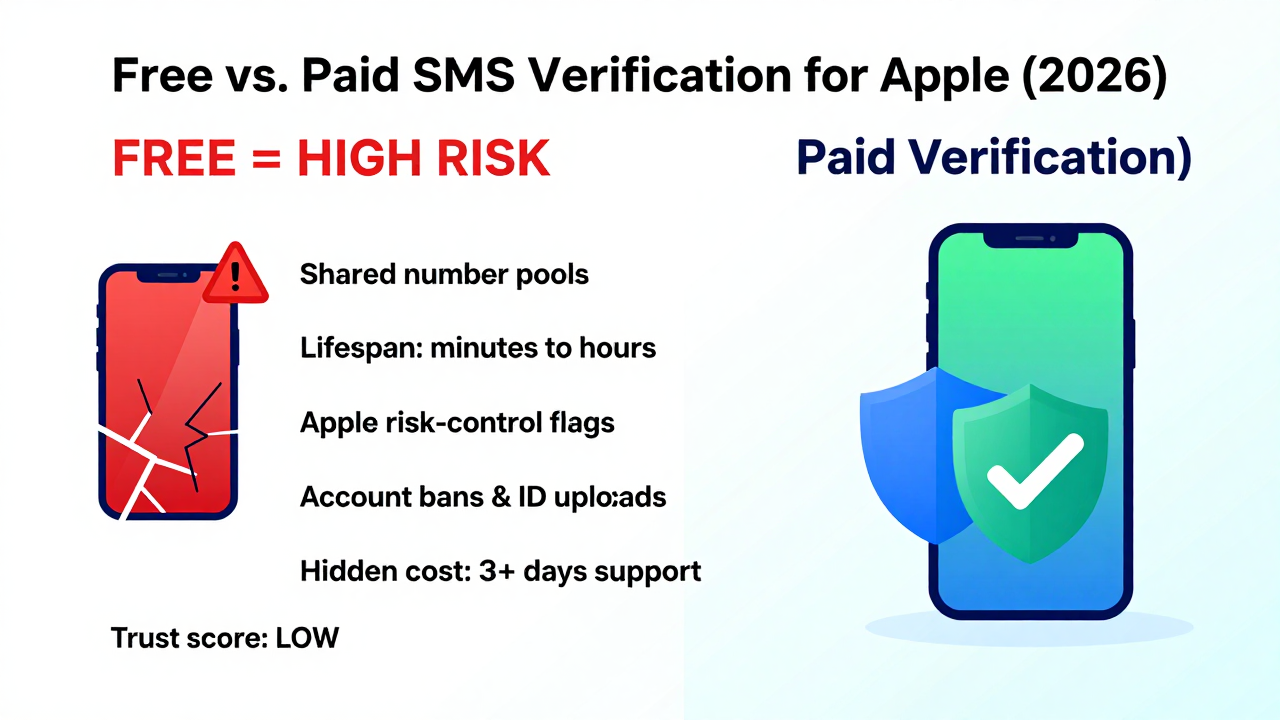
Why do I say that? I've tested plenty of these so-called free platforms, and a clear pattern emerges: free numbers have an extremely short lifespan — typically minutes to a few hours at most. If your Apple registration flow takes a little longer, or your network hiccups, the verification code may never arrive before the platform recycles the number.
Here's the bigger headache. Shared number pools mean dozens of people could be using the same number for registrations simultaneously. Apple's risk-control systems in 2026 are remarkably sharp. Once they detect a number linked to too many accounts, they'll trigger additional verification — sometimes even demanding ID uploads. Suddenly, the few dollars you saved cost you hours of customer support and back-and-forth.
The Hidden Costs Nobody Talks About: Time and Account Trust Score
Cross-border operators I've spoken with say the real pain isn't receiving the code — it's the chain reaction that follows. Say you register an Apple account using a free verification platform and pass the first check. Then you discover that account is severely restricted in every subsequent marketing move.
In 2026, Apple places enormous weight on an account's "birth environment." An account registered through a public number carries a very low trust score in their backend. The symptoms are specific: certain iCloud services won't work properly, App Store downloads repeatedly trigger re-verification, and enabling two-factor authentication can lock you out entirely.
Here's a cautionary tale from the field. A friend running a dropshipping site decided to cut costs by using a free verification platform to batch-register 20 Apple accounts for ASO work. Within a week, all 20 accounts were banned — and his primary developer account got caught in the crossfire. When he reviewed the damage, he told me the appeal process alone consumed three full working days. Factor in the labor cost, and he paid more than ten times what a legitimate verification service would have charged.
So when you search for "free SMS verification for Apple," the real question isn't "which platform is free." It's "is this platform's number pool clean enough to survive Apple's 2026 risk-control rules?"
The Smart Path Forward: From Free to Cost-Effective Verification
I'm not saying every free option is worthless. For purely personal, one-off registrations, a free platform can get the job done in a pinch. But if you're running a cross-border operation — even a one-person studio — it's worth rethinking how you position verification in your workflow.
A pragmatic approach gaining traction in the industry: treat verification as infrastructure, not a one-time cost-cutting hack. In 2026, many providers now offer per-use or project-based pricing. The per-unit cost is actually modest, but the number stability and cleanliness are on a completely different level.
When evaluating providers, I recommend focusing on three dimensions. First, does the number's country code match your target market? Many cross-border businesses need US, UK, or Southeast Asian numbers — not domestic virtual ones. Second, does the provider offer number exclusivity, meaning only you use that number during its validity period? This dramatically reduces association risks. Third, how fast is their support response? A provider that replies within 10 minutes at 3 AM is worth far more than one that makes grand promises during business hours.
One platform that consistently comes up in industry conversations is Getfollow, which follows this exact playbook — independent number pools, pay-as-you-go pricing, and multi-region coverage. It gives small cross-border teams a middle ground between "free and exposed" and "premium and pricey." To be clear, I'm citing them as an observation, not an endorsement. Test providers yourself before committing.
The 2026 Verification Pitfall Checklist: Small Details, Big Consequences
Drawing from my own experience and feedback from peers, here's a practical checklist for 2026. Every item on this list was learned the hard way.
- Be skeptical of "permanently free" claims. Any service promising lifetime free verification is either harvesting your personal data or offering terrible number quality. Bandwidth and number resources cost real money in 2026 — nobody runs a charity.
- Check the number's country code first. Many free platforms hand out numbers from obscure regions. Using those for Apple registrations will trigger an automatic high-risk flag.
- Watch the delivery latency. If a platform's average code delivery time exceeds 60 seconds, walk away. Apple's verification codes typically expire within minutes — delay equals failure.
- Never reuse one number across multiple platforms. Even if you paid for the number, match one number to one core account. Cross-platform data correlation in 2026 is far more advanced than you think.
Another piece of feedback I hear repeatedly from cross-border operators: the first 24 hours after successful verification is a critical observation window. Avoid frequent logins or major profile changes during this period. Let the account settle — think of it like breaking in a new car. Steady at the start, fast on the road.
Free vs. Paid: Running the Actual Numbers
People assume the money saved on free verification is real savings. But when you tally the full cost, the picture changes. Here's a rough framework: getting a cross-border account from registration to stable operation takes roughly 2 to 3 hours of focused effort. If a verification failure gets that account banned, those hours are gone.
Say your hourly rate is $15. One failed verification costs you $30 to $45 in wasted time. Meanwhile, a paid verification number in 2026 typically costs anywhere from a few cents to a couple of dollars. Run that math, and the answer becomes pretty clear.
That said, I understand the budget pressure on solo operators. So here's my recommendation: tier your usage. Core business accounts — like the Apple developer account tied to your main product — absolutely deserve high-quality verification. Peripheral test accounts, like temporary burner registrations, can use free options, but go in knowing you might lose them at any moment.
Final Thoughts: Small-Scale Testing Is the Only Shortcut
On the topic of free SMS verification for Apple, my core message is simple: free is a trap, but blindly paying is also wasteful. The 2026 cross-border landscape rewards precision and careful management — not extreme moves at any single point.
If you're hunting for the right verification solution, don't start with a big package. Run a small test instead. Spend a modest amount on 5 to 10 numbers, register accounts across different platforms, and monitor stability, ban rates, and support responsiveness over a week. The data will tell you everything. Test results don't lie — they'll show you which provider deserves a long-term relationship.
The cross-border road is full of potholes, but every misstep is also a learning opportunity. Verification is just the first step — yet it lays the foundation for everything that follows. Hopefully, this guide helps you dodge one more pitfall and keep your peace of mind.
Frequently Asked Questions
Is free SMS verification for Apple accounts actually safe in 2026?
For one-off personal use, it can work in a pinch. For business accounts, it's a serious risk. Free platforms typically use shared number pools, which Apple's risk-control systems easily flag. You might get the account registered, but you'll likely face verification loops, service restrictions, or outright bans shortly after.
Why do free verification numbers stop working so quickly?
Free platforms recycle numbers constantly to serve as many users as possible. A number's lifespan can be as short as a few minutes. If your registration process hits any delay — slow network, captcha retry, form errors — the number may already be reassigned by the time the code arrives.
What should I look for when choosing a paid verification service?
Three things matter most: number exclusivity (you're the only user during the validity period), country code matching your target market, and responsive customer support. Also check whether the provider has a track record with Apple-specific verification, since that ecosystem has stricter requirements than most.
Can I use one verification number for multiple Apple accounts?
Technically possible, but strongly discouraged. Apple's systems track number-to-account associations. Multiple accounts tied to one number will trigger fraud alerts and can lead to all associated accounts being banned. Match one number to one core account whenever possible.