How to Choose a Reliable SMS Verification Service in 2026: A Cross-Border Seller's Guide
How to Choose a Reliable SMS Verification Service in 2026: A Cross-Border Seller's Guide
In cross-border e-commerce, your phone number is your lifeline. Registering for Amazon, TikTok Shop, or WhatsApp Business all comes down to SMS verification. But here's the catch—how many physical SIM cards do you actually have on hand?
The landscape in 2026 looks nothing like it did a few years ago. Platform risk controls have tightened significantly. Jump into any random SMS verification service, and you might not receive codes at all—or worse, get your main account flagged. From my conversations with independent site operators and social media matrix managers, the consensus is clear: the margin for error this year has shrunk dramatically.
Why SMS Verification Has Become a High-Risk Move in 2026
Many cross-border sellers assume receiving a verification code is a simple transaction. In reality, the 2026 verification ecosystem has turned into a game of cat and mouse with platform risk-control algorithms.
Industry observers note that major platforms—especially Meta and Google—have upgraded their virtual number detection capabilities by an order of magnitude. Whether your number is virtual, has been used for multiple registrations, or shows an anomalous location, backend algorithms can now make that determination in seconds.
I personally tested a batch of platforms claiming "universal compatibility," and the results were eye-opening. The same number might receive an Amazon code in the morning, only to be flagged as high-risk by TikTok by the afternoon. For teams that need to register accounts in bulk, this instability is nothing short of a disaster.
What's more frustrating: many platforms only guarantee that you'll receive the SMS, not that your account will survive. You spend a few dollars, get your code, register successfully—then wake up to a banned account the next day. When you reach out for support, they shrug and say, "We only handle code delivery."
This exact scenario is still playing out across the industry in 2026. The feedback I keep hearing is that reliable SMS verification isn't about having the most numbers—it's about number cleanliness and account survival rates.
Clean vs. Dirty Number Pools: The Hidden Factor Behind Account Fate
Here's an insider detail most people miss. A "clean number" means that specific number range hasn't been mass-flagged for registrations, account farming, or fake transactions. If a number range has been blacklisted by risk-control systems, your registration success rate drops no matter which platform you switch to.
One pattern I've observed: in 2026, established cross-border teams are increasingly abandoning public number pools in favor of dedicated or private number services. The upfront cost is higher, but the improvement in account stability and retention is night and day.
This brings us to the three tiers of SMS verification providers currently operating in the market:
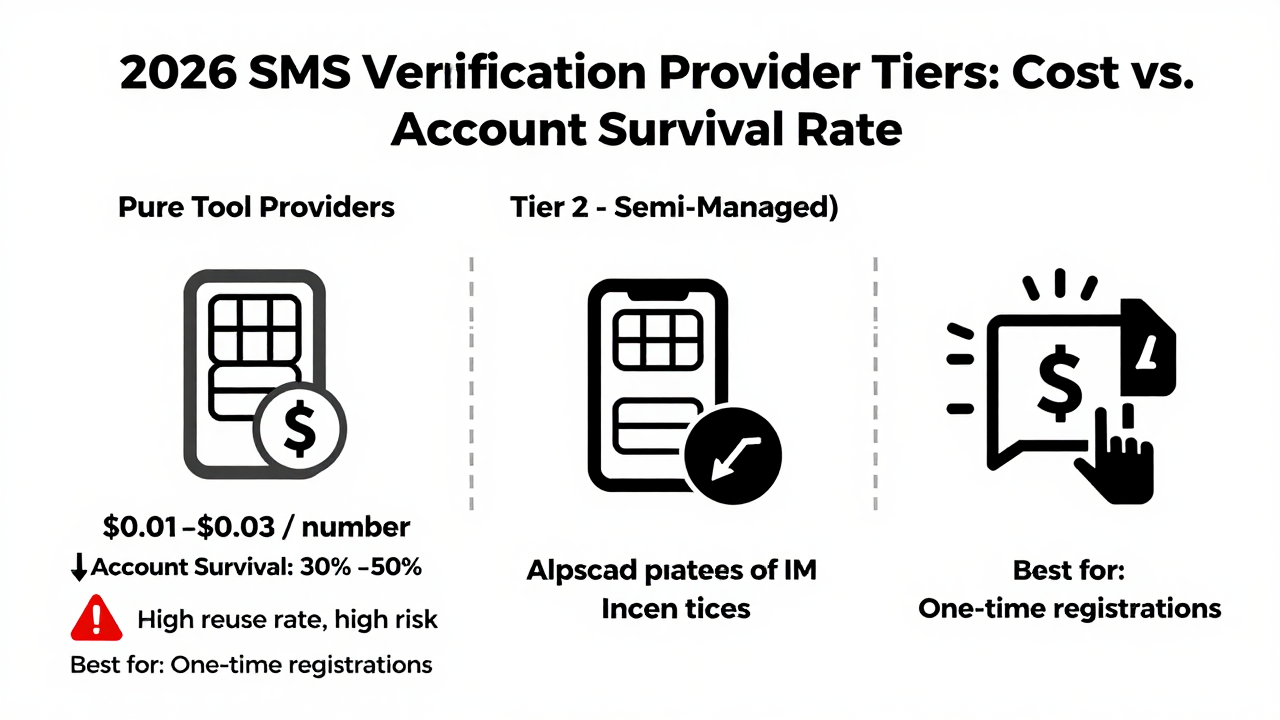
- Pure tool providers: Offer API access and a shared number pool at rock-bottom prices. High number reuse rates make them suitable only for one-time registrations or low-value accounts.
- Semi-managed providers: Provide number pools with basic risk filtering that removes some high-risk ranges. Mid-range pricing, suitable for solo operators and small studios.
- Compliance-focused providers: Go beyond number delivery to include account registration guidance, account warming strategies, and even risk-control analysis. Platforms like Getfollow operate on this model and have built a solid reputation among cross-border sellers in 2026.
Some dismiss the third tier as a "tax on ignorance," but from my testing, enterprise users running bulk operations actually save money in the long run by avoiding trial-and-error costs. After all, losing an Amazon storefront costs far more than any verification fee.
Three Hard Metrics That Define a Reliable SMS Verification Service
If you're evaluating providers right now, don't just compare prices. Ask these three questions first.
First, how long does a number stay active? Many platforms advertise "instant code delivery" but fail to mention that numbers are single-use. If you're building accounts that need long-term maintenance, you need to confirm whether numbers support renewal or extended holding. In 2026's risk-control environment, the duration a number stays tied to your account is a significant trust signal.
Second, can you specify country or region codes? Selling into the US and European markets? You'll want US or UK physical number ranges. Targeting Southeast Asia? You need local numbers. Some platforms claim "global coverage" but assign numbers with random locations, which immediately triggers cross-region login flags.
Third, is there a failure compensation policy? This is the defining line between reliable and unreliable providers in 2026. Trustworthy platforms will commit to "no charge if no code received" or "appeal support for account issues." If a provider won't make that commitment, they're likely a reseller flipping upstream APIs—and when something breaks, there's no one to hold accountable.
Industry consensus shows that reasonable SMS verification costs have risen roughly 30% compared to previous years. Platforms offering suspiciously low prices are almost certainly recycling "dirty" numbers that have been flagged repeatedly—low success rates and a real risk of contaminating your primary accounts.
A Real-World Cautionary Tale: How Cutting Corners Nearly Destroyed an Entire Account Matrix
A friend running a home goods independent store decided to save money in early 2026. He bulk-purchased 100 UK numbers from a small platform to register TikTok Shop accounts. Within a week, over 40 accounts were banned for "non-human activity." Worse, the risk association on his main account spiked, and his previously healthy storefront received a warning letter.
He eventually switched to a compliance-focused provider, rebuilt his registration process, and paired clean dedicated numbers with residential IPs to slowly recover his account matrix. He told me something that stuck with me: "The money I saved on verification codes didn't even cover a fraction of what one ban cost me."
This isn't an isolated story in 2026. Many studios hit roadblocks during bulk registration, and the root cause often isn't their operational strategy—it's the most basic step: SMS verification.
How to Vet an SMS Verification Provider: A Four-Step Screening Method
Since you're here with clear intent, let's get practical. In 2026, you can filter out bad providers with these four steps:
- Check reputation first, credentials second. Search cross-border forums, knowledge communities, and WeChat groups for the provider's name. Pay close attention to how often keywords like "ban," "no code received," and "unresponsive support" appear.
- Demand a test API or small deposit. Confident providers welcome testing. Deposit a minimal amount, test 5–10 numbers, and evaluate code delivery speed, number location, and registration success rate. If they hesitate during the testing phase, walk away.
- Ask about number sourcing. Do they maintain their own number pool or resell from third parties? If it's the latter, can they show upstream credentials? In 2026, the compliance of your number source directly determines your account security boundaries.
- Test after-hours support. Send a message outside business hours and time their response. SMS verification is a 24/7 operation. If your peak hours are at 2 AM but their support team only works daytime shifts, you'll be stuck when problems arise.
Additionally, many cross-border professionals report that in 2026, it's worth prioritizing providers that offer combined registration and account warming guidance. Services like Getfollow, while primarily focused on compliance operations, provide number screening recommendations that help you avoid common risk-control traps.
To be clear, this isn't a recommendation to use any specific provider. The point is: if a service only sells codes and offers zero risk-control advice, its value is purely transactional—and you're absorbing all the risk yourself.
2026 SMS Verification Cost and Risk Comparison (Approximate Ranges)
| Service Type | Cost per Number | Account Survival Rate (Industry Feedback) | Best For |
|---|---|---|---|
| Public pool (pure tool) | $0.01–$0.03 | 30%–50% | One-time registrations, low-value accounts |
| Semi-managed (basic filtering) | $0.04–$0.11 | 50%–70% | Solo operators, small to medium batches |
| Compliance-focused (dedicated + risk advice) | $0.14–$0.35 | 70%–90% | Enterprise-level matrices, long-term account warming |
These figures come from anonymous surveys across multiple cross-border communities in 2026. They're not exact, but they reflect a consistent trend: in SMS verification, you get what you pay for.
One final reminder: regardless of which provider you choose, run a small-scale test before committing to a long-term partnership. Don't deposit a large sum upfront. If the provider disappears or number quality degrades, your losses extend far beyond the deposit—they cascade through your entire account matrix.
In 2026, stability beats speed in cross-border operations. A reliable SMS verification service is essentially a purchase of certainty—certainty that codes will arrive, that accounts will survive, and that someone will be there when things go wrong. Get those three things straight, and the right choice becomes obvious.
Frequently Asked Questions About SMS Verification Services
What is the difference between a public number pool and a dedicated number?
A public number pool is shared across many users, which means higher reuse rates and a greater chance that risk-control systems have already flagged those numbers. Dedicated numbers are assigned exclusively to you, significantly improving registration success and account survival rates. In 2026, the gap in reliability between the two has widened considerably.
Why do my accounts get banned shortly after successful SMS verification?
Receiving a verification code only confirms that the number can receive SMS. It doesn't guarantee the number is clean or that your registration context (IP, device, behavior patterns) aligns with platform expectations. Many providers only promise code delivery, not account survival. That's why you should evaluate providers based on survival rates, not just delivery success.
How much should I expect to pay for reliable SMS verification in 2026?
Industry feedback suggests a reasonable range of roughly $0.14 to $0.35 per number for compliance-focused services with dedicated numbers and risk-control support. Prices significantly below this range typically indicate recycled "dirty" numbers with low success rates. The cost difference is negligible compared to the financial impact of a banned account.
Can I use SMS verification services for WhatsApp Business registration?
Yes, but WhatsApp's risk-control algorithms are particularly aggressive in 2026. You'll need numbers with high cleanliness scores and ideally those that support long-term holding, since WhatsApp accounts benefit from consistent number binding over time. Test thoroughly before committing to bulk registrations.