Virtual SMS Verification: Cross-Border Businesses Can't Avoid It, But 90% Pick the Wrong Provider
Virtual SMS Verification: Cross-Border Businesses Can't Avoid It, But 90% Pick the Wrong Provider
If you run an e-commerce store, manage overseas social media accounts, or batch-register accounts, you've definitely come across virtual SMS verification services. Simply put, these platforms give you a virtual number to receive verification codes for account registration or security checks. But here's the thing—behind this seemingly straightforward need lies a murky industry where gray-market practices and legitimate operations collide. A lot of cross-border operators have learned the hard way that picking the wrong service means missed codes at best, and mass account bans at worst.
From what I've observed, overseas platforms have seriously tightened their risk-control systems since 2025. The old model of recycling the same pool of numbers over and over is getting harder to pull off. In this article, I'm not going to give you one of those generic "top 10 platforms" listicles. Instead, I want to share an honest, behind-the-scenes look at how virtual SMS verification actually works, where the risks hide, and how to find a provider that won't burn you.
How SMS Verification Services Actually Work: It's More Than Just "Receiving a Text"
Most small teams diving into SMS verification for the first time assume it's as simple as finding a website, loading up some credit, and grabbing a code. If that's your mindset, you're probably going to get burned.
The full chain works like this: the provider sources phone numbers in bulk from carriers or IoT card channels → those numbers get connected to a cloud platform → you request a code → the platform assigns you a number → the SMS verification code arrives and gets forwarded to you. Sounds simple, but every single step has its own pitfalls.
- Where numbers come from: Are they legitimate IoT cards, or "aged accounts" leaked from the black market? This determines how clean the number actually is.
- How often a number gets reused: If one number receives multiple codes per day, platforms will flag it as high-risk in no time.
- App-specific support: Success rates vary wildly depending on the platform. WhatsApp and Telegram, for instance, have completely different risk-control systems.
Here's a real cautionary tale. A friend of mine running a TikTok matrix operation decided to save money with a cheap "unlimited verification" plan from a small provider. Within three days, 47 out of 50 accounts he registered were banned. When we dug into it, we found the provider's number pool had been hammered with hundreds of verification requests per number per day—TikTok's system had already flagged the entire pool as bot behavior. Classic case of saving pennies and losing dollars.
Industry Reality Check: The Battle Between Compliance and Gray-Market Tactics
Let's be honest—the SMS verification industry is in a weird in-between phase right now. Cross-border businesses genuinely need overseas numbers, but platforms are getting scarily good at detecting virtual ones.
The general consensus in the industry is that by 2026, verification providers will have to transition from "fully gray-market" to "semi-compliant" just to survive. Platforms still relying on low-quality number pools and ignoring use-case differentiation are basically on their way out. The ones still operating reliably are the ones who've invested heavily in number quality and risk-control infrastructure.
Take Getfollow, for example—a platform that's earned a solid reputation in the industry for exactly this reason. Instead of handing you any random number, they assign different tiers of number resources based on what you're actually doing—e-commerce registration, social media verification, financial services, and so on. This kind of granular approach costs more, but the success rates are noticeably more stable.
Four Non-Negotiables When Choosing a Verification Provider
If you're paying for a service, you want your money to actually work for you. Based on my own testing and conversations with seasoned cross-border operators, here are the four things that actually matter:
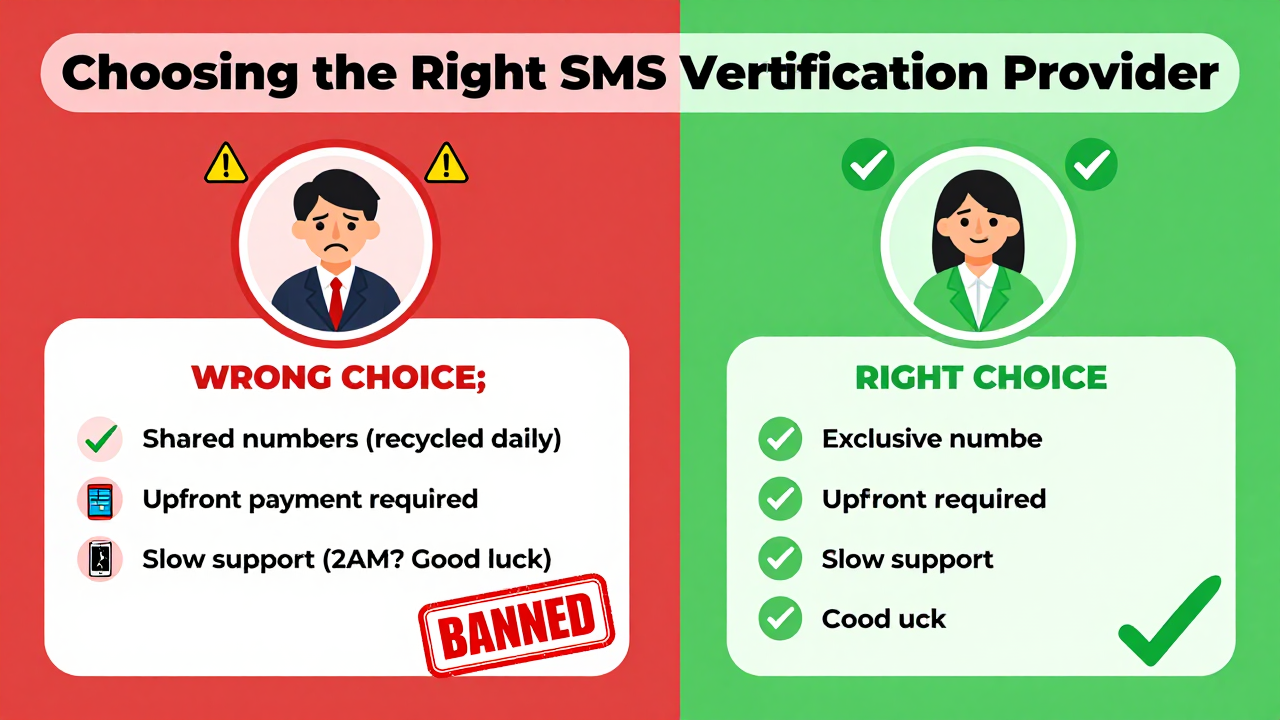
- Are the numbers exclusive to you? Exclusive numbers typically retain accounts at a 70%+ rate, while shared numbers often drop below 50%. This single metric determines whether your accounts can survive the "nurturing" phase.
- Do they offer use-case-specific numbers? A good provider will ask what platform you're registering for and match you with the right number segment. If they say "we handle everything" without asking a single question, that's a red flag.
- Are the payment terms flexible? Reliable platforms let you pay per code or top up a small amount for testing. If a provider pressures you into dropping hundreds of dollars upfront, walk away. Testing a batch of numbers with a small payment first is the industry-standard move.
- How fast is customer support? Verification issues love to strike at 2 AM. If support takes hours to respond, your accounts are as good as dead. Before committing, send a test message in the middle of the night and see how quickly they reply.
One more thing—don't shop by price alone. Plenty of cross-border operators have reported that suspiciously cheap platforms either cut corners on code delivery rates or sneak in "hidden fees" to make up the difference. In the end, you pay more than you would have with a legit provider.
Risk Warning: Two Hurdles You Can't Avoid—Bans and Retention
Even if you pick the perfect platform, accounts registered through virtual numbers still carry risk. No provider can fully shield you from this—it's just the nature of cross-border operations.
The first hurdle is registration-time risk control. Some platforms—Amazon and PayPal come to mind—have strict requirements around number location and carrier. If you try to use a virtual number, you'll likely run into a "phone number cannot be verified" error. In these cases, you need a dedicated number service, not standard SMS verification.
The second hurdle is account retention after registration. Accounts created with virtual numbers that don't show normal login and usage patterns get flagged as "zombie accounts" pretty quickly. Industry consensus says that if you pair a verified account with a real device environment and a stable IP, retention rates can hit 60–70%. But if you register and abandon the account, retention can drop below 30%.
So here's my take: verification is just step one—what you do after registration is what actually matters. Don't treat SMS verification as a magic key. It's one tool in your cross-border toolbox, nothing more.
Final Thoughts: Test Small First, Then Scale Up
The virtual SMS verification space is deep, but it's not impossible to navigate. The key is approaching it with a testing mindset instead of going all-in from day one.
My advice? No matter which provider you're considering—even one with a solid reputation like Getfollow—start with a small payment, test a batch of numbers, and check success rates, delivery speed, and number quality on the platforms you actually use. If the results look good, then think about a long-term partnership. If not, cut your losses and move on to the next option.
Making mistakes on the cross-border path is inevitable. What's not okay is making the same mistake twice. Hopefully, this breakdown of virtual SMS verification helps you avoid a few unnecessary detours.
Frequently Asked Questions
What is virtual SMS verification and how does it work?
Virtual SMS verification lets you receive text message codes on a virtual phone number instead of a physical SIM card. The provider assigns you a number from their pool, and when a verification code is sent to that number, it appears in your online dashboard. It's commonly used for registering accounts on platforms that require phone verification.
Why do my accounts get banned after using SMS verification services?
Bans usually happen for two reasons. First, the number you used may have been recycled across too many accounts, triggering the platform's fraud detection. Second, the account itself may lack normal usage patterns—logging in, interacting, and maintaining a stable IP—which makes it look automated. The number quality and your post-registration behavior both play a role.
Are free SMS verification platforms safe to use?
Free platforms are almost always a bad idea. They rely on heavily recycled numbers, which platforms have already flagged. You might get your code, but your account is far more likely to be banned shortly after. If you're running serious cross-border operations, paying a small amount for a reputable service is the smarter investment.
What's the difference between shared and dedicated numbers?
Shared numbers are assigned to multiple users, which increases the risk of being flagged. Dedicated numbers are exclusive to you, giving you a much higher chance of passing risk-control checks and keeping your accounts alive. Dedicated numbers cost more, but for high-value accounts, they're worth every penny.
Which platforms are best for WhatsApp and Telegram verification?
WhatsApp and Telegram have different risk-control systems, so you need a provider that offers numbers specifically suited to each. Look for services that ask about your use case and match you with the right number segment. Getfollow is one example that does this well, but always test a small batch first before committing.