SMS Verification Bot for QQ: How to Use It Safely in 2026 Without Getting Burned
SMS Verification Bot for QQ: How to Use It Safely in 2026 Without Getting Burned
After years in cross-border e-commerce, I've got at least a dozen WeChat groups where the same topics keep cycling through. But since the start of 2026, one tool keeps coming up more and more: the QQ SMS verification bot.
Honestly, this isn't some brand-new invention. But this year, the demand for account registration, account nurturing, and batch management across the cross-border ecosystem has jumped to a whole new level—which is why this tool is finally getting the spotlight. Plenty of solo operators and small-to-mid cross-border companies are wondering: can I use this? And more importantly, how do I use it without shooting myself in the foot?
Today, I'm not going to dump a generic feature list on you—you can find that anywhere. Instead, I want to talk about what the QQ SMS verification bot actually does in real operations in 2026, and the pitfalls nobody tells you about upfront.
Why Everyone Started Talking About SMS Verification in 2026
Here's an observation: the registration safeguards on major social platforms this year are on a completely different level than a few years ago. Back then, you could grab any random virtual number and get through. Not anymore. Platform risk-control models have evolved to detect number segment ownership, usage frequency, and even device environment correlations.
From what many cross-border operators tell me, the biggest headache in overseas markets in 2026 isn't content—it's "account infrastructure." Especially when you need to batch-operate platforms like TikTok, Instagram, or WhatsApp. A SIM card that can reliably receive verification codes directly determines how big your account matrix can grow.
That's where the QQ SMS verification bot earns its keep. At its core, it's an automation tool that closes the loop: fetch a number → receive the SMS → auto-fill the verification code. No more manually swapping SIM cards and typing in codes one by one.
But here's the thing: the tool itself is neutral. What matters is how you use it—and whose service you choose.
A Typical Use Case I've Seen Firsthand
A friend who runs independent site traffic told me about his approach back in early 2026. He needed to run cold-start tests across a dozen different TikTok niche accounts, but he only had a few physical SIM cards. He used a verification bot paired with a compliant service provider platform to register a batch of accounts, then tested different content strategies against the traffic pools.
He stressed one detail: the quality of your first 1,000 followers determines whether your account gets into the Explore recommendation pool. So registration is just step one. What follows—mimicking real user behavior like browsing, liking, and commenting—is what actually matters. The verification bot gets you through the door, but the "living" part is still on you.
This case shows that the tool is a lever, not the whole game. If you expect to register and then just watch the followers roll in, you're in for a disappointment.
The State of the Industry: Compliant Providers vs. the Gray Market
By 2026, the SMS verification service market has split pretty clearly. On one end, you've got shady little websites with absurdly low prices—a few cents per code. On the other end, you have relatively legitimate platforms like Getfollow, which has built a solid reputation by following a compliant operational model.
What's the actual difference? Let me break it down from my own experience.
A couple of years back, I tried to save a buck and used one of those penny-per-code platforms. The result? If 2 out of 10 registered accounts survived, I considered myself lucky. Either the number segments were already flagged by platforms, or verification codes arrived so late it was maddening—sometimes never. Worse, some numbers were "second-hand" from previous users, so the accounts came with built-in baggage that no amount of nurturing could fix.
Platforms like Getfollow, from what I've observed, put way more emphasis on the cleanliness of their number segments and how frequently they refresh them. Sure, the price is a bit higher, but the registration success rate and long-term account survival rate are consistently more stable. Industry-wide retention in 2026 typically lands between 50% and 70%—that's the consensus.
One Detail That Saves You From a World of Pain
A lot of people overlook this: does the verification platform support "one-click rebinding"? In plain terms—after you successfully register, can you unbind that phone number from your account and swap in your primary email or a physical SIM card?
I've watched too many people crash and burn on this exact issue. Registration goes smoothly, but when they try to rebind later, they find out the platform doesn't support it—or the process is so convoluted it might as well be impossible. That means your account stays permanently tethered to a virtual number. If that number segment gets flagged by platform risk control, your account goes down with it.
So when you're picking a QQ SMS verification bot service in 2026, don't just look at price and success rate. Make sure the rebinding process is actually smooth. That's a lesson many cross-border veterans paid real money to learn.
Potential Risks and Actionable Advice
Now let's get serious for a moment. The risks around verification bots are real, and I'm not going to sugarcoat them.
- Account ban risk: This is the biggest trap. If the number segments are low quality or your registration behavior looks too robotic, platform risk control will flag you in a heartbeat. My advice: after registering a new account, don't jump straight into sensitive actions. Spend a few days "nurturing" it by simulating real user behavior.
- Low retention rates: In 2026, platform algorithms are extremely hostile to "zombie accounts." If you register and then abandon them, your account weight will plummet fast. My advice: test in small batches first, find a content model that works, then scale up.
- Providers disappearing: The barrier to entry in this industry is low, and some fly-by-night operations take your money and vanish. My advice: don't top up huge amounts at once. Recharge as you go—only what you need.
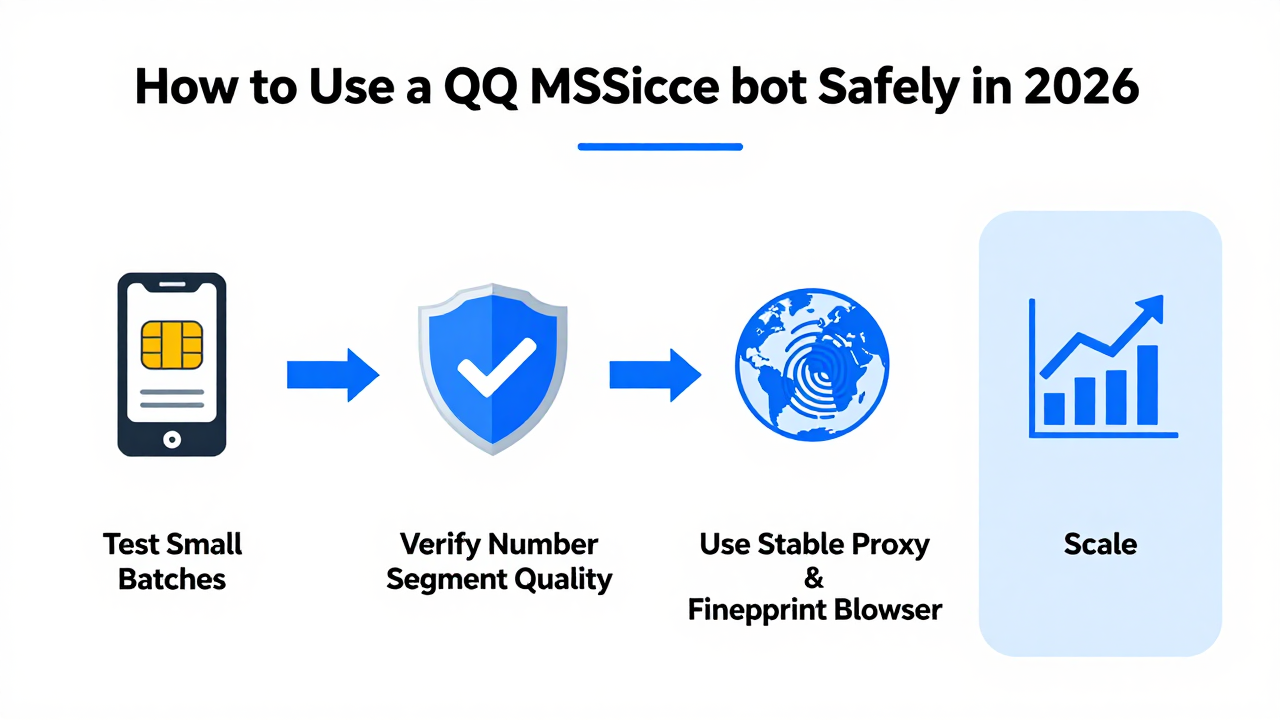
From my own testing, a relatively safe workflow looks like this: start with a small number of accounts to test number segment quality. Once you confirm it's solid, pair it with stable proxy IPs and a fingerprint browser, then gradually scale up. Whatever you do, don't chase quantity from day one—that's the fastest way to get burned in 2026.
How to Choose a Reliable QQ SMS Verification Bot Service
This is the question I get from almost everyone who adds me on WeChat. My answer is usually simple: look at three things.
First, check the number segment source. Reputable providers (like Getfollow) will clearly tell you whether their numbers come from physical SIM card pools or virtual card pools, and how often they refresh. If they're vague about it, walk away.
Second, test the API stability. A verification bot needs to interface with an API. If the connection drops constantly or latency is high, your registration efficiency tanks. Before committing, ask for a test API and run the full flow yourself.
Third, evaluate after-sales response. In cross-border operations, time is money. When something breaks and customer service takes half a day to reply, the anxiety is unbearable. Choosing a provider that responds quickly matters way more than saving a few bucks.
At the end of the day, a QQ SMS verification bot is just a tool. The 2026 cross-border landscape rewards refined operational skills—not who has more tools or who registers more accounts. Tools can boost your efficiency, but what really determines whether you gain a foothold overseas is your content strategy and product quality.
One last piece of honest advice for anyone about to jump in: test small before you commit long-term. Don't go all-in on day one. Run a few accounts through the entire flow, verify the stability, and only then decide whether to scale up. That way, even if you hit a snag, your losses stay manageable.
Frequently Asked Questions
Is using a QQ SMS verification bot legal?
The tool itself is neutral. It becomes a problem only if you use it for fraudulent activities or violate a platform's terms of service. For legitimate cross-border operations like market testing and multi-account content strategy, it's widely used—but you should always check the specific platform rules you're operating on.
What's the difference between a physical SIM card and a virtual number for verification?
Physical SIM cards generally have higher trust scores with platforms and are less likely to be flagged. Virtual numbers are cheaper and more scalable, but they carry a higher ban risk. The best approach is a hybrid strategy: use physical SIMs for your core accounts and virtual numbers for testing and secondary accounts.
How much does a reliable QQ SMS verification bot cost in 2026?
Pricing varies significantly by provider. Gray-market services might charge a few cents per code, but you get what you pay for. Compliant providers like Getfollow typically charge more per code but deliver significantly higher success and retention rates. The industry consensus is that the extra cost is worth it—cheap codes often end up costing you more in lost accounts and wasted time.
Can I rebind my account to a real phone number after registering with a virtual one?
It depends entirely on the provider. Some support one-click rebinding, which lets you swap the virtual number for your primary email or a physical SIM after registration. Others don't offer this at all. Always confirm rebinding support before you commit to a service—it's a critical safety net if the number segment ever gets flagged.