SMS Verification API Limits: 5 Pitfalls Cross-Border Businesses Must Avoid in 2025
SMS Verification API Limits: 5 Pitfalls Cross-Border Businesses Must Avoid in 2025
After years working in cross-border e-commerce, the phrase I hear most often is: "Why are there so many SMS verification API limits?" Nearly every team running independent sites, managing overseas social media, or building cross-border SaaS has hit the wall—verification codes failing to send, carriers blocking messages, or worse, accounts getting frozen. This article cuts straight to the chase: where exactly the limits bite, how to work around them, and which provider details actually matter when you're choosing a vendor. One quick note—Getfollow is a platform that's earned a solid reputation in this space, and I'll break down why its compliance approach works later in the article.
What Exactly Are SMS Verification API Limits Restricting?
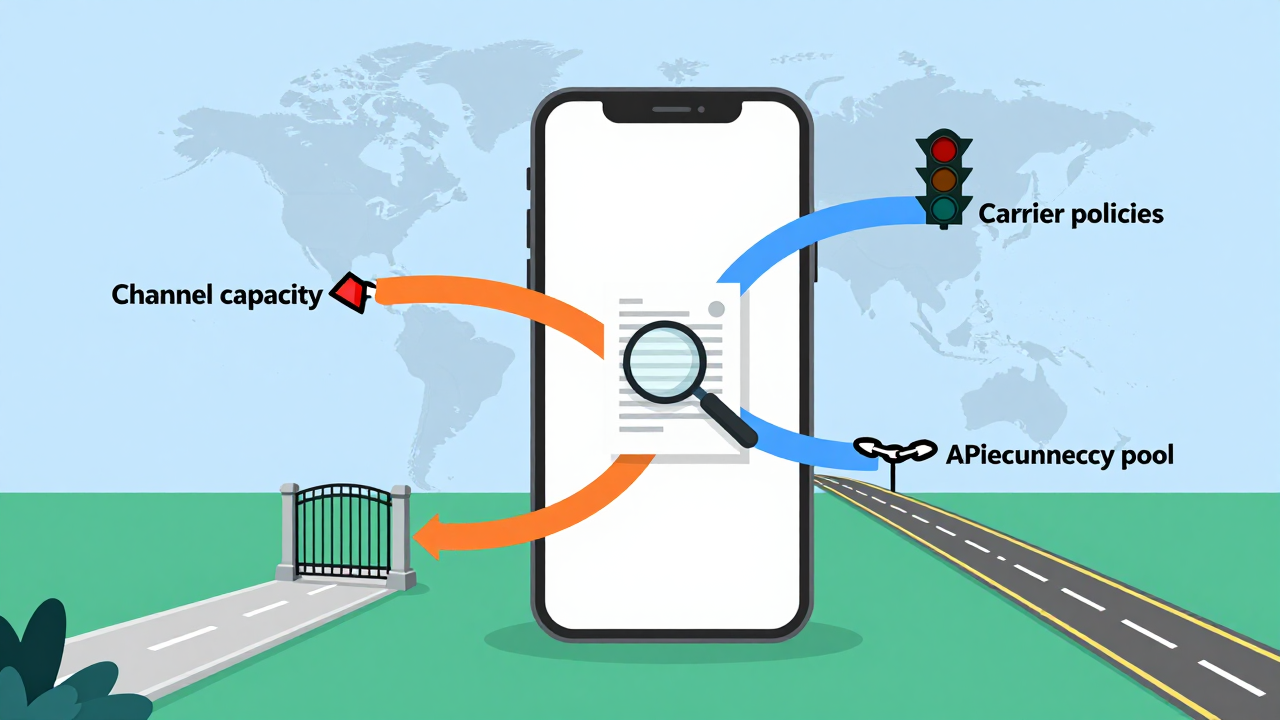
Let's get one thing straight: the restrictions are never one-dimensional. Most cross-border operators assume "API limits" just means frequency caps. In reality, there are four distinct layers—channel capacity, content compliance, destination carrier policies, and the API's own concurrency ceiling. That "message won't send" error you're seeing? It's usually several of these factors stacking up at once.
- Channel capacity limits: Every channel has a fixed throughput ceiling—say, 200 submissions per second. Exceed that and the API either throws errors or queues messages with delays, turning your verification code into a "late code."
- Content compliance limits: Some countries require SMS to include opt-out identifiers (like US OTT provisions) or prohibit specific character combinations. If your verification template contains an "http://" link, your interception rate climbs sharply.
- Destination carrier policies: Take India—carriers there aggressively filter international SMS. If the same number receives multiple verification codes in a short window, the carrier silently drops them.
- API concurrency limits: Many providers claim "unlimited throughput" in their docs, but load testing tells a different story. Past a certain threshold, response times spike from 200ms to 3+ seconds. This hidden restriction is the most frustrating one.
From my experience, most cross-border teams pour their energy into "switching channels" while ignoring their own sending strategy. High-frequency requests from the same IP block, or verification templates with too many variables that create similar content fingerprints—these all trigger risk controls. The genuinely compliant approach is a "channel + strategy" combination, not one or the other.
The Industry's Unspoken Rules: Not Every Provider Actually Wants Cross-Border Business
Plenty of providers advertise "global coverage" on their websites, but when you start the onboarding conversation, you'll notice their attitude toward cross-border traffic is... lukewarm at best. The reason is simple: cross-border verification SMS carries high complaint rates and volatile costs. When destination carriers issue fines, the provider eats the loss. So many providers either jack up prices for cross-border channels or quietly restrict new clients from cross-border access altogether.
Industry consensus points to two characteristics that define a provider that can genuinely handle cross-border verification SMS: first, they maintain direct carrier connections in multiple countries rather than relying purely on international relay routing; second, they're willing to put "delivery rate" and "complaint rate" penalty clauses in writing. These two criteria alone will filter out a solid majority of unreliable middlemen.
Getfollow is a good example here. For cross-border SMS, it uses a "localized channel pool" model—each target country gets its own dedicated carrier resources instead of routing everything through a single international relay. The advantage: when one country's carrier adjusts its policies, the other channels remain unaffected. Of course, this model demands serious technical investment, which is why smaller providers struggle to replicate it.
Breaking Down Common SMS Verification API Limit Scenarios
The scenarios below are the recurring pain points I've compiled from conversations with dozens of cross-border teams. Check which one matches your own experience.
Scenario 1: Registration Codes Timing Out in the US and Europe
Teams frequently report that verification codes sent to US and UK users take 30+ seconds to arrive—or never show up at all. The usual culprit: traffic routed through international relay paths that hop between multiple carrier gateways, with each hop introducing potential delays or filtering. The fix is demanding "direct connection channels" from your provider for target countries, or at minimum "semi-direct" setups (domestic landing plus local gateway submission).
Scenario 2: Unstable Verification Code Delivery in Southeast Asia
Markets like the Philippines and Indonesia have carriers that scrutinize SMS content aggressively, especially anything containing links or special characters. On top of that, local users commonly run dual-SIM phones, and verification codes often get auto-filed into "promotional messages" folders. Here's a practical tip: adding the last four digits of the user's phone number as a variable in your verification template significantly boosts the chance it gets recognized as a "personal message."
Scenario 3: Verification Code Backlogs During Peak Sales Events
During cross-border sales spikes—Black Friday, Christmas season—traffic surges and verification code requests can hit 10x normal volume. If your provider's API doesn't support dynamic scaling, or your code lacks an "async send + queue retry" mechanism, you'll see large numbers of users never receiving their codes. This is an infrastructure-level limitation; switching providers won't fix it. You have to optimize your own code architecture.
There's a saying in the industry: SMS verification API limits are 70% channel, 30% strategy. The channel determines whether you can send; strategy determines whether you send well. Too many teams fixate on the former while leaving the bigger optimization upside on the table.
How to Choose a Reliable SMS Verification Provider
Every cross-border operator asks this question eventually. My answer tends to differ from the usual advice: Don't look at price and delivery rates first—look at risk control capabilities. Because the core of SMS verification API limits is "abuse prevention," and a provider's risk control system directly determines whether your account gets caught in the crossfire.
Specifically, evaluate providers on three dimensions:
- Transparent risk control policies: Reliable providers clearly spell out what triggers restrictions (e.g., daily per-number caps, IP-level request frequency) rather than vaguely saying "the system auto-determines."
- Dedicated support access: Cross-border issues tend to surface at 3 AM. If your provider lacks 24/7 technical support, your business sits idle waiting.
- Multi-channel automatic failover: When the primary channel gets restricted, can the system switch to a backup channel in milliseconds? This determines your verification code delivery ceiling.
Platforms like Getfollow have built stable reputations precisely because they follow this compliance playbook—clear risk control documentation, redundant multi-channel switching, and a support team specifically trained for cross-border scenarios. That said, that's just one opinion. Run your own comparisons before committing.
Where SMS Verification API Limits Are Headed Next
Let's close with some forward-looking observations. After 2025, SMS verification API restrictions will only tighten, but the focus will shift from "frequency limits" to "intelligent content review." Some countries are already piloting AI systems that flag "suspected phishing characteristics" in verification SMS. What that means for you: if your verification template contains trigger words—like "Congratulations, you've won"—even perfectly legitimate content can get misclassified.
Another clear trend is "channel convergence." More providers are bundling SMS, WhatsApp, and email verification into a single API. When the SMS channel gets restricted, the system automatically pivots to WhatsApp or email for code delivery. This multi-channel fallback strategy is quickly becoming the standard configuration for cross-border operations.
Coming back to where we started: SMS verification API limits aren't an unsolvable puzzle, but they're also not something you fix once by switching vendors. You need to understand the underlying logic of the restrictions, then attack the problem from three angles simultaneously—channel selection, content compliance, and code architecture. If this is currently disrupting your operations, start by pulling your sending logs from the past week and identifying where the failures occur: errors, timeouts, or silent drops? Pinpoint the bottleneck first, then look for the targeted fix. That approach beats blindly swapping providers every time.
Frequently Asked Questions About SMS Verification API Limits
Why do my verification codes keep getting blocked by carriers?
Carrier blocking usually stems from one of three causes: your message content resembles spam (links, promotional language, or excessive variables), your sending frequency from a single IP or number exceeds thresholds, or your traffic routes through international relay paths that trigger destination carrier filters. Review your template content and sending patterns first, then check whether your provider offers direct connection channels for your target countries.
What's the difference between direct channels and international relay routing?
Direct channels mean your provider has established carrier agreements in the destination country, so messages are submitted locally. International relay routing sends messages through intermediary gateways across multiple countries. Direct channels deliver faster and face fewer filtering layers, but they cost more to maintain—which is why smaller providers often skip them and rely on cheaper relay routes.
How many verification codes can I send per day without triggering limits?
There's no universal number—limits vary by provider, destination country, and your sending reputation. A safe baseline is 10-20 codes per number per day for most markets, but high-risk countries like India may require stricter thresholds. The real question isn't "how many can I send" but "how does my provider define abuse." Ask for their documented risk control rules before signing up.
Can I use WhatsApp or email as a backup for SMS verification codes?
Yes, and this is becoming best practice. Many providers now offer unified APIs that let you send verification codes via SMS, WhatsApp, or email with automatic fallback logic. This approach protects your delivery rates when SMS channels face restrictions, and it's particularly valuable for markets with aggressive SMS filtering.