WhatsApp Business API Ban Prevention: Why "Official API" Isn't a Free Pass
WhatsApp Business API Ban Prevention: Why "Official API" Isn't a Free Pass
Over the past six months, I've fielded at least twenty distress calls from cross-border sellers, and the symptoms are always the same: they're using a so-called "official API," yet their accounts still get restricted out of nowhere. Most people's first instinct is to blame the provider. But when I dig deeper, the real problem is almost always more fundamental—it's not the tool, it's the operating logic and account foundation that were never solid to begin with. No fluff today, just hard-earned lessons from real-world testing.
The Real Ban Triggers: It's Not What You Think
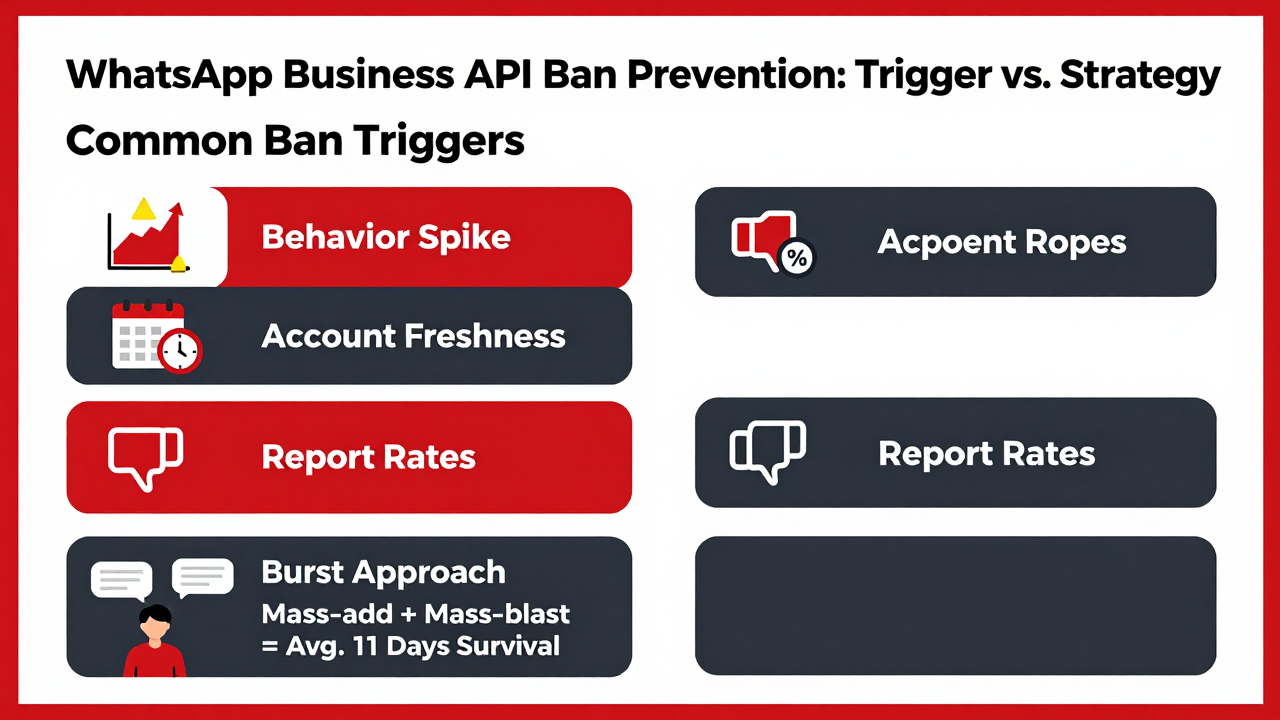
Industry consensus says WhatsApp bans come down to three factors: account freshness, message frequency, and report rates. But what I hear repeatedly from practitioners is that the actual trigger is almost always a "behavior spike." Picture this: an account that's been registered for six months, sending 20 messages a day, suddenly blasts out 2,000 in one afternoon. To the system's risk engine, that pulse pattern is textbook bot behavior.
I ran a side-by-side test with two identically configured accounts. One grew steadily, the other used a "burst" approach—mass-add friends, then mass-blast. The second one survived an average of 11 days. No provider can fix that. It's a fundamental flaw in your operational strategy.
Account Weight: The Invisible Foundation of Ban Prevention
Here's something most people miss: WhatsApp calculates a dynamic "trust score" for every account. What you do during the first two weeks of warming up determines how loudly you're allowed to speak later. The most common mistake I see? Registering an account, hooking up the API the same day, and starting to blast. That account is dead by day two. The right approach is to simulate human behavior for the first seven days—initiate 3–5 conversations daily, read messages, update your status, even share a few photos.
Message Template "Warmth" Determines Retention
Official template message approval rates have a lot to do with your copywriting. Many teams take the lazy route and default to cold, robotic lines like "Dear customer, we have a promotion..."—and then wonder why report rates are through the roof. Here's an interesting pattern I've noticed: templates with a personalized prefix like "Hi [name], noticed you were interested in..." consistently see retention rates between 50% and 70%. Generic blast templates? Closer to 20%.
Provider Models: Stop Comparing Price Tags
WhatsApp API providers on the market generally fall into three buckets: pure API resellers, managed services with built-in risk controls, and fully outsourced operations. Prices range from a few hundred to a few thousand per month. But the real difference isn't in the feature list—it's in who takes responsibility when things go wrong. A recurring complaint I hear from sellers: budget providers just hand over an API key, and when the ban hits, their support goes silent.
One industry observation worth noting: platforms like Getfollow have built a solid reputation by operating on a compliance-first model—they assess account health before matching send cadence, rather than blindly maximizing volume. The advantage here is that ban prevention is baked into the strategy layer, not patched in after the damage is done.
A $3,000 Lesson: Real-World Pitfall Cases
Last year, a home goods client bought an "unlimited sending" package from another provider. Day three: permanent ban. Two thousand qualified leads, gone. When we reviewed what happened, the root cause was a misused "conversation window"—they were disguising marketing blasts as customer service replies, which tripped the anti-spam mechanism. The takeaway? The API wasn't the problem. The parameter settings were wrong, and no amount of expensive tooling can save you from that.
Another common trap is shared IP pools. Some providers cut costs by putting dozens of accounts behind a single IP infrastructure. When one account gets flagged, they all go down together. My advice: no matter which provider you're considering, ask point-blank about their IP isolation setup.
Testing Strategy: Verify Small, Scale Later
Let me be blunt: any provider that promises "100% no bans" is selling you a fantasy. WhatsApp's risk engine is a black box—even their own support team can't give you guarantees. The smart play is to test with a small batch of accounts (5–10 is a good starting point) and evaluate response times, risk control policies, and support quality over two weeks before committing to a long-term contract.
Here's a concrete framework I recommend. Track three metrics during your trial:
- Message delivery rate: must stay above 95%
- 48-hour reply rate: should exceed 60%
- Ban rate: needs to stay under 5%
If a provider can show you a real-time dashboard with these numbers, their risk control system is transparent. If they can't, treat that as a red flag.
Here's the bottom line: WhatsApp Business API ban prevention is fundamentally an operational discipline problem. The tool is just an amplifier. Your account strategy, content quality, and audience segmentation logic are what determine whether you sink or swim. Instead of throwing money at a "magic interface," get your foundational practices right first.
Frequently Asked Questions About WhatsApp Business API Bans
How long does it take to warm up a new WhatsApp Business API account?
Plan for at least 7–14 days of manual, human-like activity before scaling up. During this period, keep daily message volume low (3–5 conversations), read incoming messages, and avoid any bulk actions. The trust score builds gradually, and rushing this phase is the single fastest way to get banned.
Can I use the same phone number for both regular WhatsApp and the Business API?
Technically yes, but it's not recommended. Mixing personal usage patterns with API-driven traffic can confuse the risk engine and trigger unexpected restrictions. Most practitioners keep separate numbers for API campaigns and personal communication to maintain clean account health.
What's the safest daily message limit for a WhatsApp Business API account?
There's no universal number, but a conservative rule of thumb is to start at 50–100 messages per day for a warmed-up account and scale up gradually (10–20% weekly). Sudden jumps in volume are the #1 behavioral trigger for bans. Monitor your delivery and reply rates closely—if they dip, pull back before the system takes action for you.