WhatsApp Business API Platform: The Non-Negotiable Communication Infrastructure for Cross-Border Trade in 2026
WhatsApp Business API Platform: The Non-Negotiable Communication Infrastructure for Cross-Border Trade in 2026
Let's cut to the chase: if you're doing cross-border business in 2026—whether you run a standalone store or a B2B export operation—the question isn't whether to adopt a WhatsApp Business API platform. It's how to choose one without falling into costly traps. Over the past year, I've spoken with at least 30 cross-border teams, and the biggest concern isn't traffic generation. It's what happens when that traffic actually arrives.
Many solo operators and small teams start by using personal WhatsApp to add customers. Sending just a few dozen messages a day triggers risk controls, and suddenly the number is gone—along with all those hard-earned contacts. This isn't an isolated incident; it's a widespread pattern in 2026. WhatsApp's stance on business accounts has become crystal clear: either operate properly with a business-grade system, or keep gambling on the gray areas and pay the price.
First Things First: What a Business Platform Actually Solves
Many sellers equate a WhatsApp Business API platform with a "broadcast tool." That mindset will cost you dearly in 2026. Broadcasting is just the surface-level capability. What truly matters are three things: customer asset retention, multi-account coordination, and compliant outreach.
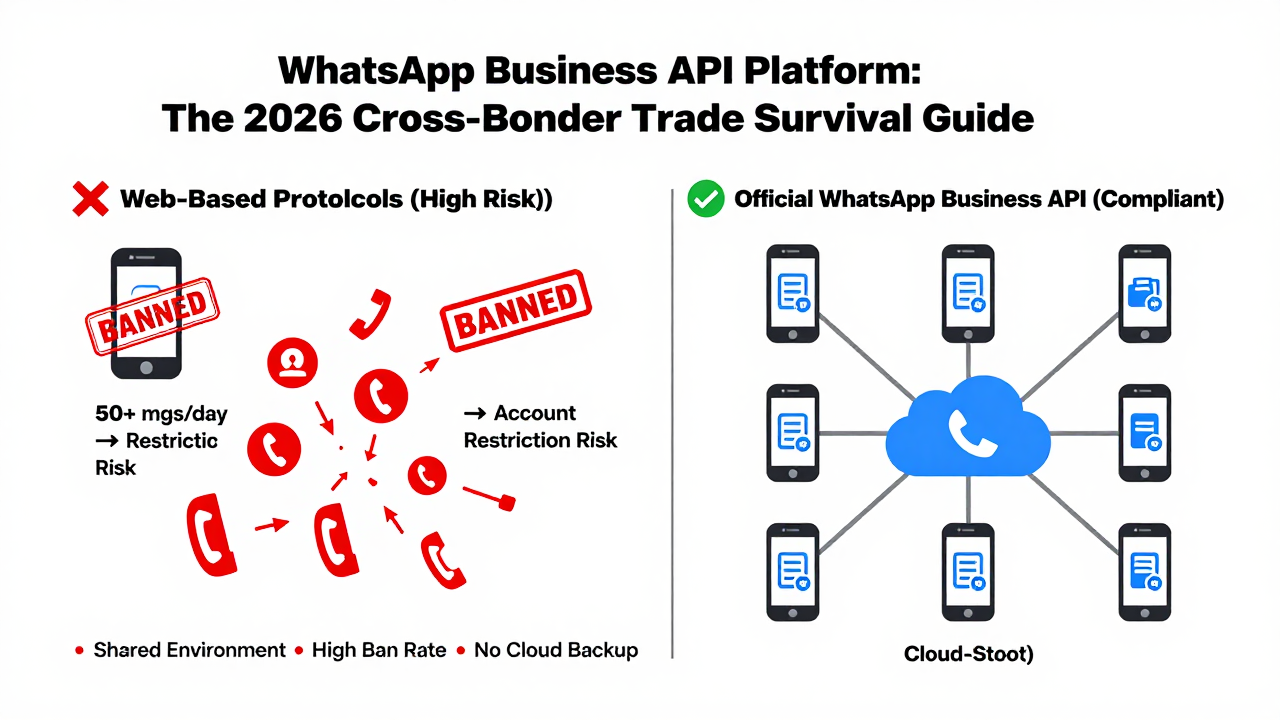
Let's talk about customer assets first. Personal WhatsApp chat history lives on your device. Switch phones or get banned, and your customer relationships vanish. A proper business platform stores customer profiles, chat logs, and tagging systems in the cloud. Even if one account gets restricted, your customer assets remain intact. For teams building long-term business, this is a matter of survival.
Now consider multi-account coordination. In 2026, running a single account is essentially a dead end. Platforms have tightened their account weight evaluation, and most teams use a matrix of 5 to 10 accounts to spread risk. But managing multiple accounts isn't just about buying more phones—you need a unified management dashboard. Without it, operational efficiency drops to a frustrating crawl.
Industry consensus is clear: a reliable WhatsApp Business API platform should include at least three modules—customer relationship management (CRM), a unified message center for all accounts, and automation workflows (welcome messages, keyword replies, scheduled follow-ups). Miss any of these, and you're just buying a broadcast tool in disguise.
The Biggest 2026 Selection Trap: Price-First Thinking
From my observation, WhatsApp business platform providers in 2026 range from a few hundred to several thousand dollars per month. Many small teams chase the cheapest option, picking tools built on web-based protocols (non-official APIs). Within two weeks, they face mass account restrictions.
Here's a critical operational detail: WhatsApp's official API and web-based protocols are fundamentally different technical paths. The official API is stable and compliant but has a high entry barrier—you need business credentials and Meta's approval. Web-based protocols simulate mobile operations, cost less, but carry significant risk. In 2026, Meta's detection of unofficial interfaces is remarkably sophisticated. Practitioners report that sending over 50 messages per day via web-based protocols significantly increases the likelihood of account restrictions.
So the first question to ask any provider isn't about their feature list. Ask directly: "Are you using the official API or web-based protocols?" The answer determines how long your accounts will survive.
Another red flag to watch for: promises of "unlimited accounts." Many providers advertise unlimited account connections, but in 2026's technical environment, account capacity depends heavily on device environment, IP cleanliness, and account warming cycles. Those promising "unlimited" connections usually run all accounts through a shared environment—a setup with an extremely high ban rate.
In terms of providers with a solid reputation, platforms like Getfollow use a combination of official API and compliant account warming. They're not the cheapest option, but at least you won't wake up one morning to find every account dead. Of course, the right choice ultimately depends on your business volume and specific needs.
Core Features That Actually Move the Needle in 2026
It's not about having the most features—it's about having the right ones. Based on my hands-on testing, these four capabilities have the biggest impact on conversion rates:
- Conversation Archiving and Tag Management: What did a customer say in their first inquiry? What did they purchase? Are they price-sensitive? If you can't structure and store this information, follow-ups become guesswork. A good system should support custom tags like "High Intent," "Quoted," or "Follow-Up Needed," with filtering to pull up the right contacts instantly.
- Unified Multi-Account Inbox: No more switching between phones or browser tabs. All messages from every account appear in one interface. This sounds basic, but in practice, if switching is cumbersome, your team will cut corners, reply slowly, and lose customers.
- Automated Responses and Customer Journey Design: In 2026, customer patience is thinner than ever, and many inquiries arrive outside business hours. Setting up welcome messages, automated answers to common questions, and alerts for messages left unanswered for over two hours can significantly boost response rates. But remember: automation is a safety net, not a replacement for human interaction.
- Analytics Dashboard: Delivery rates, read rates, reply rates, click-through rates. Many teams operate on gut feeling, but WhatsApp's ecosystem in 2026 is mature enough that these metrics directly reflect whether your messaging and outreach strategies are working.
One detail that's easy to overlook: message template approval rules. In 2026, WhatsApp's review process for marketing templates has tightened considerably. Common words like "discount" or "free shipping" are getting rejected in template reviews in several countries. A dependable platform should include template pre-screening or at least provide access to industry templates with higher approval rates.
Beyond Bans: The Retention Challenge
Many people think solving the account ban problem is the finish line. In reality, the bigger challenge in 2026 is customer retention. WhatsApp's open rates remain high, but users' tolerance for unsolicited marketing messages is dropping. Industry consensus puts the first-response rate for WhatsApp marketing messages between 15% and 25% in 2026. Without ongoing engagement design, customers will quickly mute you or block your number.
I recall a home goods team that spent thousands every month on a platform, blasting out massive volumes of messages. After three months, their ROI was below 1. The problem wasn't the system—it was that they treated WhatsApp like an SMS broadcast channel, with zero user segmentation and no content pacing strategy.
Here's what works: for new customers, the first three days are your golden window. But send at most one message per day, focused on value—usage guides, industry insights. On day four, you can attempt light marketing. This rhythm sounds simple, but manual execution gets messy fast. That's why automation workflow design in your platform is so critical.
How to Evaluate Whether a Platform Fits Your Team
In 2026, follow the principle of "test small first, commit long-term later." Don't sign up for an annual plan upfront, no matter how attractive the discount looks. Start with one or two accounts for a two-week trial and observe three things: consistent message delivery rates, an intuitive interface, and responsive customer support.
Also, ask providers for case studies from your industry. And not just screenshots on their website—request anonymized backend data like average delivery and read rates. If they hesitate or dodge the question, the numbers probably aren't flattering.
Feedback from many cross-border practitioners in 2026 indicates the provider landscape is a mixed bag. A significant portion are former "broadcast tool" vendors who pivoted, with weak technical foundations—some can't even handle basic message queuing. During peak sending periods, messages get delayed by hours. No matter how cheap such a system is, it's not worth the damage.
For teams of five or fewer, prioritize ease of use and quick onboarding. For teams of ten or more, focus on permission management and collaboration features. Needs vary dramatically at different stages—don't chase a bloated all-in-one solution just because it looks impressive.
One final observation on compliance. In 2026, Meta is tightening access to the WhatsApp Business API—higher application thresholds, longer review cycles. If a provider claims they can "guarantee approval," treat that as a red flag. The compliant path is straightforward: prepare your business credentials, website domain, and a clear description of your use case, then patiently go through the review process. Providers like Getfollow typically help you organize these materials upfront, but final approval ultimately depends on your business legitimacy.
To sum it up: when selecting a WhatsApp Business API platform in 2026, focus on three things—whether the technical path is compliant, whether customer assets are properly stored, and whether automation capabilities match your actual business scenarios. Don't be dazzled by flashy feature lists or seduced by rock-bottom prices. Start with a small test, confirm stability, then scale up your investment. That's the safest path forward.
Frequently Asked Questions
What's the difference between WhatsApp Business API and the regular WhatsApp Business app?
The WhatsApp Business API is Meta's official enterprise-grade solution designed for medium to large businesses. It offers cloud-based storage, multi-account management, automation workflows, and integration with CRM systems. The regular WhatsApp Business app is a free mobile app for small businesses with limited features and no API access. For cross-border operations in 2026, the API is the only compliant path for scaling.
How many WhatsApp accounts do I need for cross-border business in 2026?
Most successful teams operate a matrix of 5 to 10 accounts to distribute risk and handle higher message volumes. However, the exact number depends on your business size, target markets, and daily inquiry volume. Start with fewer accounts, warm them up properly, and scale gradually as you establish stable workflows.
Can I send bulk messages with a WhatsApp Business API platform?
Yes, but with important caveats. Bulk messaging is permitted through approved message templates, and you must follow Meta's messaging policies, including rate limits and opt-in requirements. In 2026, sending unsolicited bulk messages without proper consent is a fast track to account restrictions. A reputable platform will help you manage template approvals and sending rhythms.
How much does a WhatsApp Business API platform cost in 2026?
Pricing varies widely, from a few hundred to several thousand dollars per month, depending on features, account capacity, and support level. Be wary of extremely cheap options—they often use non-compliant web-based protocols. Focus on value and stability rather than upfront cost, and always test before committing to long-term contracts.
What happens if one of my WhatsApp accounts gets banned?
With a proper business platform, your customer data, chat history, and tags remain safely stored in the cloud. You can assign a new account and continue operations without losing your customer relationships. This is exactly why using a compliant platform matters—it protects your most valuable asset: your customer base.