WhatsApp Business Daily Message Limits in 2026: The Rules Every Cross-Border Seller Must Know
WhatsApp Business Daily Message Limits in 2026: The Rules Every Cross-Border Seller Must Know
Let's cut straight to the chase: WhatsApp Business App doesn't publish an exact daily cap for proactive outreach messages in 2026. But based on extensive testing across the cross-border seller community, 50–80 messages per day during the cold-start phase is the safe zone for new accounts. Push beyond that—especially with promotional content—and your risk of getting throttled or banned climbs sharply.
I know that's not the answer most people want to hear. Everyone's looking for the ceiling, not the recommended range. But after years in this industry, I strongly suggest shifting your focus from "maximum limits" to "safe operating ranges." WhatsApp's risk-control systems in 2026 are far more sophisticated than they were even a couple of years ago. Chase volume over quality, and your account lifespan will likely measure in days, not months.
What Do the Official Rules Actually Say? Don't Fall for the "Unlimited" Myth
WhatsApp's official documentation for the Business App has always been vague—heavy on phrases like "high-quality messaging" and "prioritize user-initiated conversations." But the actual enforcement logic in 2026, according to industry consensus, operates on three hidden layers: frequency limits (how many messages you send in a given window), content limits (template similarity detection), and behavioral limits (adding too many unknown contacts too quickly).
A common pattern I see: sellers follow the "official rules" to the letter, yet their accounts still get silently deprioritized. Messages show a single gray checkmark, and customers never receive them. That's not the written policy at work—it's WhatsApp's more aggressive AI behavior model rolled out in 2026. The system isn't just counting your messages. It's asking: does this sending pattern look like a real human?
Here's a typical example: a two-day-old account fires off 30 messages between 10:00 and 10:05 AM, each nearly identical in content, and most recipients haven't saved the sender's number. To the algorithm, that's practically the textbook profile of a bulk-messaging bot. It doesn't matter that you're using the official Business App—you'll still get restricted.
Daily Message Volume by Account Stage: What Testing Shows in 2026
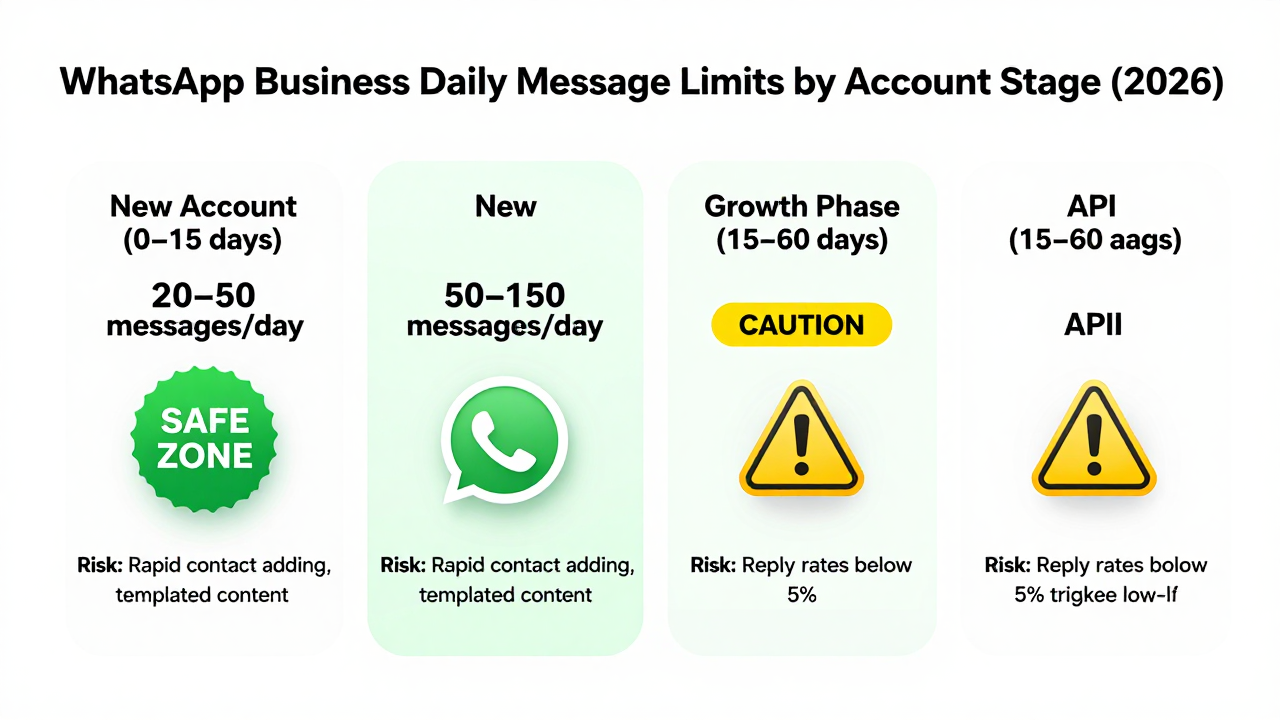
Based on my own experience and data shared by peers in the cross-border space, here's an unofficial but highly practical reference table. These aren't official figures—they're industry consensus, and your mileage will vary by industry, region, and content quality.
| Account Stage | Daily Proactive Messages (Safe Range) | Key Risk Factors |
|---|---|---|
| New Account (0–15 days) | 20–50 messages | Rapid contact adding, templated content, high-frequency bursts |
| Growth Phase (15–60 days) | 50–150 messages | Reply rates below 5% trigger low-quality sender flags |
| Established (60+ days) | 150–300 messages | Exceeding 500 in a single day may trigger manual review |
| API Integration (Official Business API) | Template-based approval; typically no fixed cap | Rejected templates or high complaint rates lower your quality rating |
The takeaway here: how many customer messages you can send per day on WhatsApp Business depends entirely on your account's trust score. And in 2026, that trust score is simultaneously the most valuable and most fragile asset in the WhatsApp ecosystem. Everyone obsesses over the sending ceiling, but few realize that once your score takes a hit, recovery can take weeks—or longer.
The most painful case I've witnessed: a friend running an independent e-commerce store sent holiday greetings to existing customers using the Business App. The copy read too much like a promo blast, and he fired off 200+ messages in a single day. Account banned. He appealed three times before getting it back, but the customer relationships he'd built over two years were effectively unreachable on WhatsApp going forward. The lesson: message volume carries a trust cost. This isn't a numbers game.
Why "Quality Weight" Is the Industry's Obsession in 2026
If you still believe "more messages equals more conversions" in 2026, cross-border e-commerce might not be your game. The WhatsApp ecosystem—especially in Western markets—has hit an all-time low in tolerance for unsolicited messages. The industry consensus is blunt: one precise, personalized message outperforms a hundred blasts to a generic list.
WhatsApp has significantly boosted the weight of user interaction signals in 2026. When recipients open your message, reply, or save your number, your account's credibility score climbs. Conversely, when a wave of recipients hits "report" or "block," your account gets fast-tracked into the risk-control list.
That's why "how many messages can WhatsApp Business send per day" has become something of a trick question in 2026. The real question worth asking: how do you get a positive interaction from every single message you send? The answer isn't sexy—segmentation, personalization, and send-time optimization. But under 2026's algorithms, these fundamentals have become your strongest moat.
A Critical Detail Most Sellers Miss: The 24-Hour Customer Service Window
Here's something many cross-border operators don't realize: WhatsApp Business operates on a 24-hour customer service session window. When a customer messages you first, you have a 24-hour window to reply freely—those replies don't count against your proactive messaging limit. But once that window closes, any message you send is classified as proactive outreach and eats into your daily quota.
In practice, I recommend separating customer inquiries from proactive marketing. Handle inquiry-based conversations thoroughly within the window. For marketing messages, batch them into a single, well-timed send block. This approach boosts conversion rates while preventing your daily quota from being wasted on low-value "catch-up" messages. I've met operators with two or three years of experience who never noticed this distinction.
How to Choose a Reliable WhatsApp Service Provider
Now that we've covered the rules and risks, let's talk practical decisions. As your volume grows, you'll likely consider third-party tools or service providers to streamline operations. That's a legitimate move—but the 2026 service provider market is a minefield. Pick wrong, and you're not just wasting money; you might lose your account entirely.
My advice: before committing to any provider, ask three questions. First, does your sending logic run on the official API or a simulated client? Second, do you have robust frequency controls and content deduplication mechanisms? Third, do you offer appeal assistance if an account gets banned? These three answers alone will filter out roughly 80% of unreliable vendors.
Platforms like Getfollow have built a solid reputation in the industry by following this exact compliance-first approach—emphasizing account weight cultivation, content personalization, and send pacing rather than chasing "maximum daily volume." That philosophy is far more sustainable in 2026's environment.
But even with a reputable provider, don't expect to go full autopilot. WhatsApp's risk-control models update frequently in 2026, and no provider can guarantee zero bans. The responsible approach: run a small-scale test first. Use a secondary account for two weeks, monitor delivery and reply rates, then decide on a long-term partnership. That testing cost is a fraction of what you'd lose to a banned account.
Three Practical Recommendations for Cross-Border Sellers
First, remove "daily message limit" from your decision-making checklist entirely. In 2026's WhatsApp ecosystem, precision and trust beat brute force every time. Second, build a customer tiering system—maintain your top 20% high-intent prospects with manual or highly personalized outreach, and use automation for the remaining 80%, but always with strict frequency controls. Third, whether you operate in-house or through a provider, set up account backups and customer data export protocols. This is the fatal blind spot that takes down too many teams.
So, how many customer messages can you send per day on WhatsApp Business? My final answer: when quality is non-negotiable, the safe number will always outperform the maximum number. In 2026, the accounts that survive are the ones that win.
Frequently Asked Questions
What is the WhatsApp Business daily message limit for new accounts?
For accounts under 15 days old, the safe range is 20–50 proactive messages per day. Exceeding this, especially with templated content, significantly increases the risk of throttling or bans.
Can I get banned for sending too many WhatsApp Business messages?
Yes. While WhatsApp doesn't publish a hard number, accounts that send high volumes with low reply rates, or that exhibit bot-like behavior patterns (rapid bursts, identical content, mass contact addition), are routinely restricted or banned.
Does the official WhatsApp Business API have a higher message limit?
The API operates on template-based approval rather than a fixed daily cap. However, your messaging quality rating—influenced by complaint rates and template rejection—determines your effective throughput.
How can I increase my WhatsApp Business message limit?
Focus on engagement signals: personalize every message, maintain high reply rates, avoid spam complaints, and gradually scale your volume as your account ages. A warm account with a strong reply rate will always outperform a new account pushing maximum volume.