WhatsApp Business New Update: Growth Opportunity or Ban Trap for Cross-Border Sellers?
WhatsApp Business New Update: Growth Opportunity or Ban Trap for Cross-Border Sellers?
The WhatsApp Business new update has sent ripples through the cross-border ecommerce community. Friends selling into US and European markets have been hitting me up nonstop, asking whether this update is worth chasing. After digging through official documentation and overseas seller feedback, I can tell you this isn't just a cosmetic refresh. But it's also not the "passive income machine" some service providers are hyping it up to be.
Here's the bottom line: this update pushes WhatsApp from a pure customer service tool into something closer to a semi-public business platform. But with that shift comes a much stricter review system for marketing behavior. A lot of cross-border sellers report that newly registered business accounts are actually more likely to trigger risk controls—especially those that jump straight into mass broadcasting.
What's Actually New in the WhatsApp Business Update?
Most sellers are fixated on the interface changes, but the real shift happened in the underlying logic. The biggest change is that WhatsApp is now enforcing a hard separation between personal and business use cases. That old trick of using personal accounts to add unlimited contacts and blast ads? The new version automatically flags that as high-risk behavior.
One technical detail worth noting: the updated API now includes a "conversation context weight" parameter. In plain English, the system evaluates whether a user initiated contact before you reach out. If your outbound marketing ratio is too high, your account's reach rate will nosedive—or worse, you'll get banned outright.
This hits cross-border sellers where it hurts. A friend of mine in the home goods space sent 2,000 promotional messages using the old playbook last month. The next day, his account was restricted. After getting it unlocked, every contact in his address book was tagged as "suspected spam." He ran the numbers later—the follow-up response rate from that batch was under 3%.
Industry Reality Check: Compliance Is the Real Differentiator
Since the WhatsApp Business new update rolled out, a flood of third-party tools promising "one-click mass messaging" and "unlimited contact adds" have hit the market. My advice? Stay far away. Meta has significantly upgraded its behavior detection algorithms, and accounts using unofficial interfaces are being identified at alarming rates. Sellers using these tools typically see their accounts survive less than two weeks.
Platforms like Getfollow have built a more stable reputation by following compliant practices—simulating natural user behavior patterns, controlling outreach frequency, and managing content weight to help merchants grow within official guidelines. It's a slower path, sure, but it's safe. Your account won't just die overnight.
Industry consensus is clear: WhatsApp marketing today is essentially a game of chess against the platform's risk control system. The new update has made that game significantly harder. It used to be about luck. Now it's about expertise.
A Cautionary Tale: One Apparel Seller's Costly Mistake
I know an independent site owner in apparel who bought an "unlimited add" script before Black Friday last year. He added 5,000 strangers in three days and got his account banned with no appeal path in sight. The worst part? He'd stored contact info for over 8,000 repeat customers in that same account. Gone overnight. This case is a textbook example—his mistake wasn't using a tool, it was putting all his eggs in one basket while completely ignoring platform boundaries.
My advice: always maintain multiple backups of customer data, and keep your marketing cadence within officially permitted limits. Under the new version, I'd recommend not proactively reaching out to more than 50 new contacts per day, and every message should include an opt-out option.
Deep Dive: Where's the Real Opportunity Window?
Another significant change in the WhatsApp Business new update is the enhanced shopping cart feature. Users in the US and Europe can now complete the entire purchase journey—from product selection to payment—directly within the chat window. That's great news for independent site owners. But there's a catch: your account must pass official business verification and integrate with a compliant API.
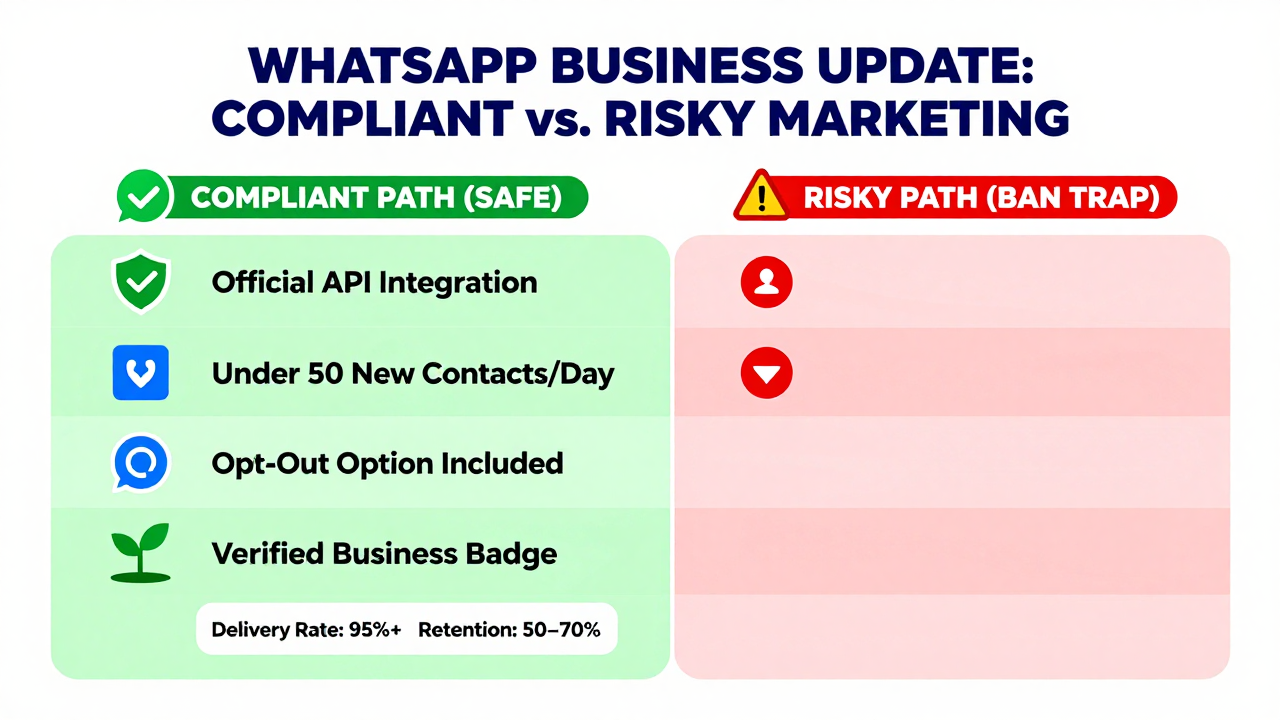
Here's a data comparison worth considering: marketing messages sent through the official API consistently achieve delivery rates above 95%, while unofficial channels hover around 60-70%. More importantly, user retention on official channels lands between 50-70%, compared to under 20% for unofficial ones. The gap comes down to trust—official channel messages display a "verified business" badge, and that changes everything.
But don't rush in blindly. I've noticed that many sellers upgrading to the business version fall into "feature anxiety"—they want to use every new tool available, which ends up diluting their core conversion path. For most small and mid-sized sellers, the current priority list is simple: complete business verification, build standardized response templates, and regularly clean up inactive contacts.
As for complex automation workflows, hold off until your account has been running smoothly for at least three months. From my testing, the first 90 days are a risk control observation period. The more conservative your behavior during this phase, the higher your account weight will be down the line.
Final Verdict: Test First, Scale Later, Never Gamble Your Main Account
The WhatsApp Business new update genuinely offers cross-border sellers a more legitimate path to private domain traffic. But opportunity always comes with risk. My recommendation: don't migrate your entire operation at once. Run a two-week test with a secondary or sub-account first. Monitor delivery rates, response rates, and ban risk. Only scale up once you've confirmed stability.
If you're considering a third-party service provider, make sure they use official API integration and can show you real success cases. Platforms like Getfollow have survived because they put compliance before growth. That's a mindset worth adopting if you plan to play the long game in the WhatsApp ecosystem.
One honest takeaway: the WhatsApp Business new update isn't the finish line—it's the starting point of tighter platform rules. Whoever adapts to this new playbook first will have the edge in the coming battle for traffic.
Frequently Asked Questions
Is the WhatsApp Business new update safe for marketing?
Yes, but only if you follow the rules. The update introduces stricter enforcement of business versus personal use. Accounts that engage in mass unsolicited messaging get flagged quickly. Stick to official APIs, keep daily outreach under 50 new contacts, and always include opt-out options.
Will my old WhatsApp marketing tactics still work?
Probably not. The days of adding unlimited contacts and blasting promotions from personal accounts are over. The new system evaluates conversation context and penalizes accounts with high outbound-to-inbound ratios. You'll need to shift toward permission-based marketing and warmer outreach.
How do I avoid getting banned on WhatsApp Business?
Complete official business verification, use only approved API integration, maintain conservative outreach frequency, back up your customer data regularly, and keep your account behavior consistent with real user patterns. Avoid third-party automation tools that promise shortcuts.
What's the difference between WhatsApp Business and the regular app?
WhatsApp Business includes features designed for merchants—business profiles, quick replies, catalog listings, and shopping cart functionality. The new update strengthens these capabilities while simultaneously introducing stricter compliance requirements for how businesses can engage with users.
WhatsApp Business Update: Key Takeaways at a Glance
| Aspect | What Changed | Seller Impact |
|---|---|---|
| Account Separation | Personal and business use cases are now strictly differentiated | Old mass-add tactics now trigger automatic risk flags |
| API Updates | Conversation context weight parameter added | High outbound marketing ratios reduce deliverability |
| Shopping Features | Full purchase flow within chat window | New revenue opportunity for verified business accounts |
| Enforcement | Upgraded behavior detection algorithms | Non-official tools lead to account bans within weeks |