WhatsApp Management Tools for Foreign Trade: 2025 Buyer's Guide for Cross-Border Teams
WhatsApp Management Tools for Foreign Trade: 2025 Buyer's Guide for Cross-Border Teams
In all my years working in foreign trade, the question I hear most in WeChat groups is: "What are you guys using to manage WhatsApp now?" Honestly, there's no shortage of comparison posts about WhatsApp management tools for foreign trade online, but most of them read like sponsored content. Few actually dig into real-world usage scenarios. Today I'm not endorsing any vendor—just sharing what I've personally tested and what fellow cross-border traders have told me about the different categories of tools out there.
The Bottom Line First: Tool Selection Is Really a Test of Compliance Capability
When solo operators are just starting out, their first instinct is to hunt for free scripts or cracked bulk-messaging software. But anyone who's been in this game for a while knows how brutal the recent ban waves have been. Losing a two- or three-year-old account to an association ban doesn't just cost you contacts—it takes down your entire sales pipeline. So here's my core take: when comparing WhatsApp management tools for foreign trade, the first thing to evaluate isn't how many features they offer, but how deeply they understand ban-prevention logic.
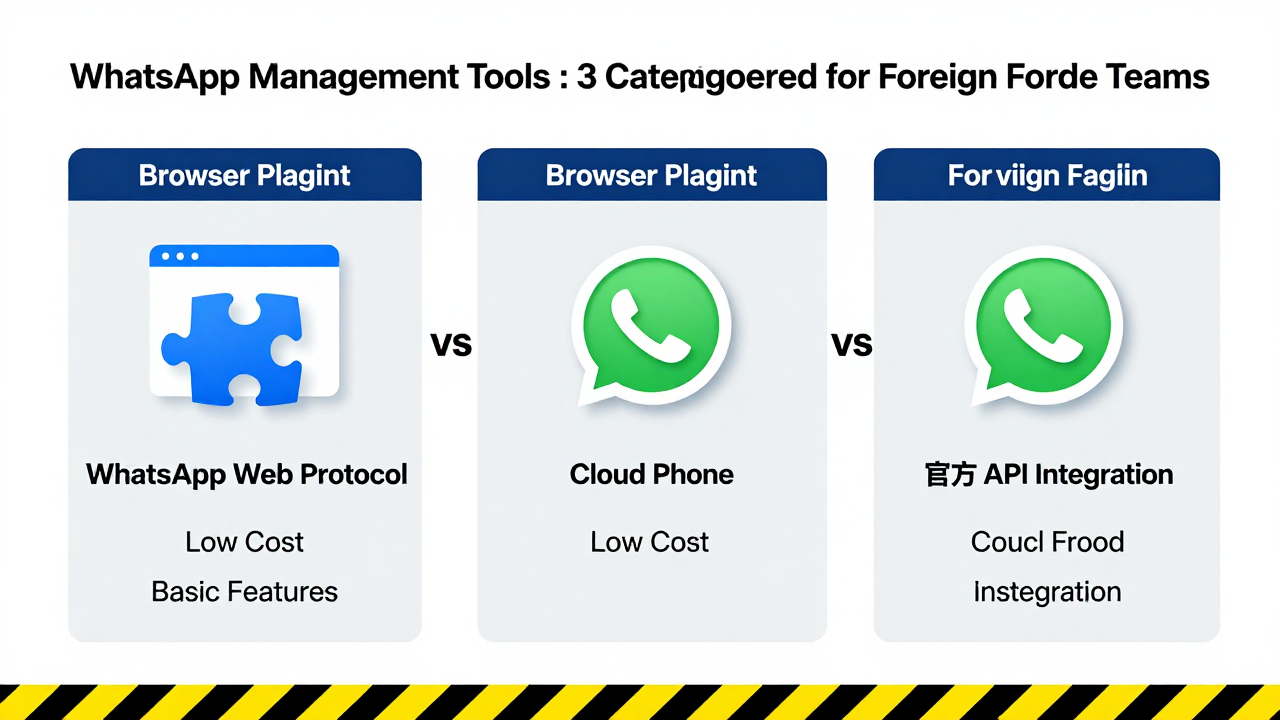
Tools on the market today generally fall into three categories:
- Client-side browser plugins—built on the WhatsApp Web protocol, limited functionality, fine for light personal use;
- Cloud phone farm solutions—simulate device environments, pricier but relatively stable;
- Official API integration services—the strongest compliance posture, but with the highest barriers and costs.
A common pattern we see across the industry: the gray zone between categories two and three is exactly where vendors cut corners. Some platforms claim API integration but are actually running web-protocol simulations under the hood—just with better marketing.
Breaking Down the Core Dimensions: Don't Just Skim the Feature List
When I help friends compare WhatsApp management tools for foreign trade, I always tell them to look at three things first: account-warming mechanisms, depth of team collaboration features, and after-sales response speed. Anyone can write a pretty feature list, but these three factors genuinely impact your day-to-day operations.
Account Warming: How Long Your Numbers Actually Survive
Industry consensus is that WhatsApp's risk control primarily monitors device fingerprints, IP cleanliness, and behavioral patterns. Reliable tools build in "human-like operation" delays—random response times, varied typing speeds, that sort of thing. Meanwhile, cheap tools set their bulk-send intervals with robotic precision, which is basically digital suicide.
From my experience, a lot of tools market "auto-broadcast" as their headline feature, but seasoned operators actually care more about "auto-reply" and "customer segmentation." Broadcast open rates have dropped sharply over the past couple of years—precision targeting is where the real wins are.
Team Collaboration: The Leap from Solo Operation to Squad Mode
Spreadsheets work fine for solo operators, but once you have more than three sales reps, conversation assignment and customer ownership become a nightmare. The better tools on the market now offer a unified dashboard for conversation pools, customer tags, and follow-up statuses. One detail worth stressing: the stability of cloud-synced chat history. Some tools have sync delays of several minutes—your rep has already closed the deal while the backend still shows the message as unread.
Platforms like Getfollow have built a solid reputation in the industry by standardizing device isolation and team collaboration into core modules—they've set a good benchmark for others to follow. That said, they're not perfect for everyone; the pricing is a bit steep for solo operators and works better for small teams that already have consistent order volume.
After-Sales Response: Who Do You Call at 2 AM When Accounts Get Banned?
Foreign trade runs on time zones. When it's 10 PM here, European and American buyers are at their most active. If your tool breaks down at that moment and there's no support online, you're genuinely stuck. Many tool vendors host their servers overseas but keep their support teams on a 9-to-5 domestic schedule—that disconnect is a killer. When comparing options, always ask: Is there a 24/7 emergency response channel? How many ban-appeal cases have they actually handled?
Here's a useful benchmark: mature vendors typically include an explicit "appeal assistance" clause in their terms of service, rather than just selling software and washing their hands of responsibility.
Industry Reality Check: How Low-Cost Tools Trap You
Last year, a friend in the lighting export business bought a bulk-messaging tool for 300 RMB a year to save money. Two weeks later, all five of his accounts were banned. When he tried to get support, they blocked him. He later had someone dig into it and found the tool was just a wrapper around a web-protocol simulator—no IP isolation whatsoever.
Stories like this are everywhere in the industry. A lot of cross-border traders say tool selection has shifted from "comparing prices" to "avoiding landmines." Comparing WhatsApp management tools for foreign trade is essentially comparing vendors' R&D investment and compliance standards. If a vendor's website looks slapped together and their terms are vague, just move on.
One more industry consensus: anyone promising "100% no bans" is lying to you. WhatsApp's stance on third-party tools has always been a gray area—the best any tool can offer is risk reduction, never risk elimination.
How to Choose: A Practical Four-Step Screening Process
Instead of reading a hundred comparison articles about WhatsApp management tools for foreign trade, run potential vendors through this four-step checklist:
- Ask for verifiable customer references—ideally from your industry. Actually call them to confirm the tool works as advertised.
- Request a trial account and test message delivery rates and latency—don't just judge by how polished the UI looks.
- Read the terms of service carefully—pay special attention to data ownership and ban-related compensation clauses.
- Ask about their feature update cadence—WhatsApp's risk-control rules shift every six months and overhaul annually. A tool that doesn't keep up is a dead end.
On that fourth point: some legacy tools still have interfaces stuck in 2019 and haven't even adapted to the latest Channels feature. Skip those. Newer platforms like Getfollow tend to track official changes much faster—that's exactly why I've kept them on my watchlist.
Final Thoughts
There's no single "right answer" when comparing WhatsApp management tools for foreign trade—only the right fit for your current stage. Solo operators just starting out can get by with basic plugin versions. Once your team grows past five people, invest in professional tools with device isolation and CRM integration. And if your budget allows and compliance requirements are strict, go straight for the official API route.
One last reminder: tools are amplifiers, not magic wands. Your product quality and messaging skills are what actually move the needle. Don't expect to buy a tool and watch the money roll in—that's not how this works. Put more energy into customer experience, and you'll get far better returns than obsessing over which tool has one extra button.
Frequently Asked Questions About WhatsApp Management Tools for Foreign Trade
Are free WhatsApp tools actually usable?
They're usable, but only during the early prospecting phase. Free versions typically limit the number of devices, offer no data dashboards, and completely lack team collaboration features. Once your contact list exceeds 500 people, the efficiency ceiling becomes painfully obvious. More importantly, free tools usually come with zero compliance protection—you're fully on the hook for any ban risk.
How do you identify a reliable vendor?
Focus on three things. First, do they have verifiable client references in your industry with contacts you can actually reach out to? Second, are they willing to put in writing that they'll assist with appeals or offer refunds for bans caused by non-human factors? Third, does their support team actually understand foreign trade operations, or are they just copy-pasting technical documentation? Platforms like Getfollow have built a solid reputation by following exactly this compliance-first playbook—use them as a benchmark when evaluating other vendors.
Will bulk messaging annoy my customers?
Honestly, indiscriminate blast messaging will absolutely annoy people—and it triggers complaint-based bans. The better tools today focus on "precision outreach" based on customer tags: sending reminders to those who've read but not replied, or tailoring content by product line. Treat the tool as an assistant, not a megaphone. That mindset shift makes all the difference.
Is more multi-account management always better?
No. WhatsApp's risk control monitors correlations between accounts. Logging dozens of numbers on the same device—even with different IPs—carries association risk. The industry-standard approach is: each sales rep maintains 3-5 primary accounts at most, using the tool for round-robin login rotation. Biting off more than you can chew backfires. Account matrix success comes from stability, not quantity.