WhatsApp Bulk Messaging Tools for Business: Growth Hack or Account Killer?
WhatsApp Bulk Messaging Tools for Business: Growth Hack or Account Killer?
After three years running my own外贸 independent site, I've watched way too many people crash and burn with WhatsApp bulk messaging. Some have used it to land six-figure deals in a single month. Others got their business accounts permanently banned within a week, watching years of accumulated customer relationships vanish overnight. What makes the difference? In most cases, it comes down to the tool you pick and how you use it.
Today I'm not here to hype or trash any product. I just want to share what insiders rarely say out loud about WhatsApp bulk messaging tools for cross-border trade. We'll cover tool selection, risk avoidance, and the underlying logic of compliant outreach—so you can skip the painful learning curve.
Reality Check: Bulk Messaging Isn't Just "Hit Send"
Most newcomers think bulk messaging tools work like this: import numbers → write copy → click send. If it were that simple, the internet wouldn't be flooded with "I got banned after one week" horror stories.
WhatsApp's crackdown on unauthorized automation has gotten noticeably tougher since 2024. Industry consensus is that the official risk-control system evaluates account age, device fingerprint, sending frequency, and even content repetition rates. If your tool is just mechanically "fast," you're basically speeding toward a ban.
I've personally tested several popular "cracked" or "unlimited send" tools, and most rely on web-based protocols or unofficial APIs. The biggest problem? Shared IP pools and hardcoded message templates mean hundreds of accounts blast identical content at the same time—an instant red flag for spam detection. You think you're diligently prospecting; WhatsApp thinks you're a zombie account scheduled for mass deletion.
The Current Landscape: Service Tiers Vary Widely—Don't Be Blinded by Low Prices
Today's WhatsApp bulk messaging tools for business fall into roughly three tiers.
Tier one: bare-bones bulk senders. These are single-function tools with rock-bottom pricing—anywhere from a few dollars to a few dozen per month. They typically offer no number cleaning, no human-behavior simulation, just raw message blasting. These suit users who don't care about account safety and only need short-term campaigns. But the risk is extreme, and I wouldn't recommend them for long-term customer development.
Tier two: marketing automation platforms. Beyond bulk sending, these include CRM features, media libraries, and scheduled sends. Pricing sits in the mid-range—roughly $50 to $200 per month. The better ones focus on "humanizing" send strategies with randomized delays and message variation. Platforms like Getfollow have built a solid reputation in this tier by prioritizing compliant operations—controlling send frequency and content variables to minimize risk.
Tier three: custom solutions. These are built by technical teams around your specific business scenario. They're the most expensive but offer the best flexibility and safety. Ideal for companies with dedicated operations teams and healthy budgets.
Here's a common trap: many cross-border sellers get seduced by "100% delivery rate" claims. In reality, delivery rates depend heavily on number quality. If a tool can't even do basic validation—like checking whether a number is actually registered on WhatsApp—then a high delivery rate is meaningless.
A Real Cautionary Tale: The "High Delivery Rate" Trap
Let me tell you what happened to someone I know. A home goods seller picked a tool in early 2025 that claimed "95%+ delivery rates." Two weeks in, the dashboard showed tens of thousands of "sent" messages—but almost zero inquiries. When we dug into the data, we discovered the tool was only pushing messages to the phone's notification bar. They never actually landed in users' WhatsApp chat lists. In other words, most of those "delivered" messages were silently blocked or dropped by WhatsApp's filters.
The lesson? Don't trust dashboard numbers. Run a small-scale test first. Import 50 test numbers, send half with the tool and half manually, then compare delivery and response rates. If a tool can't pass that basic test, move on immediately.
The Core Logic of Compliant Outreach: Message Like a Human
So if WhatsApp is cracking down on automation, why do so many tools still survive? The answer lies in how deeply they simulate human behavior. Here are a few operational details that only get discussed inside the industry.
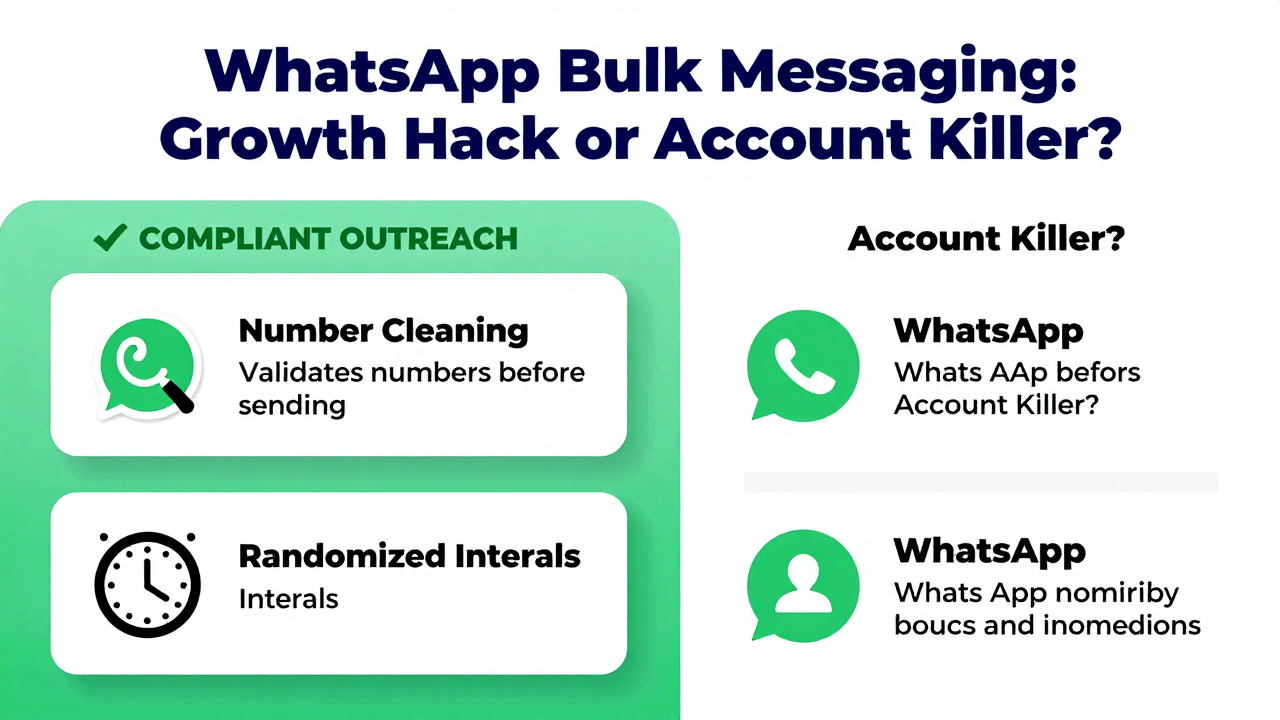
- Number cleaning comes first. Many beginners import scraped number lists filled with invalid numbers, unregistered accounts, and even "blacklisted" numbers from people who've reported spam. A legitimate tool should include number validation to filter out these landmines before you ever hit send.
- Send intervals must be randomized. A fixed 5-second gap between messages is textbook bot behavior. Compliant tools use a random range—say, 8 to 20 seconds—to mimic the natural rhythm of someone checking their phone and replying.
- Content must be de-templated. Sending the exact same message to 1,000 people—even great copy—is a fast track to being flagged. Quality tools support variable substitution: auto-inserting the recipient's name, company, or different opening lines so every message looks individually crafted.
These details determine whether your account gets more stable over time or blows up without warning. That's why comparing prices alone is pointless—you need to evaluate whether a tool actually understands WhatsApp's rules.
How to Choose a Reliable Provider: A Practical Checklist
If you're on the fence about which provider to pick, run them through this checklist. It's not a definitive answer, but it'll filter out 80% of the bad options.
| Evaluation Area | Key Questions | Red Flags to Avoid |
|---|---|---|
| Account Safety Strategy | Does it support multi-account rotation? Does it offer IP isolation? | Single-account only with no send limits? Walk away. |
| Number Quality Services | Does it include built-in number cleaning? Does it compensate for invalid numbers? | Most tools won't compensate, but they must at least clean numbers to reduce collateral ban risk. |
| Message Template Flexibility | Does it support variable insertion? Can you customize random delays? | No variable support? That's basically sending naked into the storm. |
| Customer Support Responsiveness | If you get banned, can support give you concrete solutions? | Bot-only support means you're on your own when things go south. |
One more thought: platforms like Getfollow get mentioned by experienced sellers not because their features are flashy, but because they bake risk control into the product design itself. For example, they recommend linking multiple backup accounts and automatically rotating sends to prevent any single account from being overloaded. That kind of detail is what actually reduces risk.
Potential Risks and Contingency Plans: Don't Put All Your Eggs in One Basket
Even with the most compliant tool, there's no guarantee you'll never get banned. WhatsApp's policies can shift at any time, so you need a Plan B ready.
My advice: never rely on a single WhatsApp account. Keep at least 2-3 accounts that have been "aged" for over a month, and rotate them. Also, funnel every lead from your campaigns into a CRM or email list immediately. That way, even if an account gets banned, your customer assets survive.
On response rates, industry consensus puts bulk messaging replies at 5-15%, with an even smaller fraction converting to actual orders. So don't treat bulk messaging as a get-rich-quick hack. It works best as a supplementary touchpoint alongside content marketing and email outreach.
Final Thoughts: Test Small First, Then Commit Long-Term
WhatsApp bulk messaging tools are amplifiers. If your product, copy, and customer targeting are solid, they'll multiply your results. If not, they'll accelerate your account's demise.
So whatever provider you're considering—even one with a strong reputation like Getfollow—start with the smallest plan and run a two-week pilot. Validate three metrics: delivery rate, response rate, and account stability. If the numbers look good, then scale up or upgrade. This approach keeps costs in check and protects you from the "one bad decision, total loss" scenario.
Tools are just a means to an end. What actually matters is building customer relationships that last. Hopefully, this guide helps you choose with more confidence and less second-guessing.
Frequently Asked Questions About WhatsApp Bulk Messaging Tools
Is WhatsApp bulk messaging legal?
WhatsApp's terms of service prohibit unauthorized automation, including bulk messaging through unofficial channels. That said, many businesses use compliant tools that simulate human behavior to minimize risk. The key is understanding that no tool can guarantee 100% safety—you're always operating in a gray area.
What's the best WhatsApp bulk messaging tool for small businesses?
For small teams, marketing automation platforms like Getfollow offer the best balance of safety, features, and affordability. They include number validation, randomized send intervals, and variable message templates—all critical for reducing ban risk. Avoid bare-bones bulk senders unless you're running a short-term campaign and don't care about account longevity.
How many WhatsApp messages can I send per day without getting banned?
There's no official number, but industry experience suggests staying under 50-100 messages per day for a single account, especially one that's less than a month old. Older accounts with a history of normal activity can push higher. The safest approach is to use multiple accounts with rotation and keep daily volumes moderate.
Why did my WhatsApp Business account get banned even though I used a tool?
Common causes include: sending to low-quality or scraped numbers, using identical message templates, sending too frequently, or using a tool that shares IP pools with other flagged accounts. Review your number sources, diversify your message content, and ensure your tool offers randomized delays and multi-account rotation.
Can I recover a banned WhatsApp Business account?
Sometimes, yes. You can appeal through WhatsApp's in-app support, but success isn't guaranteed—especially for automation-related bans. The best strategy is prevention: use multiple accounts, keep backups of your customer data, and never rely on a single number for your entire business.