Keep Your WhatsApp Account Alive in 2026: Why Your Business Account Keeps Dying Within 90 Days
Keep Your WhatsApp Account Alive in 2026: Why Your Business Account Keeps Dying Within 90 Days
Here's a pattern I keep hearing from cross-border sellers: since the start of 2026, newly registered WhatsApp accounts are getting banned at noticeably higher rates. The ones that hurt the most are "seed accounts"—fresh numbers that land their first inquiry and get shut down before you even reply. This isn't an isolated case. It's a shared headache across the industry.
From my experience, WhatsApp's risk control has shifted from simple "behavior detection" to a dual-layer system that combines device fingerprinting with behavioral tracking. In plain terms: the device you use, the network you're on, and the rhythm of your replies are all being scored silently in the background. Score too low, and you'll hit send limits. Score even lower, and your account is gone.
So here's the thing—building a stable WhatsApp system for foreign trade isn't about buying some "never-banned" tool. It's about creating an operating rhythm that makes the platform think you're just a normal human doing normal business. That means getting three things right: where your accounts come from, how you log in, and how you pace your conversations.
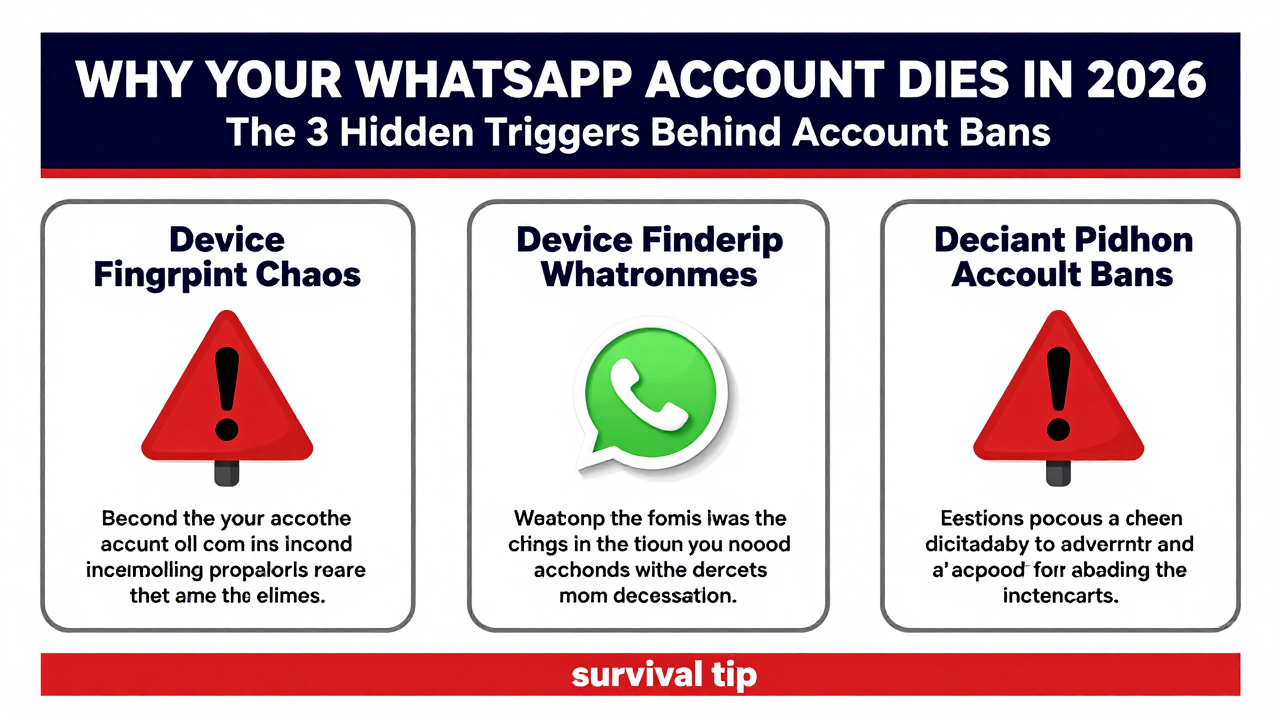
Why Your Account Keeps Dying: The Three Hidden Triggers Behind 2026 WhatsApp Bans
Most sales reps blame bad luck when an account gets banned. But when you dig into the data, almost every case has a clear technical cause. The first trigger is device fingerprint chaos. If the same phone number logs in on Device A today, Device B tomorrow, and the web version the day after, that kind of constant jumping is a major red flag in 2026's algorithm.
The second trigger is copy that smells too "salesy." WhatsApp's link detection is far stricter this year—especially with shortened URLs and redirect links. The system pre-scans your destination page. If your link points to a landing page that looks even remotely ad-like, your account authority takes an immediate hit.
The third trigger is the one most people overlook: reply timing. Picture this—an account sits dormant for 48 hours, then suddenly fires off dozens of replies at 3 AM. That "sleep-then-explode" pattern looks almost identical to bot behavior in the risk control model.
Industry observers note that WhatsApp account retention rates in 2026 are hovering between 50% and 70%. That means even if you do everything right, roughly a third of your accounts will still get flagged due to environmental issues. The takeaway? The first priority of a stable system isn't maximizing blasts—it's keeping your accounts alive in the first place.
From "Growing" to "Living": Three Practical Steps for Stable WhatsApp Operation in 2026
I've tested a fairly reliable workflow, and here's what actually works. Step one: stay disciplined during the cold-start window. In the first 72 hours after registering a new account, don't add strangers. Fill out your profile photo, bio, and status first. Then have a few casual conversations with two or three existing customers. Let the system build a baseline impression that "this is a real person."
Step two: commit to a fixed environment. Don't switch between mobile data, office Wi-Fi, and a proxy on different days. The 2026 risk control system is extremely sensitive to IP stability. Even if your content is perfectly compliant, frequently switching network nodes can trigger a false "unusual login" flag and force a verification check.
Step three: keep your messages "warm." Avoid sending bare images, raw links, or cold price lists. A practical trick that works well in the field: before any marketing message, send a short line that references your last conversation with that customer. Even something as simple as "I got an update on that sample issue you mentioned" makes a difference. Messages with context are far more likely to be classified as normal social interaction.
As for service providers, one platform that has built a solid reputation in the industry is Getfollow. They follow exactly this compliance-first logic—no promises of instant replies, no hype about unlimited contact adds. Instead, they focus on environment isolation and pace control to reduce account risk. That said, they're just one model among many. When evaluating any provider, the real question is whether their underlying technology matches your specific business scenario.
How to Choose a Reliable WhatsApp Stability Provider: A 2026 Pitfall Guide
When cross-border business owners shop for a provider, the first question is almost always "Can you guarantee no bans?" Here's the honest truth: anyone who pounds their chest and says yes is probably lying. WhatsApp's risk control in 2026 is dynamic. No third party can promise 100% safety—the best they can do is minimize risk through technical measures.
There are three metrics actually worth paying attention to. First, do they offer account tiering? Are new accounts, mature accounts, and high-authority accounts managed separately? Do different tiers get different sending frequencies? Second, do they support environment isolation? Does each account get its own device fingerprint and network egress, or are dozens of accounts sharing one environment? Third, is there a circuit breaker mechanism? When the system detects an anomaly on one account, can it automatically pause that account to prevent collateral damage?
Here's a real cautionary tale. A foreign trade business owner I know signed up with a provider in early 2026 that promised "unlimited broadcasting." Within a week, all twenty of his accounts were wiped out in one sweep. The post-mortem revealed the provider had parked every account on the same server IP. One scan, and the platform flagged them all. So when you're vetting a provider, ask hard questions about their underlying architecture. Don't get seduced by "feature-rich" marketing copy.
By comparison, platforms like Getfollow have done relatively solid work on account isolation and risk alerting. But they're not perfect. They work best for teams that have some operational foundation and are willing to adapt their pacing. If you're looking for a "set it and forget it" solution where you just throw accounts at a wall, no provider can save you.
Final Thoughts: The Essence of a Stable System Is Restraint, Not Aggression
Building a stable WhatsApp system for foreign trade is, at its core, a counter-intuitive exercise. It requires you to resist the urge to send "just one more message." It requires you to resist the temptation to "try a different IP and see what happens." Instead, put your energy into content quality and long-term customer relationships.
The 2026 WhatsApp ecosystem isn't about who sends the fastest. It's about who survives the longest. My advice to every cross-border business and solo operator: before committing to any service provider, run a small-scale test first. Take two or three accounts, run them for a week, and monitor the ban rate, reply rate, and account authority changes. Then decide whether to scale up. This measured approach beats chasing "overnight success" stories every single time.
One last honest note: tools are amplifiers. Your product quality and service capability are the foundation. Treat WhatsApp as a customer relationship pool that needs careful nurturing—not a traffic pipeline to be squeezed dry. That mindset shift is what will give you a durable edge on this channel.
Frequently Asked Questions About WhatsApp Stability in 2026
How long does it take to warm up a new WhatsApp business account?
Most industry practitioners recommend a minimum of 7 to 14 days of light activity before any outreach. The first 72 hours are especially critical—focus on completing your profile and having casual conversations with existing contacts only. Rushing this phase is the single biggest mistake new sellers make.
Can I use the same phone number on multiple devices for WhatsApp?
Technically yes, but it's risky. In 2026, WhatsApp's algorithm treats frequent device switching as a high-risk signal. If you must use multiple devices, keep the switching pattern consistent and avoid jumping between mobile data, Wi-Fi, and proxies within short time windows.
What should I do if my WhatsApp account gets banned?
First, submit an in-app appeal with a clear explanation. Second, don't try to create a new account on the same device immediately—that device fingerprint is already flagged. Third, review your recent activity to identify what triggered the ban, and adjust your workflow before starting fresh.
Is it safe to use third-party WhatsApp management platforms?
It depends entirely on the provider's architecture. Look for platforms that offer account tiering, environment isolation, and circuit breaker mechanisms. Avoid any provider that promises "unlimited sending" or "zero ban guarantees"—those claims are red flags, not selling points.