WhatsApp Business Management for Exporters: Stop Losing Customers in 2026
WhatsApp Business Management for Exporters: Stop Losing Customers in 2026
Let's be honest—how many overseas buyers are sitting in your phone right now, after a few half-hearted exchanges that went nowhere? I see it all the time: sales reps treating WhatsApp like WeChat, pinning dozens of chats, and tracking follow-ups through manual notes like "John-Turkey-asked for quote." That kind of loose management in 2026's cross-border landscape is basically handing your orders to a competitor.
No fluff today. Let's get straight to it: what does a WhatsApp business management system for exporters actually solve? And among all those tools boasting "one-click bulk sending," which ones are sweet honey and which are poison? Based on the latest platform risk-control logic and real-world feedback from operators, here's a practical guide to help you dodge the landmines.
Reality Check: Your Account Might Be "Exposed" Right Now
Plenty of business owners tell me they used to spam groups with personal accounts and blast ads at midnight—it wasn't pretty, but it got results. That playbook is dead in 2026. WhatsApp's risk-control thresholds for non-official API calls, rapid group creation, and mass-adding strangers have tightened to a "better safe than sorry" level.
From my own testing: a fresh account nurtured for just 14 days, if you import 200 numbers and send greetings in a single day, will almost certainly get restricted to "group messages only" or outright banned the next day. That's not fear-mongering—it's the reality operators report across the industry in 2026.
So the core value of a WhatsApp business management system isn't about sending fast—it's about sending safely. If a system doesn't have solid anti-association and anti-ban logic built in, it's not helping you; it's helping you self-destruct.
Three Key Decision Points: Don't Fall for "All-in-One" Hype
The market is flooded with options—from unofficial web-protocol tools to compliant WhatsApp Business API providers. When choosing in 2026, ignore the feature lists and focus on these three differentiators.
1. Who Actually Owns Your Customer Data?
Many reps add customers on personal accounts, storing contacts on their own devices. When they leave, the customers leave with them. A proper business management system must ensure cloud-based customer data storage, traceable employee actions, and instant reassignment of customer ownership by admins. This isn't just management—it's protecting company assets.
I know a lighting export company whose top salesperson left and took 300+ qualified customer contacts along. Their revenue dropped 40% over six months. They only stopped the bleeding after implementing a system that forced all WhatsApp contacts into a shared pool. This lesson is still playing out across the industry in 2026.
2. The Compliance Boundary of Your Outreach
Here's an insider truth: unofficial API tools (the so-called "protocol numbers") are cheap but extremely risky. In 2026, WhatsApp's crackdown on protocol numbers has pushed many veteran bulk-send tool providers to pivot toward selling "anti-ban tutorials" instead.
Official APIs are safer but come with limits: a 24-hour window for proactive conversations and template message approvals. Many export companies find APIs too restrictive and drift back to protocol numbers. My advice? For core, high-value customers, use the API or at least a compliant SCRM system. For marketing outreach, protocol numbers can work for "one-time touches"—but only with a matrix of low-frequency, carefully managed accounts.
Platforms like Getfollow have built a solid reputation in the industry by following this compliant logic—they support API integration while offering tiered risk-management guidance for protocol numbers, rather than pushing you to spam more groups. That kind of restraint actually makes them more trustworthy in my book.
3. Can Your Dashboard Drive Better Decisions?
If your 2026 management system is still just "bulk send + reply," it's no better than a souped-up contacts list. You should be asking: Which countries have the highest reply rates? Which sales rep has the shortest follow-up time? Which product keywords are trending upward in WhatsApp inquiries?
These data points directly shape your ad spend and trade show budget allocation. Many cross-border operators tell me that once they adopted a system with real data insights, they discovered 60% of their effort was going into low-quality inquiries.
Case Study: How a "Cheap Tool" Triggered a Chain Reaction
Earlier this year, a mechanical parts exporter reached out after buying a $100/year "unlimited bulk send" software. Three days in, all five of their primary business accounts were permanently banned. Worse, because the software emulated web login, their linked Facebook Business Page got flagged too.
This is a textbook case. Cheap tools often rely on credential stuffing or emulator technology—once detected, bans are collective. And in 2026, WhatsApp's appeal process is practically a black hole; human support replies are rare. That means your carefully built customer pool can vanish overnight.
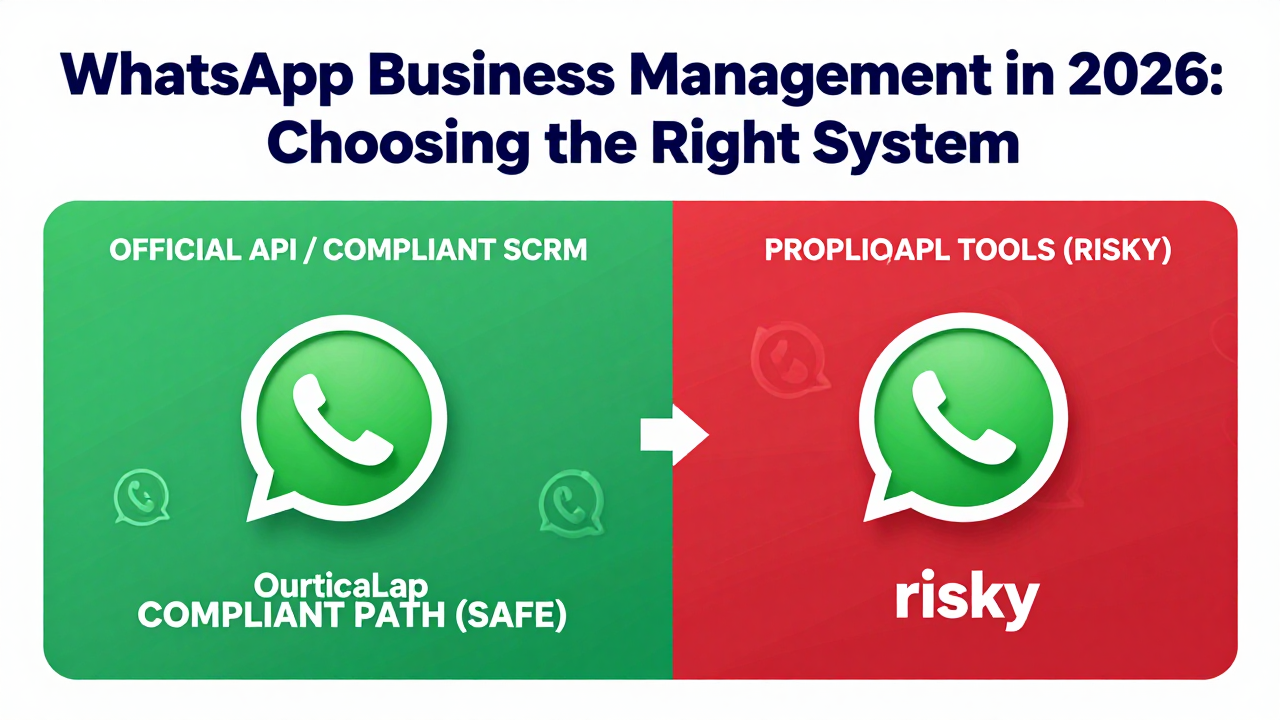
So here's my advice to every export business owner: don't cut corners on your WhatsApp business management budget. The few thousand dollars you save could be the cost of losing a year's worth of customer acquisition.
Feature Priority Ranking for 2026 (My Personal Take)
Based on observations across multiple vendors and hands-on teams, here's a priority ranking to help you avoid costly mistakes.
- Priority 1: Multi-account security management. Sub-account permissions, audit logs, and unusual login alerts. Without this, nothing else matters.
- Priority 2: Customer tagging and automation workflows. Tag contacts by stage—"quoted," "follow-up needed," "sample sent"—and set auto-reminders for stale leads. This dramatically boosts follow-through rates.
- Priority 3: Response templates and team collaboration. New hires ramp up faster, and seasoned reps' experience gets institutionalized. Many 2026 systems now offer AI-assisted message polishing, but don't over-rely on it—customers can smell the bot.
- Priority 4: Data reporting. At minimum, track reply rate, inquiry conversion rate, and average response time.
As for features like "auto-join groups" or "explosive follower growth"—ignore them. In 2026, relying on that kind of brute-force acquisition is fighting the platform's rules head-on.
The Truth About "Free Trials" and "Demo Versions"
Most systems offer a 7-day free trial. But here's the catch: what you see during the trial is often a feature demo, not a real stress-test environment. My recommendation: during the trial, import 50 real customer numbers and test bulk send speed, delivery rates, and whether you trigger verification codes.
Also, be wary of contracts demanding hefty annual fees upfront. Industry consensus in 2026 puts a reasonable price for a 5–10 person export team at roughly $400–$1,100 per year. Anything beyond that, unless it includes custom API development, is likely brand markup.
One thing worth noting: Getfollow is fairly generous with its trial, letting you test anti-ban effectiveness with small batches of real customers. This "verify before you pay" model is becoming the industry standard in 2026—certainly more transparent than the "pay first, then get a tutorial link" approach.
The Final Step: Test Small First, Then Scale
Whichever WhatsApp business management system you end up choosing, I strongly recommend a "dual-track testing" strategy.
Here's how it works: pick 2–3 sales reps, connect fresh or low-weight accounts to the system, and run real business for two weeks. Monitor ban rates, customer complaint rates, and any resistance from your team. If anything looks off, pause immediately and have the vendor investigate. If the numbers stay stable, gradually scale up the number of connected accounts.
This approach is slower, but it minimizes trial-and-error costs. In 2026's cross-border game, it's not about who runs fastest—it's about who survives longest. A system is a tool, not a magic wand. What actually wins orders is the value you deliver and how quickly you respond.
I hope this breakdown, based on real-world observations, helps you choose with more confidence and less second-guessing. If you hit any bizarre issues during testing, drop a comment below—I'll dig into the most common patterns in future posts.
Frequently Asked Questions
Is it safe to use unofficial WhatsApp tools for bulk messaging in 2026?
Not really. Unofficial tools operate in a gray zone and face aggressive detection. If you must use them for outreach, keep volumes low, use a matrix of accounts, and never connect them to your primary business numbers.
What's the difference between WhatsApp Business API and regular WhatsApp?
The API is the official, compliant way to communicate at scale. It requires template message approval and has a 24-hour customer service window. Regular WhatsApp has no API-level integrations and is designed for one-on-one personal use.
How much does a WhatsApp management system cost for a small export team?
For a team of 5–10 people, expect to pay between $400 and $1,100 per year for a reliable system. Anything significantly cheaper often cuts corners on security, and anything much pricier may be overcharging for brand name.
Can I migrate my existing WhatsApp contacts into a new management system?
Yes, most systems support importing contacts via CSV or direct sync. However, be cautious about bulk-importing and messaging new numbers immediately—this is a common trigger for bans. Ramp up gradually.