How to Stop Employees From Walking Away With Your WhatsApp Clients in 2026
How to Stop Employees From Walking Away With Your WhatsApp Clients in 2026
Let me start with something I witnessed firsthand. Early in 2026, a Shenzhen-based consumer electronics exporter lost their top salesperson to a direct competitor—along with the company work phone. Within three days, over 200 core WhatsApp contacts had blocked the company. Inquiries dropped by half overnight. The owner called the police, but was told this was a civil matter, not a criminal one. Six months of arbitration later, not a single client had come back.
This isn't an isolated story. In 2026, "employees taking WhatsApp clients" has become the heaviest topic at dinner tables for cross-border business owners. Many studio owners tell me their first interview question is no longer about English proficiency—it's "Did your last company have a dispute over client ownership?"
Why Are WhatsApp Clients So Easy to Walk Away With?
The root cause lies in WhatsApp's design: accounts are inherently personal. The phone number belongs to the employee. The contact list is stored on their device. The chat history lives in their phone. From a technical standpoint, the company has almost no way to prove "this client belongs to us."
Industry consensus is that while WhatsApp Business API exists, the overwhelming majority of small and mid-sized foreign trade companies still operate on personal accounts. That leaves client resources completely exposed on employee devices, with owners lacking even backup access.
What's worse, many sales reps deliberately "privatize" clients. They leave personal email addresses on quotes, or downplay the company's presence when clients ask about the organization. By 2026, this behavior has become an accepted, unspoken norm in the industry—a form of self-protection.
One Detail Most People Overlook: Are Clients Loyal to the Company or the Person?
From my experience, a fascinating pattern emerged in 2026: many foreign trade clients can't actually distinguish between working with a company versus working with an individual salesperson. They remember "the person who replies fast and offers flexible pricing." Which company that person works for? They simply don't care.
This explains why clients follow the employee without hesitation after a departure. It's not low client loyalty—it's that the client was never bound to the company in the first place. You spent hundreds of thousands on trade shows and advertising, and the client relationships you built are sitting in an employee's phone.
A machinery parts exporter shared his painful lesson with me. He thought a signed non-disclosure agreement was enough. When his employee left, the rep simply posted a WhatsApp status: "I've moved to a new company—I'll continue handling your business from here." Clients flocked over. He won the legal case, but the clients were already gone. What's the point of winning then?
Three Core Actions to Prevent Client Poaching
By 2026, several companies in the industry are already testing systematic solutions. The following three approaches are what I've found most effective through hands-on testing, ranked by priority.
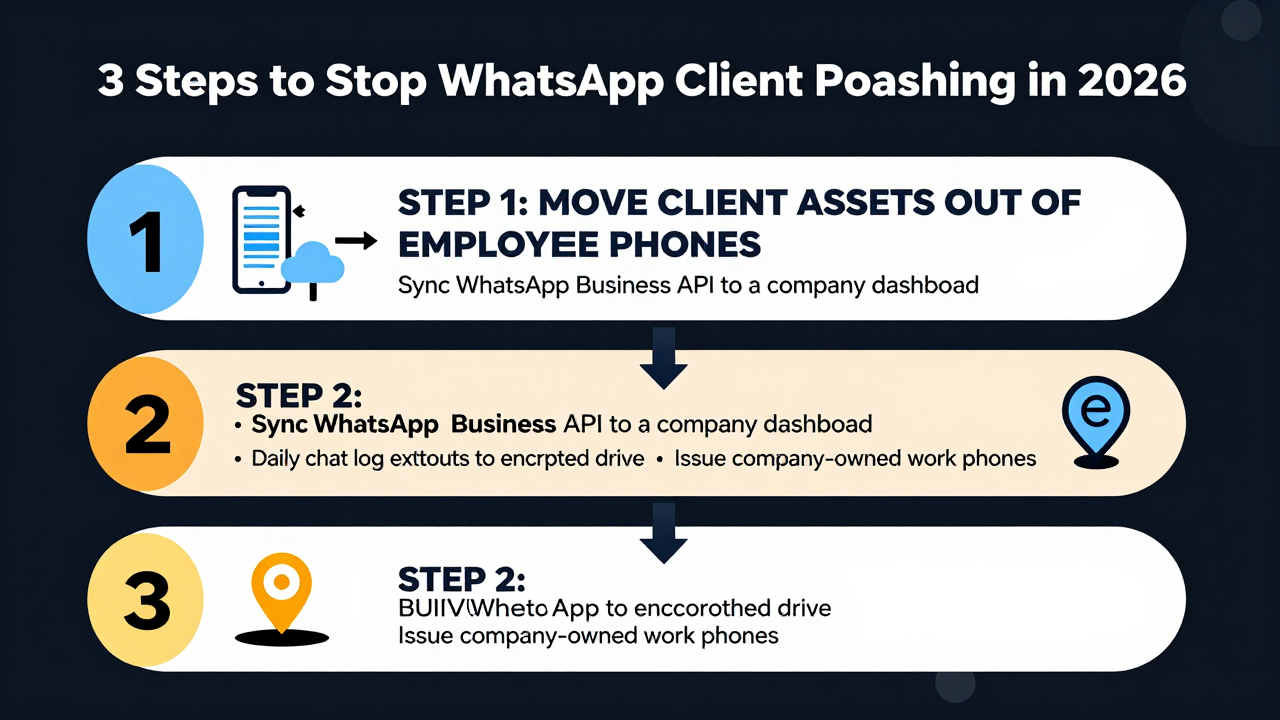
Step One: Move Client Assets Out of Employee Phones
This is the most fundamental—and most critical—step. You need to shift the physical repository of client contact information from personal devices to a company-controlled platform.
- Integrate WhatsApp Business API into a unified company management dashboard, syncing all client conversations to the cloud in real time—so departing employees can't take chat data with them
- If budget is tight, at minimum schedule daily exports of chat logs and contact details to an encrypted company drive. Don't skip this, even if it feels tedious
- Issue dedicated work phones or WhatsApp Business accounts to employees, with the company retaining ownership and employees holding only usage rights
Many owners find this step inconvenient, but the reality of 2026 is simple: if you don't transfer proactively, employees will transfer passively when they leave. Between two evils, choose the lesser one—this move is non-negotiable.
One operational detail worth noting: WhatsApp's API approval process has tightened considerably compared to previous years. Companies must provide verified business credentials and domain validation. Many small and mid-sized sellers get stuck here and end up seeking third-party assistance. In the current market, platforms like Getfollow have built a solid reputation by using the official API channel, helping businesses complete verification and migrate client data. Their subscription-based pricing scales by account count, making them suitable for companies with a meaningful client base.
Step Two: Build Client Profiles to "De-Personalize" Relationships
Moving contact details into company systems isn't enough. You also need clients to develop awareness of the company itself. In 2026, foreign trade clients make increasingly rational decisions—they'd rather work with a company that has a stable brand image than tie themselves to an individual.
Here's the practical playbook: every client interaction on email or WhatsApp should include the company letterhead, website link, and product catalog. Send holiday greetings in the company's name, not an individual's. Consider mailing small branded gifts periodically, so clients physically experience "this is a company, not just one person."
I've seen a home goods team implement this effectively. They required all sales reps to include the company name and website in their WhatsApp signatures. Reps initially resisted, feeling it made them look robotic. But after six months, client churn dropped noticeably—when clients searched the company name, they found the official website and social media profiles, which naturally built trust.
Step Three: Use System Design to Raise the Cost of "Taking" Clients
This step is widely overlooked. Don't rely on moral persuasion—use financial incentives. In 2026, many foreign trade companies are adopting a "lifetime commission model": even after a rep leaves, as long as the client continues working with the company, the former rep still earns a commission—just at a gradually decreasing rate.
The beauty of this system: departing reps have zero incentive to poach clients. If clients stay with the company, the rep keeps earning. If the rep takes the clients away, they lose that income entirely. It's a classic case of trading loyalty for money.
Another detail: explicitly define client information ownership in employment contracts, with penalty clauses. While legal enforcement can be slow, it creates deterrence. Data from 2026 labor arbitration cases shows companies with clear contractual terms win disputes at significantly higher rates than those without.
Industry Reality in 2026: What Service Providers Can and Cannot Solve
As foreign trade companies increasingly prioritize client asset protection, a wave of "client preservation" service providers has emerged. Their core value is handling compliant migration and centralized management of WhatsApp client data. Take Getfollow as an example—their service essentially moves client relationships scattered across personal employee phones into a company-owned account system via the official API channel.
But I need to be clear: these services aren't a silver bullet. They solve the "technical ownership" problem, not the "human loyalty" problem. If an employee is determined to take clients, they can still add every contact on their personal phone before resigning, even with a unified management system in place.
The pragmatic approach for 2026 is combining three elements: technology tools + system design + brand building. Relying on a single tool or a single contract won't stop a determined individual.
When choosing a service provider, I recommend starting with a small pilot. Migrate one business group's client data, observe stability and customer support response for two to three weeks, then decide on full rollout. Industry feedback in 2026 shows significant price variation—from a few hundred to several thousand per month—with the core differences being whether human customer support is included and how complete the data migration is.
There's also an easily overlooked risk: non-official API channels carry account suspension risks. In 2026, WhatsApp has significantly intensified enforcement against non-API interfaces. Companies using third-party plug-in tools have seen accounts permanently banned overnight, losing all client data. This pitfall is even more devastating than employees taking clients. When selecting a service provider, verify they use the official API channel, not gray-market interfaces.
Final Thoughts: Stop Focusing on "Prevention" and Start Making Clients a Company Asset
In 2026, competition in foreign trade has shifted from the product level to client asset management. You block one employee—what about the next one? You block employees—what if clients proactively follow them anyway?
Instead of obsessing over "prevention," invest your energy in converting client relationships from "personal trust" to "company trust." It takes time, but once that conversion happens, employee departures become minor hiccups rather than existential crises.
If you haven't started assetizing your clients yet, begin today. At minimum, back up WhatsApp chat logs and client contact details to your company system. As for third-party service providers, run a small test first, observe the results, then decide. The market has matured considerably by 2026—finding a reliable partner beats going it alone.
Frequently Asked Questions
Can I legally prevent an employee from contacting clients after they leave?
Yes, but enforcement varies. If your employment contract includes clear client ownership clauses and non-solicitation agreements with penalty provisions, you have legal recourse. However, the process can take months or years, and clients may be gone by then. That's why system-level protections matter more than legal ones.
Is WhatsApp Business API worth the cost for small exporters?
If you have more than 50 active clients on WhatsApp, the API is worth it. It gives you cloud-synced chat history, team management features, and official compliance. For smaller operations, daily manual exports to an encrypted drive can work as a stopgap, but it's not scalable.
How do I choose between Getfollow and other client management services?
Focus on three things: whether they use the official WhatsApp API channel, whether they offer human customer support, and how complete their data migration is. Run a small pilot before committing. Also check their track record with companies of similar size and industry.
What should I do if a client contacts me saying my former employee reached out to them?
Respond quickly and professionally. Reassure the client that your company remains their point of contact, highlight your company's strengths (product quality, after-sales support, pricing stability), and remind them of any contractual commitments they have with you. Don't badmouth the former employee—focus on your value proposition.
How long does it take to build a "company-first" client relationship?
Based on what I've seen across multiple companies, expect three to six months of consistent effort. This includes branded communications, company-level touchpoints, and systematic follow-ups. The key is consistency—clients need repeated exposure to see you as an organization, not just an individual.