Custom WhatsApp Bulk Messaging Limits: 3 Truths Cross-Border Sellers Must Know in 2026
Custom WhatsApp Bulk Messaging Limits: 3 Truths Cross-Border Sellers Must Know in 2026
Let's cut to the chase: cross-border teams still using one-size-fits-all bulk messaging tools in 2026 are basically paying for poor deliverability and account bans. Custom WhatsApp bulk messaging limits have become industry standard—not because they sound more sophisticated, but because WhatsApp's official stance on commercial traffic now forces everyone to operate with precision.
Why Custom Sending Limits Became Non-Negotiable in 2026
People ask me all the time: "Isn't it just sending messages? What's the real difference between a basic tool and custom limits?" The answer hides an open secret the industry doesn't love discussing—WhatsApp's algorithm is extremely sensitive to message frequency and new account behavior. By 2026, their risk control systems can pinpoint accounts engaged in aggressive marketing with scary accuracy.
From my experience, here's a textbook case: a Shenzhen-based 3C accessories team used traditional bulk software last year, blasting 5,000 messages daily. Within three days, 80% of their accounts got restricted. After switching to a custom limit system—capping daily sends at 300 with randomized delays—their account survival rate jumped to over 90%.
What Custom Limits Really Mean: Not "Send More," But "Send Smarter"
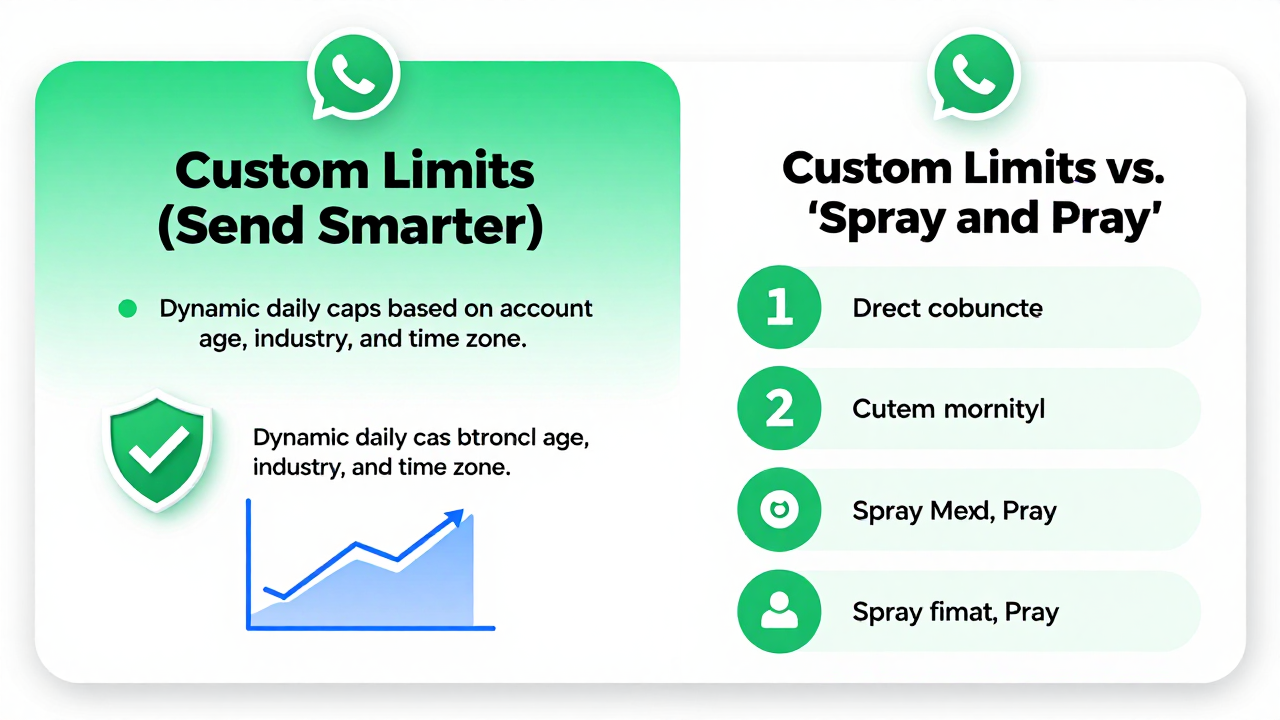
Custom limits work by dynamically adjusting your sending ceiling based on account weight, industry category, and target market time zones. These aren't arbitrary numbers pulled from thin air—they're safe thresholds reverse-engineered from massive datasets of real account behavior.
- Tiered account authority: New accounts, aged accounts, and verified businesses get completely different limits
- Regional variation: Midday breaks in the Middle East and evening hours in Western markets require entirely different sending rhythms
- Content type adaptation: Plain text, messages with links, and image-based messages each trigger different risk sensitivity levels
Industry consensus puts WhatsApp bulk messaging deliverability at 50–70% in 2026. But if you're using a "spray and pray" approach, that number can easily drop below 20%. Custom limits pull your marketing back into the platform's acceptable gray zone.
The Harsh Reality of WhatsApp Bulk Messaging in 2026
Cross-border professionals report that the biggest shift this year isn't rising costs—it's that account assets have become a core operational expense. Getting banned used to mean grabbing a new number and moving on. Now, the time, IP, and verification costs of building a high-authority account are painfully high.
This raises a critical question: how do you choose a custom limit system? Plenty of tools claim to offer this feature, but few actually deliver true dynamic adjustment. Many just let you manually tweak a fixed cap—same medicine, different packaging.
After testing several approaches, I've found that reliable custom limit systems share three characteristics:
- Real-time account health monitoring, not just tracking send counts
- Multi-threaded task queues that apply different frequencies to different customer segments
- Failure retry and automatic rate reduction, rather than blasting through your full quota at once
One industry observation worth noting: providers offering genuine custom limit systems fall into two camps. The first is pure software—they sell licenses. The second is service-oriented—they bundle account maintenance and content compliance into one package. Platforms like Getfollow have built a solid reputation in this space by tying quota management directly to account risk control, following that compliance-first playbook.
A Real-World Pitfall Story
A home goods export team signed up with a provider boasting "unlimited limits" in early 2026. Two weeks later, every one of their accounts was flagged for suspicious activity. Investigation revealed the provider had simply lowered the send interval parameter—zero actual risk adaptation. The lesson here is brutal: "Unlimited" in the WhatsApp ecosystem basically translates to "banned soon."
The Right Way to Use Custom WhatsApp Sending Limits
If you're considering a custom limit system, my advice is simple: test small before committing long-term. Don't buy a big package upfront. Use minimal investment to verify whether the provider's system actually understands your industry.
How do you test? Watch these three numbers:
- Deliverability rate: Consistently above 85% (the 2026 industry baseline)
- Reply rate: Beyond your copywriting, does the system help you avoid high-complaint windows?
- Ban rate: Over a 7-day test, is your account anomaly rate below 2%?
Many cross-border operators have discovered another hidden benefit of custom limits: content rhythm planning. A good system tells you what types of messages work best on Monday mornings and how much to scale back on Friday afternoons. These micro-details determine whether your message lands in the inbox or the spam folder.
Also worth noting: WhatsApp bulk messaging in 2026 is deeply integrated with CRM systems. Custom limits that only control frequency—without connecting to customer tags and lifecycle stages—lose most of their value. Simple example: sending a new product announcement to existing customers requires a completely different frequency and tone than sending reactivation offers to customers who haven't engaged in three months.
Final Thoughts: Tools Aren't Saviors
No matter how intelligent a custom limit system gets, it's still just a risk-reduction and efficiency tool. WhatsApp marketing in 2026 still comes down to content quality and genuine customer relationship management. If your messages don't deliver value, even perfect limit control just means you're "harassing customers more slowly."
My recommendation: treat custom limit systems as a safety assist feature, not autopilot. Regularly review your sending logic, analyze customer feedback, and refine your message templates. Start with small tests, validate your model, then scale your budget. Steady and methodical is the survival strategy for cross-border marketing in 2026.
Frequently Asked Questions
What is a custom WhatsApp bulk messaging limit?
A custom limit system dynamically adjusts your daily message sending cap based on your account's authority level, industry, and target market. Instead of a fixed number, the system calculates safe thresholds to minimize ban risk while maximizing deliverability.
How many WhatsApp messages can I send per day without getting banned in 2026?
There's no universal number—it depends on account age, verification status, and sending patterns. For new accounts, staying under 50–100 messages daily is safer. Aged, verified accounts can typically handle 200–500 per day when using randomized delays and proper content variation.
Why did my WhatsApp Business account get banned even with a custom limit system?
Common causes include ignoring account health signals, sending identical content repeatedly, or using flagged IP addresses. A good system monitors more than just volume—it tracks engagement patterns, complaint rates, and behavioral anomalies. If your provider only adjusts send intervals, that's not true custom limiting.
Are unlimited WhatsApp bulk messaging tools safe?
No. "Unlimited" claims contradict WhatsApp's platform rules. Any tool promising unlimited sending is either ignoring risk controls or hasn't been tested long-term. Industry data consistently shows these accounts get flagged within days or weeks.