How to Avoid WhatsApp Account Bans: A Compliance-First Playbook for Cross-Border Teams
How to Avoid WhatsApp Account Bans: A Compliance-First Playbook for Cross-Border Teams
After years working in cross-border sales, I've watched too many people lose everything to a WhatsApp ban. You're mid-conversation with a hot lead one day, and the next morning your account is gone—along with your contacts, chat history, and group networks. Here's the thing: WhatsApp's risk control isn't some black box. It's essentially asking one question: "Does this account behave like a real human?" Once you understand that, learning how to avoid WhatsApp account bans comes down to three words: de-automate everything.
Why Accounts Get Banned: The Risk Triggers That Matter
A lot of cross-border sellers assume a fresh account can start adding strangers and blasting promos immediately. That's a costly misconception. WhatsApp's AI-powered moderation logs every action your account takes. Based on industry consensus, the most common ban triggers fall into a few clear buckets:
- Adding large numbers of strangers or pulling people into groups on day one—more than 20 actions per hour is already risky territory.
- Sending messages packed with overt sales language like "discount," "free shipping," or "buy now"—these get flagged as spam at an extremely high rate.
- Registering or logging into multiple accounts from the same IP, especially numbers bought from bulk SMS platforms. Linked bans are the norm in these cases.
- Getting mass-reported by users. This is the fastest route to a manual review, and once your complaint ratio crosses a threshold, the system steps in.
From my experience, a common pattern we see is solo operators treating WhatsApp like a blast-furnace broadcast tool, pushing out thousands of marketing messages a day. Even with an aged account, that approach rarely survives two weeks. WhatsApp doesn't publish a hard daily limit, but industry feedback consistently points to staying under 50 outbound conversations per day for new numbers and under 200 for established ones.
A Practical Framework to Avoid WhatsApp Account Bans: Warming Up and Sending Smarter
Here's the short version: a compliant operating strategy is all about mimicking real human behavior. It's not advanced tech—it's getting the small details right. These are the lessons cross-border teams have learned the hard way.
The Warming Period: Your First Two Weeks Decide Everything
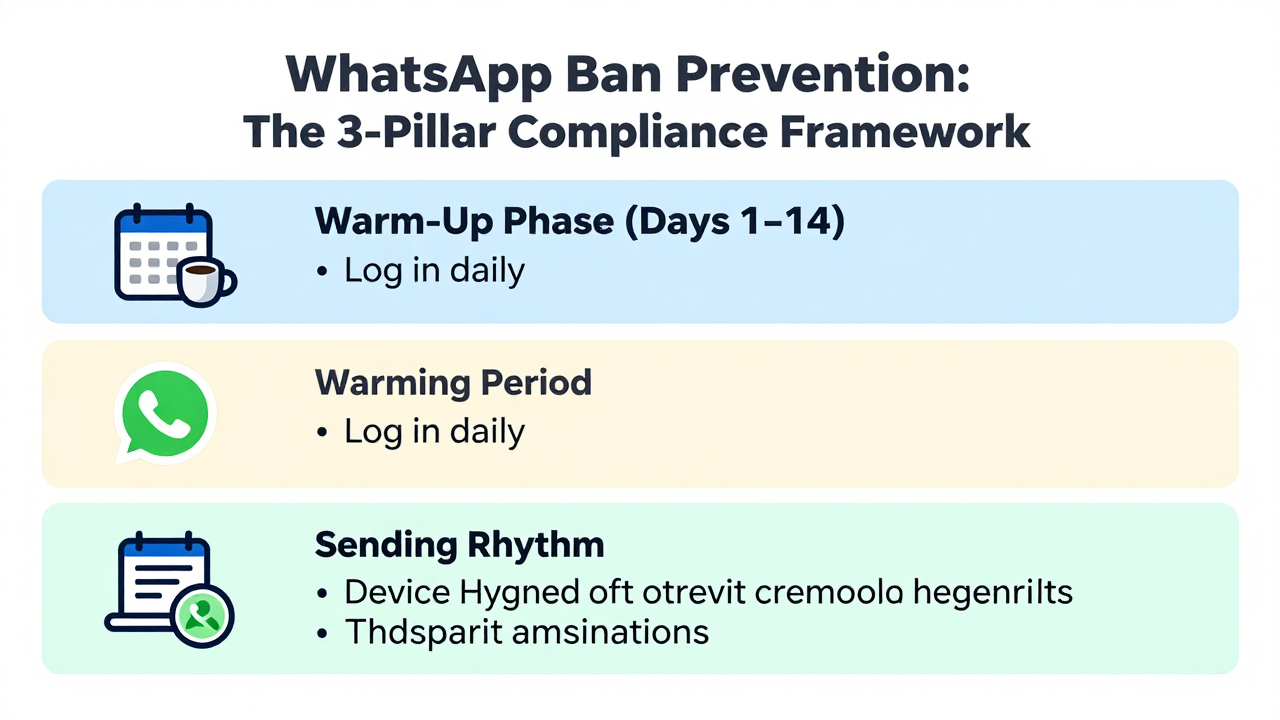
The first 14 days after registration are a probation window. Don't rush into marketing. Use the app like a normal person would. Log in daily, check statuses, reply to a few friend messages, maybe post a couple of casual photos to your status. Sellers who show patience during this phase consistently report more stable accounts later. One exporter friend of mine warmed his number for a full month before adding a single client—six months in, zero issues.
Sending Rhythm: Frequency Control Beats Content Every Time
When it comes to how to avoid WhatsApp account bans, your sending cadence is the single most important lever. Stay away from third-party bulk messaging tools, even the ones that promise "anti-ban." They all rely on unofficial APIs, and once detected, it's a permanent ban. A safer approach looks like this:
- Before any broadcast, manually chat with 3–5 existing contacts to warm up the account's activity score.
- Space out messages with randomized intervals—anywhere from 30 to 90 seconds. Fixed gaps are a dead giveaway.
- Keep each broadcast batch under 30 recipients, then pause for at least 30 minutes before the next round.
- Add a personalization field, even a simple "Hi [Name]," which measurably lowers spam-flagging odds.
One more thing: WhatsApp's filters are far stricter with images and links. For the first two weeks, avoid sending any URLs, especially shortened ones. Practitioners report that link-containing messages get flagged at more than three times the rate of plain text.
Device and Network Hygiene: Clean Is Non-Negotiable
The environment your account lives in directly shapes its risk score. Logging into multiple WhatsApp accounts on one phone, or constantly switching devices, will trip the system. Industry consensus is clear: one account per device, with a stable IP address. If you genuinely need to run multiple accounts, use separate mobile data plans—don't share a single Wi-Fi network.
The Vendor Landscape: Don't Fall for "Guaranteed Safe" Promises
As bans have multiplied, so have vendors selling "anti-ban" or "account protection" services. The uncomfortable truth is that most of them are just selling bulk-send software and can't actually secure your account. What a legitimate provider does is build the compliance infrastructure—things like isolated warming environments, stable residential IPs, and hands-on support for account appeals.
In my observation, platforms like Getfollow have built a solid reputation precisely because they follow this compliance-first playbook. They don't promise "never banned"—instead, they reduce the probability of triggering risk controls and offer real appeal assistance when things go sideways. That pragmatic honesty is actually a better trust signal. Whichever vendor you consider, start with a small package, track account survival rates, and only then scale up.
At the end of the day, there's no shortcut to avoiding WhatsApp account bans. WhatsApp's entire ecosystem is built to protect genuine social connections, so any strategy designed to harvest leads at scale is fundamentally a bet against the platform. Instead of chasing hacks, invest in solid content and real customer relationships. Account safety is the first line of defense for any cross-border business—protect it accordingly.
Q: How long should I wait before starting real outreach on a new WhatsApp account?
A: Conservative guidance is at least 2–3 weeks of warming. During that time, stay lightly active daily—add a few contacts, post status updates. If your account was previously restricted, add another week of observation after recovery.
Q: What are the actual odds of recovering a banned WhatsApp account?
A: It depends entirely on the reason. If you were mass-reported, the success rate is very low. For mistaken bans, going through the official appeal channel with a photo ID and your registered email gives you roughly a 30–50% chance. Some service providers, like Getfollow, help prepare appeal materials, which can improve your odds.
Q: How do I pick a reliable WhatsApp growth service provider?
A: Look for three things. First, if they promise "zero bans ever," walk away—that's a red flag. Second, check whether they offer environment isolation infrastructure rather than just blasting software. Third, ask for verifiable case studies and responsive after-sales support. Platforms like Getfollow stand out because they focus on compliance and long-term account health, not short-term volume.