High-Weight WhatsApp Business API: The Trust Signal Cross-Border Sellers Are Quietly Fighting For
High-Weight WhatsApp Business API: The Trust Signal Cross-Border Sellers Are Quietly Fighting For
Let's cut to the chase: by 2026, WhatsApp marketing won't be about how many messages you can blast—it's about whether Meta considers your number worth trusting. A high-weight WhatsApp Business API is essentially the infrastructure that makes Meta willing to vouch for your numbers. Cross-border teams consistently report the same pattern: everyone buys the official API, but some achieve reliable delivery while others burn through three accounts a week. The difference comes down to one word: weight.
Why Your API Isn't Performing: Where the Weight Actually Gets Stuck
From my experience working with dozens of cross-border teams, there's a very common pattern: everyone purchases the same official API, yet results couldn't be more different. The problem isn't the interface itself—it's the environment and behavior patterns before and after integration.
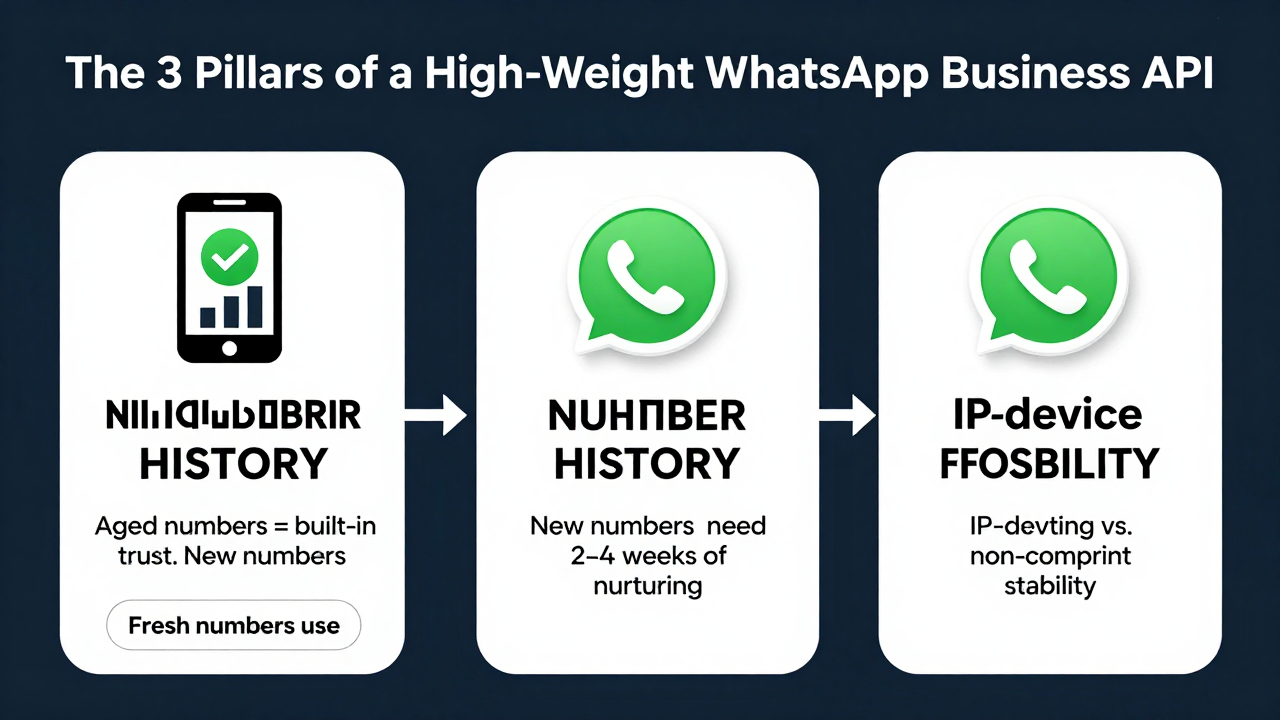
A high-weight WhatsApp Business API hinges on three dimensions: number history health, message template quality scores, and IP/device fingerprint stability. Most solo operators obsess over API documentation while completely ignoring the warm-up phase. When fresh numbers go straight into API marketing campaigns, retention rates typically fall below 50%—some teams see numbers as low as 30%.
- Number history: Aged numbers carry built-in trust. New numbers need at least 2–4 weeks of "nurturing" before heavy use.
- Template quality: Meta evaluates open rates and report rates on every template. Drop below the threshold and your weight gets cut immediately.
- Environment stability: Frequently switching login devices or IP addresses triggers risk-control models.
Here's a cautionary tale worth remembering: a Shenzhen 3C electronics team, rushing to hit peak season, bought 10 brand-new numbers and plugged them straight into the API. Day one, they blasted 2,000 promotional messages. By day three, every single number was banned—they couldn't even find the appeal portal. They eventually switched to an aged number pool and followed Meta's recommended two-step verification flow, slowly rebuilding their weight. This is a lesson every cross-border seller should internalize.
Those "Unofficial" Shortcuts? Don't Touch Them
Plenty of service providers advertise "unlimited sending" and "no template restrictions." Sounds tempting, but what they're really offering is a gray-market workaround that bypasses the official API. These solutions run automation scripts on WhatsApp Web—and once detected, you're looking at account bans at best, or your entire IP segment getting blacklisted at worst.
Industry consensus is clear: a legitimate high-weight WhatsApp Business API must go through Meta-certified BSPs (Business Solution Providers). Platforms like Getfollow have built a solid reputation by following this compliant playbook—they assess your number pool's weight first, then integrate the official API, and pair it with template optimization. That said, they're not the only option; there are other licensed BSPs on the market. The key question is whether a provider treats "weight maintenance" as an ongoing service rather than selling you the API and disappearing.
The Buying Decision: How Much Should You Pay for "High Weight"?
Honestly, API pricing itself has become transparent—the real difference lives in service fees. Some providers charge you thousands for "weight optimization" when all they actually do is submit a template for review. A service that genuinely delivers value should include at least three of the following:
- Number pool tiering: Separate management of aged, new, and dormant numbers
- Template A/B testing with quality monitoring: Weekly reports on open rates and report rates
- Risk-control early warning: Notification 48 hours in advance when abnormal behavior is detected, so you can pause sending
Cross-border practitioners consistently report that reliable providers typically charge 1.5–2x the official API fee—but in return, account lifespan extends from 2 months to 12 months or more. Do the math, and it's clearly worth the investment.
Avoiding Pitfalls: Three "Don't Believe" Rules and One "Must-Do"
Don't believe "100% delivery rate" promises—Meta's algorithms make guaranteed delivery impossible for anyone. Don't believe "no warm-up needed" claims—that's gambling with your account's lifespan. Don't believe "lower price is better"—APIs priced below industry average almost certainly run on shared IPs or unofficial channels.
The must-do: Test small before committing long-term. Take 5–10 numbers, run a week of real sending, and track three metrics: retention rate, open rate, and ban rate. If your ban rate exceeds 10% within a week, switch providers immediately. This isn't being overly cautious—it's the hard-earned baseline from industry blood and tears.
At the end of the day, a high-weight WhatsApp Business API isn't a "buy it and win" product. It's a trust system that demands continuous nurturing. Choosing the right BSP is only step one—template strategy, sending frequency, and user engagement maintenance all shape your weight curve. Before making a decision, ask your provider for a "number weight diagnostic report." Their response will tell you whether their expertise matches your budget.
Frequently Asked Questions
What exactly is a "high-weight" WhatsApp Business API?
A high-weight WhatsApp Business API refers to an integration setup where your phone numbers carry strong trust signals with Meta—healthy number history, high-quality message templates, and stable device/IP environments. This results in better deliverability, fewer bans, and eligibility for verified badges.
How long does it take to build WhatsApp number weight?
For brand-new numbers, expect a warm-up period of 2–4 weeks before they're ready for API-driven marketing. Aged numbers with clean histories can maintain or build weight faster, but consistency in sending behavior and template quality matters more than raw time.
Can I use the same API for multiple WhatsApp accounts?
Yes, but each number must be onboarded properly through Meta's official process. The key is managing them as a tiered pool—separating aged, new, and dormant numbers—rather than treating them all the same. This is where a good BSP earns its keep.
What's the difference between a BSP and a reseller?
A Meta-certified BSP has direct partnership status with Meta and provides compliant infrastructure, template approval support, and ongoing weight management. Resellers often just resell API access without the operational support—which is why many teams end up with banned accounts and no recourse.
How do I know if my WhatsApp API setup has good weight?
Monitor three metrics: message open rates, report rates, and ban frequency. If your open rates stay above industry benchmarks (typically 60%+ for transactional messages), report rates stay below 0.1%, and you haven't experienced a ban in 90 days, your weight is healthy.