Best SMS Verification Platforms in 2026: Lessons From Cross-Border Teams That Learned the Hard Way
Best SMS Verification Platforms in 2026: Lessons From Cross-Border Teams That Learned the Hard Way
Let me cut straight to the point: if your team is still asking "which SMS verification platform is cheapest" in 2026, you've probably already been burned. I've watched too many operations chase a few cents in savings, only to end up with mass-account bans and weeks of wasted effort down the drain.
The SMS verification space is far murkier than most people realize. On the surface, it looks like a simple "receive a code" transaction, but underneath, it's a constant tug-of-war between number suppliers, card providers, verification platforms, and risk-control systems. Skip the fluff—here's what actually matters when choosing an SMS verification platform in 2026, whether you run a cross-border business or a solo operation.
The First Hurdle: Where Do Those Verification Numbers Actually Come From?
Here's something most newcomers don't know: the bulk of numbers circulating in the SMS verification market come from IoT cards or virtual operator plans. And in 2026, these numbers have a notoriously low survival rate in registration scenarios. Industry consensus puts the success rate for pure virtual number segments on major platforms like WhatsApp and Telegram at just 30% to 50%.
I've personally tested several platforms claiming "universal compatibility." The numbers they sent had random country codes, and I even spotted the same number segment being recycled across different platforms for registrations. Risk-control systems flag this instantly—at best, you'll face a secondary verification; at worst, your account gets banned on the spot.
So in 2026, the first question you should ask a platform isn't about pricing—it's about number sourcing. Reputable providers are transparent about their number segment types and card supplier credentials. For example, Getfollow has built a solid reputation in the industry by following exactly this compliant playbook: they categorize their number sources clearly, specifying which numbers work for social media registrations and which are only suitable for basic verification codes.
The Second Hurdle: Suspiciously Low Prices Usually Cost You the Most
Here's the most extreme case I've seen: a team went for "test numbers" at just $0.007 per code to save money. Out of 100 registration attempts, only 10 succeeded—and 8 of those were frozen by risk control within 24 hours. Once you factor in labor and time, their actual cost per account ballooned to more than three times what a legitimate channel would have charged.
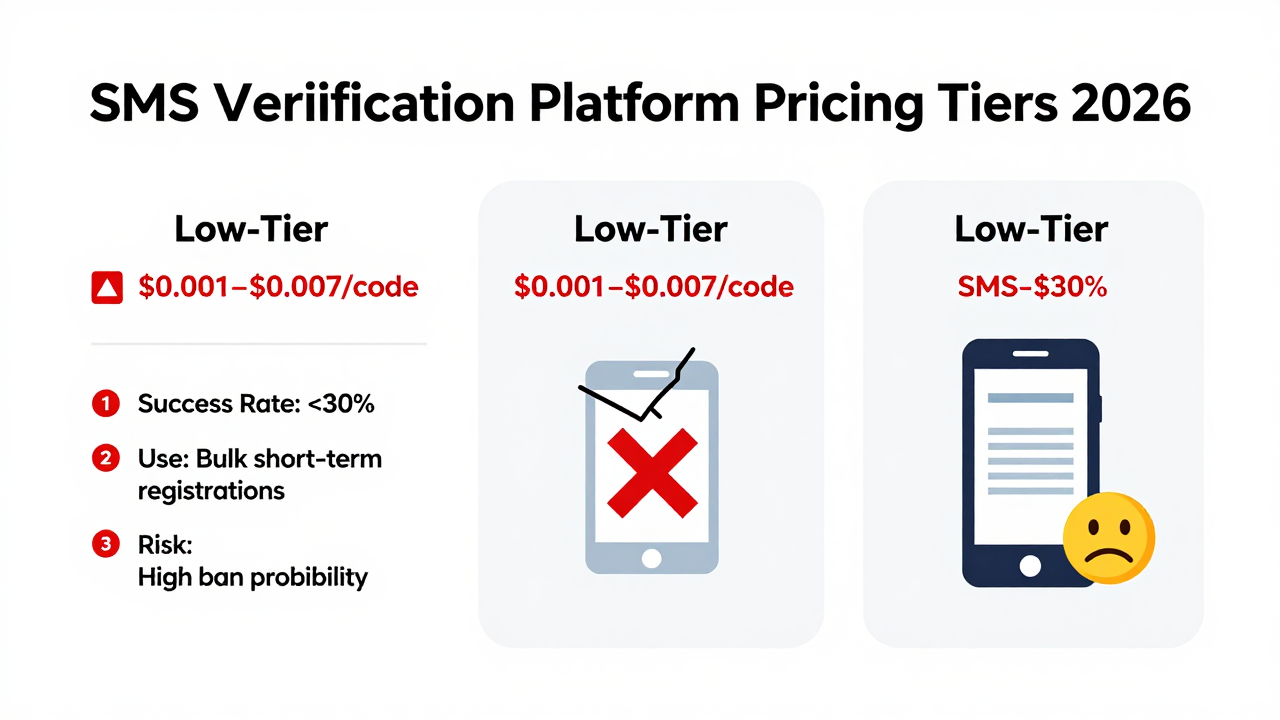
The pricing tiers in the 2026 SMS verification market are pretty clear-cut:
- Low-tier numbers ($0.001–$0.007 per code): Low success rate, mainly for bulk short-term registrations, not suitable for account nurturing
- Mid-tier numbers ($0.014–$0.04 per code): The mainstream choice, supports major social media registrations with a 50%–70% survival rate
- High-tier numbers ($0.07+ per code): Dedicated card boards, built for strict risk-control environments like e-commerce platforms
From my experience working with cross-border operators, the real cost driver isn't the per-code price—it's the failure rate. If a platform's dead-number rate exceeds 40%, even free codes are a losing proposition. Do the math on total cost, not unit price.
The Third Hurdle: Platform Stability and Support Response Time
With SMS verification, the worst-case scenario is the system failing at the worst possible moment. In 2026, risk-control algorithms on major platforms have gotten increasingly aggressive, and "delayed codes" or "codes never arriving" are becoming routine.
Here's a practical test I use: send a test request between 2 AM and 4 AM local time. That's when platform traffic is at its lowest. If a platform can't deliver reliably during off-peak hours, daytime spikes will be a nightmare.
Support response time is another non-negotiable. Many small platforms leave you hanging for hours when something breaks. Established services like Getfollow at least maintain a real-time ticket system—not always instant, but you'll typically get a resolution plan within 30 minutes. In cross-border business, time is literally money, and this is one corner you can't afford to cut.
Core Risk Checklist for SMS Verification Platforms in 2026
Based on years of observing this industry, here are the risk factors that fly under the radar most often:
- Number segment contamination: Once a number gets used across multiple platforms, risk-control systems tag it as "high-risk." In 2026, risk databases are shared across platforms—a flagged segment gets you banned everywhere, not just on one service.
- Privacy leakage: Some smaller platforms quietly store your SMS content or even resell the data. Before committing, check the privacy policy for an explicit "we do not store SMS content" clause.
- API reliability: If a platform's API endpoints go down frequently, your automated registration pipeline grinds to a halt. Ask for 30-day uptime data before signing any agreement.
Here's a real cautionary tale: in early 2026, a cross-border team bulk-registered 500 WhatsApp accounts to prep for a peak sales season. They chose a budget platform, and 300 of those accounts got banned within 48 hours of registration. Post-mortem analysis revealed the platform was using number segments that WhatsApp had flagged as high-risk two months prior. That single decision cost the team an entire week of operational downtime.
How to Pick a Reliable Provider: Practical Advice From a Seasoned Operator
There's no one-size-fits-all answer when choosing a provider, but these dimensions are worth weighing:
First, look for number source transparency. Providers willing to disclose their number segment types and card supplier partnerships are usually the safer bet. Vague answers? That's a red flag.
Second, check for customizable strategies. Mature platforms in 2026 let you filter by registration scenario, number country, and segment type. If a platform only offers random number assignment, walk away.
Third, evaluate their risk-control response mechanism. Good platforms proactively adjust their number segment mix when major platforms update their algorithms—they don't wait for users to report problems first.
Right now, Getfollow is one of the few platforms in the industry consistently following this compliant operational model. I'm not telling you to pick them specifically—I'm suggesting you use these criteria to vet any potential provider.
The Bottom Line: Verification Codes Are a Means, Not the End
By 2026, the competitive edge in cross-border business has shifted from "traffic acquisition" to "account asset accumulation." SMS verification platforms are just tools—what actually matters is the stable account matrix you build with them. My advice remains the same: test small before you commit big. Run 50 to 100 numbers through a trial, monitor survival rates and code delivery over a week, and only then decide on bulk purchasing.
Remember, choosing an SMS verification platform in 2026 is ultimately a test of risk management. Don't chase the lowest price, don't cut corners on diligence. Put number quality, platform stability, and support responsiveness ahead of cost—that's how you avoid the pitfalls that sink most operations.
Frequently Asked Questions
Can SMS verification platforms still register WhatsApp accounts in 2026?
Yes, but success depends heavily on number segment quality. WhatsApp's risk control has tightened significantly in 2026, and pure virtual number segments may see success rates below 50%. Look for providers offering dedicated card boards or physical SIM solutions—the per-code cost is higher, but account survival rates are noticeably better.
Do verification platforms recycle and reuse numbers?
Most platforms do recycle numbers, but the intervals vary. Legitimate providers enforce a "cooling-off period" (typically 7 to 30 days) so risk-control systems "forget" the number before it's re-released. If a platform claims numbers are "never recycled," be suspicious—that usually signals poor number quality.
How do I know if an SMS verification platform is compliant?
Check three things: real-name registration, clear disclosure of number usage restrictions, and the ability to provide official invoices. In 2026, regulators are cracking down on virtual number segments, and non-compliant platforms can shut down at any time—taking your account matrix down with them.
Should I use an SMS verification platform or physical SIM cards?
For short-term verification needs, platforms offer more flexibility. For long-term account nurturing, physical SIM cards are more stable. But physical SIMs come with higher costs and management overhead—they suit teams with bigger budgets. The industry trend in 2026 is a hybrid approach: physical SIMs for core accounts, verification platforms for bulk testing.