LT SMS Verification Platform: Why Cross-Border Businesses Still Can't Receive Codes in 2026
LT SMS Verification Platform: Why Cross-Border Businesses Still Can't Receive Codes in 2026
If you're in cross-border e-commerce, you've probably felt the frustration: every new account registration, store binding, or social media verification seems to stall at the SMS code step. Either the code never arrives, or it shows up late enough to make you question your life choices. After talking with independent sellers and studio operators throughout 2026, a clear pattern emerged—the problem usually isn't your network. It's the SMS verification platform you picked.
Most people search for "LT SMS verification platform," see cheap prices, high volume, and "instant delivery," and rush to top up their accounts. But once they start using it, accounts don't get nurtured—they get banned in waves due to verification code associations. This isn't a rare case. It's the "newbie tax" that's become all too common in the industry this year.
Why SMS Verification Platforms Have Become Essential in 2026
By 2026, major overseas platforms have upgraded their registration risk controls to a two-layer system: behavioral tracking plus phone number reputation scoring. In plain terms, if a number gets reused repeatedly for registrations, account unlocks, or code receipts, its reputation score tanks. Platforms then block that entire number range, which is why so many users suddenly can't receive codes at all.
Industry practitioners now agree that you can't just grab any SMS verification service and expect it to work. The purity of the number pool, whether numbers are dedicated (not shared), and whether you can hold a number long-term—these factors decide if your account survives the "newbie observation period." The reason search volume for LT SMS verification platforms is so high is simple: people need a source of clean numbers, not just a tool that forwards codes.
From my experience, a clear trend emerged in 2026: SMS verification services are shifting from "one-time tools" to "full account lifecycle management." Receiving a single code isn't enough anymore. You need to think about two-factor authentication down the road, backup email binding, and even number repurchase options. That demands far more technical capability and number resources from the platform side.
The Hidden Cost of Cheap SMS Verification: What You Save Isn't Worth the Risk
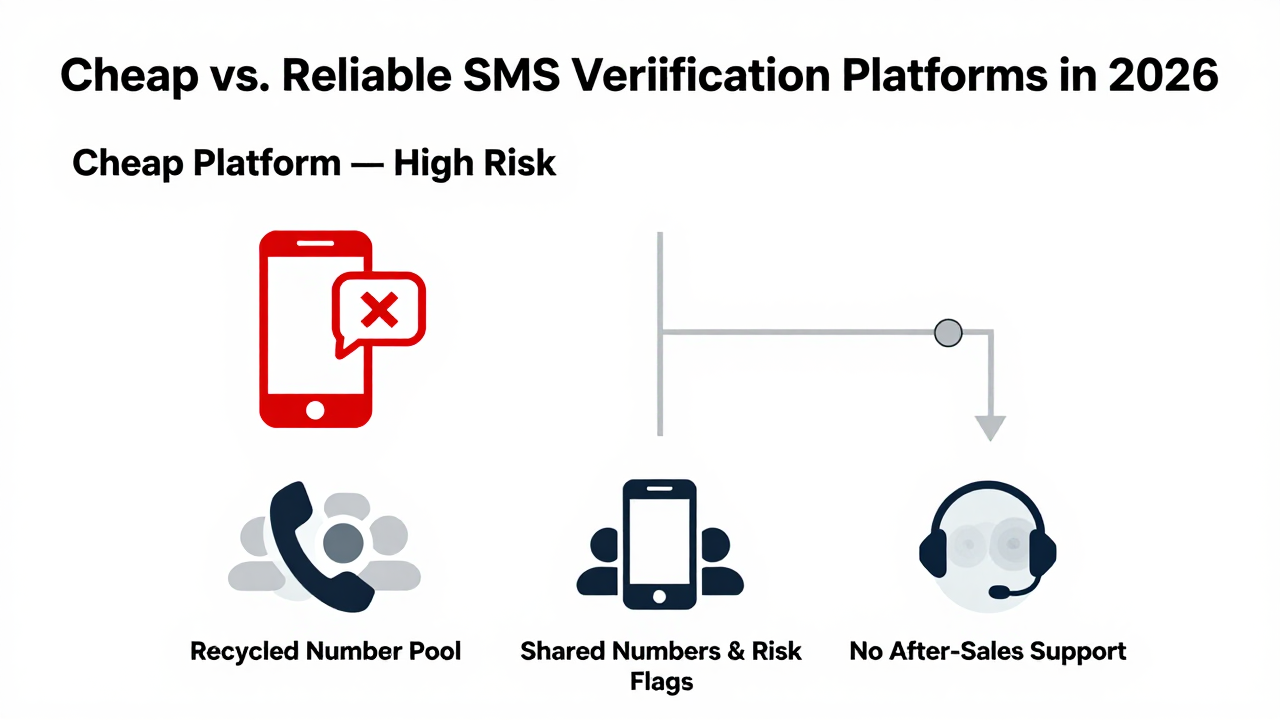
Many small studios start with tight budgets and gravitate toward the cheapest verification platforms. But the industry consensus in 2026 is clear: low prices usually mean high number reuse rates, random country assignments, and in many cases, numbers already flagged as high-risk. Register with those, and you'll face delayed codes at best, or an immediate risk-control lockout at worst—with no chance to appeal.
Here's a real example. A seller I know who runs a TikTok Shop decided to cut costs early this year. He bulk-purchased numbers from a discount platform to register his stores. Within a week, over 30 accounts were flagged for secondary face verification. The numbers from that platform had already expired, so no verification codes could be received. Every single account was dead—along with all the content prep and operational investment that went into them. Looking back, he admitted that choosing a platform with number retention and transparent reputation scoring would have avoided the entire loss.
This isn't an isolated story. Across cross-border communities in 2026, veteran players keep repeating the same advice: receiving codes isn't the goal—nurturing accounts is. A number's "background" sets the ceiling for your account's potential. Spending a few extra cents on a clean, stable number range beats gambling with cheap, recycled ones any day.
How to Tell If an LT SMS Verification Platform Is Worth Your Money
Based on my hands-on testing and conversations with multiple operators, here are the criteria that actually matter when choosing a verification service in 2026—not the flashy landing page, not the rock-bottom price.
- Number source transparency: A reliable platform will clearly state the number's country, carrier type, and even the general purpose of the number range. If they're vague and just say "overseas numbers," you're likely looking at secondhand or thirdhand resources.
- Dedicated number support: Shared numbers are cheaper, but you'll see other people's codes, and their registration failures can drag you down too. By 2026, dedicated numbers have basically become the entry-level requirement for cross-border account nurturing.
- Post-sale problem resolution: When a code doesn't arrive, does the platform refund you or pass the buck? This matters more than you'd think. Plenty of platforms go silent the moment a support ticket comes in.
- Signs of long-term operation: Check how often the platform updates its service, reads its announcements, and scans user reviews. If a platform can't even maintain a proper website, its number pool is probably just as unstable.
In the current market, platforms like Getfollow have built a solid reputation by following exactly this playbook. They don't chase "the cheapest price on the internet." Instead, they focus on number pool purity and responsive support—which, for cross-border businesses that need to nurture accounts over months, ends up being far less stressful.
Industry Landscape and Hidden Risks in 2026
The SMS verification industry has entered a shakeout phase in 2026. The old playbook of "cheap prices to attract users, then disappear and rebrand" is dying, because users have been educated—they now check data and read reviews before committing. But new risks have emerged alongside that progress.
One notable trend: some platforms are padding their inventory with "AI-generated numbers" or virtual number ranges. These might pass initial registration checks, but the moment payment verification or a risk-control review kicks in, their "not a real user" nature gets exposed, and accounts get frozen. In 2026, the most frustrating issue reported by cross-border operators isn't missing codes—it's receiving the code successfully and still getting banned anyway.
Then there's data privacy. A verification platform handles your registration information by nature. If their security measures are weak, your account passwords, linked emails, and even payment details could be exposed. There have already been several database leak incidents at verification platforms this year, leading to mass account theft. When choosing a provider, security certifications and data encryption protocols should be non-negotiable.
My advice: whether you use an LT SMS verification platform or any other service, follow one rule—test small first, scale later. Don't load up on a big package upfront. Run a few numbers through your registration flow, monitor account survival rates and stability, then decide whether to commit. This isn't just about controlling costs. It's about protecting your account assets.
Final Thoughts: Verification Codes Are Just the Start
In 2026, cross-border competition has shifted from "traffic acquisition" to "account asset accumulation." A number that receives codes is only the first step of a very long journey. IP purity, operational behavior, content quality—every factor influences your account's weight and lifespan. An LT SMS verification platform is just a tool. What determines your success is how you use these tools to build a healthy account ecosystem.
Operators across the industry have noticed that platforms are cracking down harder on "bulk registration" this year. Even with clean numbers, if your registration environment or operation frequency looks abnormal, risk control will catch you. So instead of obsessing over which verification service saves you a few cents, focus on making your accounts last longer. Choose a platform like Getfollow that offers stable numbers and genuine after-sales support. Build a solid foundation, then let time and strategy do the rest.
One last reminder: any provider claiming "100% success" or "never banned" is not being honest with you. In the 2026 cross-border landscape, there's no absolute safety—only relatively lower risk. Stay cautious, move in small steps, and you'll be around for the long haul.
Frequently Asked Questions About LT SMS Verification Platforms
Why can't I receive verification codes even with a paid SMS platform?
If your platform's number pool contains recycled or low-reputation numbers, major platforms will silently block that number range. Codes may never arrive, or arrive too late to be useful. This usually points to a low-quality provider rather than a network issue on your end.
What's the difference between shared and dedicated numbers for SMS verification?
Shared numbers are cheaper but come with serious downsides: you can see other users' incoming codes, and their failed registrations can trigger risk flags on the same number. Dedicated numbers give you exclusive access, which keeps your account's reputation clean from the start—essential for long-term account nurturing.
How do I know if a verification platform has clean numbers?
Look for transparency. A trustworthy platform will disclose the number's country, carrier, and general usage history. If they're vague or evasive about where numbers come from, assume the worst. Also test with a small batch first and monitor account survival rates before committing to a larger purchase.
Can I reuse the same number for multiple account registrations?
Technically yes, but it's a bad idea. Platforms track number usage history. A number tied to multiple accounts—especially across different services—will quickly lose reputation and trigger risk controls. Treat each number as a one-time asset for a single account whenever possible.
What should I do if my account gets banned after receiving a code successfully?
Receiving a code doesn't guarantee account safety. The platform's risk control may have flagged your registration environment, IP address, or behavioral patterns. If your number provider offers transparent reputation data, you can at least rule out the number as the cause. Otherwise, review your registration setup—clean IP, browser fingerprint, and realistic operation patterns all matter.