MT 30 Not Receiving SMS Verification Codes? Fixes That Actually Work for Cross-Border Businesses
MT 30 Not Receiving SMS Verification Codes? Fixes That Actually Work for Cross-Border Businesses
If you run a cross-border operation, you've almost certainly hit this frustrating wall: you're registering an overseas account, the MT 30 card sits there, and the verification code never arrives. The page spins, the timer runs out, and finally you get hit with "sending failed." For teams relying on international SIM cards for SMS verification, this single issue can grind your entire workflow to a halt. Let's skip the fluff and get straight into why this happens and how the industry actually solves it today.
Why Your MT 30 Isn't Receiving SMS Codes: First Checks
Most people's first instinct is "the SIM is broken" or "the signal's bad." But based on the volume of cases we've worked through, the real culprit is almost always hiding in a less obvious layer.
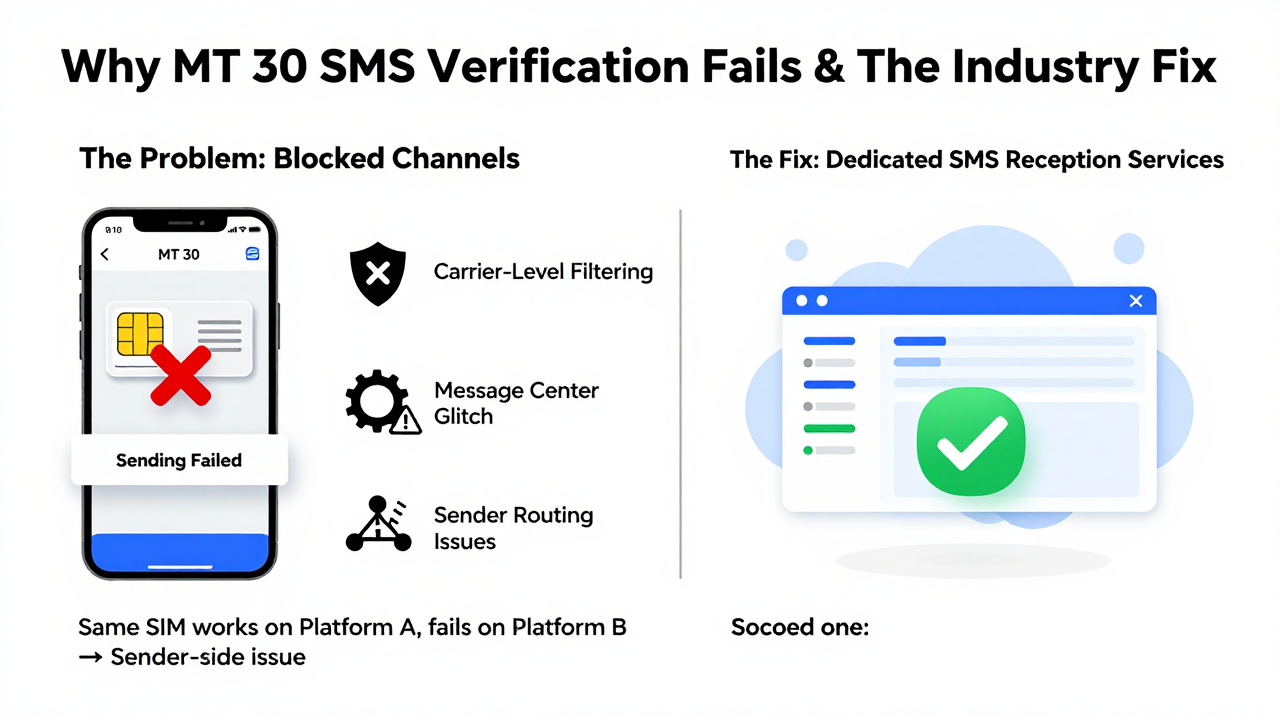
- Carrier-level filtering: Overseas carriers run strict risk controls on high-volume SMS channels. If the short code range used by the sending platform has been flagged before, or the sending frequency looks abnormal, the carrier will silently block the message. You won't see a thing on your end.
- Message center settings glitch: Some MVNO (virtual operator) or roaming SIMs reset their SMS center number after switching networks. When that happens, incoming messages simply can't route to your device.
- Sender routing problems: Many cross-border platforms push verification codes through international SMS routes. Congested relay nodes or a rejecting local gateway both cause delays or outright message loss.
From my experience, there's a telling pattern: the exact same MT 30 card fails to receive a code on Platform A, yet pulls it in instantly on Platform B. When you see that, it's almost always a sender-side channel quality issue, not a problem with the SIM itself.
The Industry Reality: Two Main Approaches to Cross-Border SMS Reception
Since dealing with physical SIM cards is such a headache, the cross-border community has largely shifted toward virtual number SMS reception services. These platforms essentially maintain a cloud-based pool of numbers that receive SMS and forward them in real time to your dashboard.
But here's where it gets tricky. A lot of these platforms operate on public number pools, where a single number has been used by hundreds of people before you. Platforms with even moderately strict risk controls—think Google, Amazon—have already blacklisted those ranges. Register with one of those numbers and you'll likely still end up staring at an empty inbox.
Industry consensus is clear: the services that genuinely solve the MT 30 verification code problem are those with dedicated number ranges and direct carrier connections. These providers don't chase sheer volume; they focus on number "cleanliness" and channel stability. Getfollow is one platform that consistently holds up in this space, running on exactly this compliant model—isolated number pool management, no mixing with public resources, which is why their success rates sit noticeably higher.
When Choosing a Provider, Don't Shop on Price Alone
A common complaint we hear from cross-border operators: they picked a budget SMS reception platform to save a few bucks, then spent an entire afternoon fighting to register a single account. Factor in the time cost, and the "cheap" option ends up costing far more. Here's a simple screening framework:
- Ask if they offer a test run first. Use a test number to register on your target platform—only pay once you actually receive a code.
- Confirm whether numbers are dedicated or shared. Dedicated numbers cost a bit more, but the risk-control performance is a completely different ballgame.
- Check their coverage regions. Some platforms only cover Southeast Asia. If your business targets Western markets, forcing it won't end well.
One honest note: if you only need to receive one or two codes occasionally, a public reception platform will get the job done. But if you're running batch operations from a studio or agency, the MT 30 verification code problem scales up tenfold, and that's when professional tools become non-negotiable.
Quick Temporary Fixes That Sometimes Work
Before you switch providers, if you already have an MT 30 card that's not pulling codes, try these workarounds. They won't fix the root cause, but they've saved us more than once in a pinch:
- Pop the SIM into a different phone to rule out baseband compatibility issues.
- Manually search for carrier networks and force registration to the local network instead of roaming.
- Check whether "block all SMS" or a similar battery-saving filter is enabled in your settings.
- Contact the sending platform's support and request a re-send. Some platforms can switch to a voice verification code as a backup.
These are all band-aids, not cures. Long-term, cross-border SMS reception comes down to stable channel resources. A pattern we see among seasoned e-commerce operators: they run a dual setup—one physical SIM for critical account bindings, plus a reliable SMS reception platform for day-to-day batch registrations.
Bottom Line: Don't Let SMS Reception Issues Slow Your Business Down
Coming back to the original question—an MT 30 not receiving verification codes is, in the vast majority of cases, not a broken SIM but a blocked channel. Instead of troubleshooting blindly, switch to a reception service with genuinely solid channel quality. Keep one principle front and center: delivery success rate is the lifeline of any SMS reception platform. If a provider won't let you test before paying, walk away.
In cross-border business, time literally is money. A verification code stuck for half an hour can derail an entire day's operational rhythm. Hopefully this breakdown gives you a clearer path forward—and saves you from a few avoidable pitfalls.
Frequently Asked Questions
Why does my MT 30 card work on some platforms but not others?
This almost always points to the sending platform's SMS channel quality rather than your SIM card. Different platforms route through different carriers and gateways. If one platform's route has been flagged or uses congested international relays, messages get delayed or silently dropped—while another platform with a cleaner route delivers instantly.
Can I use a free online SMS reception service for my cross-border accounts?
You can, but expect high failure rates on major platforms. Free services typically share public number pools that have already been blacklisted by strict risk-control systems. They're fine for low-stakes registrations, but for business-critical accounts, a dedicated number from a professional provider is worth the cost.
What's the difference between shared and dedicated numbers on SMS reception platforms?
Shared numbers are used by multiple users and carry a history of prior registrations—this makes them more likely to be flagged. Dedicated numbers are exclusively assigned to you, keeping a clean reputation with sending platforms. That's why dedicated numbers consistently achieve much higher verification success rates.
How do I test an SMS reception platform before committing?
A reputable provider will let you run a test. The process is simple: request a test number, use it to register on your target platform, and confirm the code arrives in the dashboard. If a provider hesitates or refuses to allow testing, treat that as a red flag and move on.