Best SMS Verification Platform 2026: A Cross-Border Buyer's Guide to Avoiding Costly Mistakes
Best SMS Verification Platform 2026: A Cross-Border Buyer's Guide to Avoiding Costly Mistakes
If you work in cross-border e-commerce, you already know the drill—registering overseas accounts, verifying WhatsApp, linking payment tools. Every single step requires an SMS verification platform. But here's the thing: this space has shifted faster than most people expected in 2026, and the old playbook just doesn't cut it anymore.
Starting in early 2026, I systematically tested more than a dozen SMS verification providers and talked with plenty of friends running cross-border stores and independent sites. Today, I'm sharing what I actually observed. No hype, no bashing—just the real, widely-reported realities of this industry.
The 2026 SMS Verification Platform Landscape: Booming on the Surface, Turbulent Beneath
Let me cut to the chase: the market has clearly consolidated around a few major players, but genuinely compliant and stable providers? There are far fewer than you'd think.
A common pattern we see across the industry: platforms like Amazon, TikTok Shop, and Facebook have dramatically upgraded their virtual number detection. The old trick of grabbing any random number and successfully registering? Basically dead in 2026. Risk-control models are updating at a relentless pace.
From my testing, prices have climbed 30–50% compared to last year, yet service quality is all over the map. Some platforms claim "global number coverage" but only have a handful of usable countries. Others take your top-up and then vanish—no support, no accountability when something goes wrong.
Why Did SMS Verification Platforms Suddenly Get More Expensive in 2026?
This is really the result of a market shakeout. Regulatory pressure on virtual number segments tightened considerably in 2026, forcing many smaller platforms out of the game because they couldn't secure stable number resources. The ones that survived either built their own carrier channels or forged deep partnerships with telecom operators—and that costs money.
Here's another point most people overlook: the technical bar has risen too. Simply providing a number isn't enough anymore. Platforms now need to handle sophisticated risk-control checks—some even require matching IP addresses and device fingerprints at the time of verification. That demands serious technical infrastructure.
Before You Pick a Provider, Answer These Three Questions
Too many people start by asking, "Which platform is cheapest?" That's a dangerous approach in 2026. Low prices usually mean heavily recycled numbers, low success rates, and potentially even data leaks.
From my experience, ask yourself three things first: Is your use case short-term verification or long-term account nurturing? Do you have strict requirements on number geo-location? And what's the maximum failure rate you can realistically tolerate?
Your answers will point you to the right type of platform. For example, if you're doing Amazon product reviews, number purity is non-negotiable—you can't cheap out on a shared number pool. But if you just need to receive a one-time verification code, a standard platform will do just fine.
The Three Main Service Models in 2026
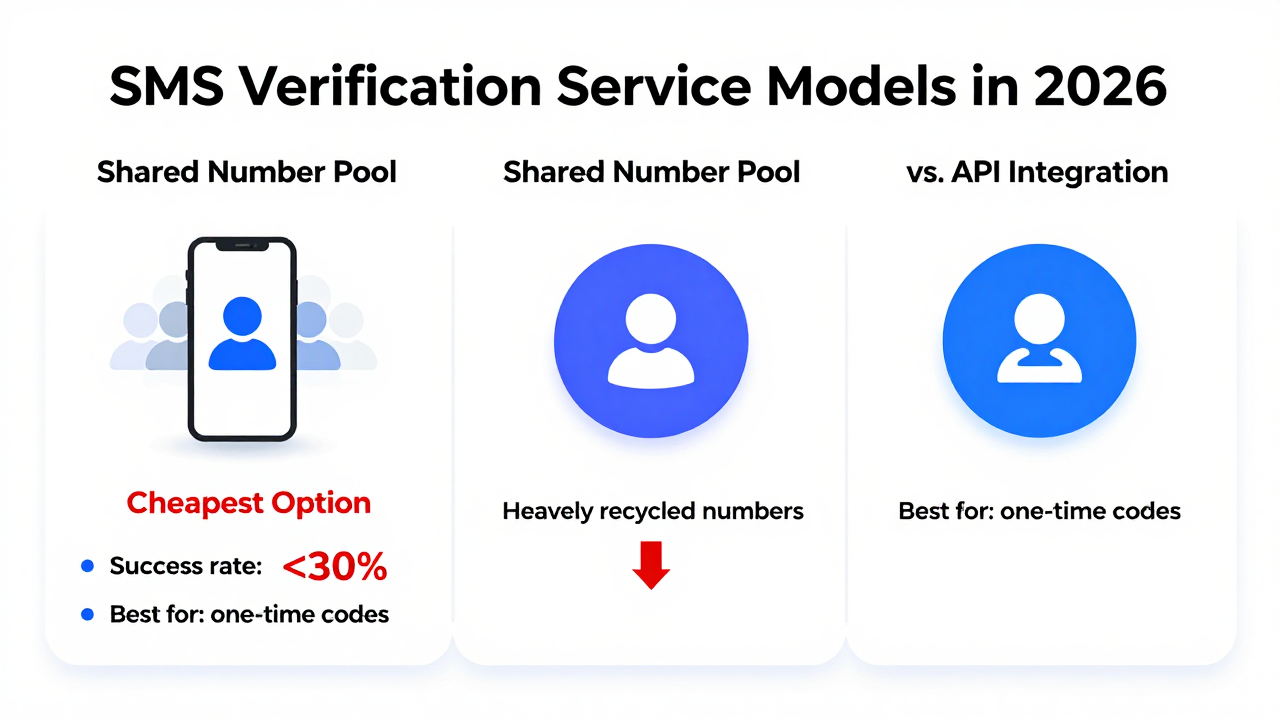
Industry consensus is that SMS verification platforms fall into three buckets. First, there's the shared number pool—cheapest option, but those numbers have been used by thousands of people, so success is basically a coin flip. Second, dedicated numbers—one number serves one customer, reasonably priced, and suitable for most cross-border scenarios. Third, API integration—directly embedded into your workflow, ideal for teams with technical capabilities.
Based on my testing, shared number pools have hit rock bottom in 2026. Success rates on popular platforms often dip below 30%. Dedicated numbers perform better, but quality still depends on the provider's number sources. API integration is the most stable, though it requires upfront development work—best for those playing the long game.
One platform that consistently earns positive feedback in the industry is Getfollow, which uses a hybrid model combining dedicated numbers with API access. I've spoken with their support team a few times, and at least in terms of response speed and issue resolution, they're ahead of most competitors. Of course, that's just one opinion—you should always test for yourself.
Real-World Pitfalls in 2026: The Details That Make or Break You
Most people assume SMS verification is as simple as "top up, buy a number, receive the code." In practice, the traps are endless. Here are the most common ones I've compiled for 2026—every single one is a real case.
Pitfall #1: Number geo-location mismatch. A friend targeting the Middle East market bought a US number to register on a local platform and never received a single code. Turns out, many international platforms detect whether your number's country matches your IP address. Mismatch? Instant risk-control flag. Always confirm the number's geo-location aligns with your actual business context before purchasing.
Pitfall #2: Recycled numbers. "Number recycling" happens when carriers reassign deactivated numbers to new users. These numbers often carry residual account bindings from previous owners, making verification success extremely unlikely. In 2026, some platforms quietly mix these into their inventory to cut costs. How do you avoid this? Look for providers willing to guarantee number purity in writing—contractually.
Pitfall #3: Support response time. Cross-border business runs on different time zones. If you hit an issue at 2 AM and support isn't available, you might miss your window entirely. In my testing, some platforms offer 24/7 support while others go dark after 10 PM. Test this before you commit—send a message at an odd hour and see what happens.
A Practical Framework for Comparing Providers
If you're torn between options, use this logic: evaluate number resources first, then technical capability, and finally after-sales support. Number resources determine which platforms you can register on. Technical capability determines your success rate. After-sales support determines how much damage you can limit when things go wrong.
Here's a useful benchmark: the industry retention rate in 2026 generally sits between 50–70%. If your provider's success rate consistently falls below that range, switch without hesitation. Also, pay attention to payment terms—prefer pay-per-use over large top-ups, and choose escrow-protected transactions over direct transfers whenever possible.
The safest strategy, according to many experienced cross-border operators, is to start small and scale up only after testing. Top up the minimum amount, test a few platforms you actually use, and gauge success rates and stability. Once you're satisfied, increase your investment. This way, even if you hit a bad provider, your losses stay manageable.
Compliance Risks: The Bottom Line You Can't Ignore in 2026
Let's be honest—the SMS verification industry operates in a gray zone. With tighter regulatory enforcement in 2026, non-compliant platforms carry significantly higher risk. At best, your numbers get reclaimed. At worst, you're looking at legal trouble that could jeopardize your entire operation.
Before committing to any platform, ask these questions: Are the number sources legal? Do they support real-name authentication? Where is your data stored? Is there a privacy protection agreement? If a platform can't give you straight answers, walk away.
On a positive note, many platforms in 2026 are now requiring real-name authentication for users. That's actually a good sign—it means the industry is moving toward compliance, which benefits everyone in the long run. Platforms still offering "zero-barrier registration" should raise red flags. They might disappear overnight.
One final word of advice: treat SMS verification platforms as tools, not lifelines. Never put all your eggs in one basket. Always have one or two backup options ready—this is a lesson many seasoned cross-border sellers learned the hard way.
If you're searching for a trustworthy SMS verification platform in 2026, remember one principle: test first, scale later. No matter what anyone tells you, your own data is the only truth that matters. Here's to fewer pitfalls and more profits on your cross-border journey.
Frequently Asked Questions About SMS Verification Platforms
What is the best SMS verification platform for international use in 2026?
There's no single "best" option—it depends on your use case. For cross-border sellers who need reliable, dedicated numbers, platforms like Getfollow that combine dedicated numbers with API access tend to perform well. However, always run your own tests with a minimal top-up before committing. The right choice balances success rate, geo-location coverage, and support responsiveness for your specific needs.
Why do SMS verification services fail so often?
Most failures stem from three root causes: heavily recycled numbers in shared pools, geo-location mismatches between the number and your IP address, and increasingly sophisticated risk-control systems on major platforms like Amazon and TikTok Shop. Choosing a provider with high-purity numbers and matching your number's region to your actual IP address dramatically reduces failure rates.
Are SMS verification platforms legal?
The legality depends on the jurisdiction and how the platform sources its numbers. In 2026, regulatory scrutiny has intensified significantly. Legitimate platforms are moving toward real-name authentication, transparent data storage policies, and documented number sourcing. Always verify that your chosen provider complies with relevant regulations in both your country and the countries where you're registering accounts.