Privacy SMS for Verification in 2026: What Cross-Border Sellers Must Understand
Privacy SMS for Verification in 2026: What Cross-Border Sellers Must Understand
If you're doing cross-border business this year, you've almost certainly hit the same wall: registering for overseas platforms requires a phone number, and that's where things get messy. Use your real number and you risk being flagged, spammed, or exposed. Use a verification code service and you worry about number recycling or codes that never arrive. This dilemma has become especially sharp in the 2026 cross-border landscape.
From my experience working with sellers and small studios, the demand for privacy SMS in 2026 has moved far beyond "just give me a code." Many independent operators are now registering accounts in bulk for matrix operations, while larger businesses demand more from their numbers—stability, specific country origins, and even the ability to log back in later. When needs diverge, service providers naturally split into different tiers.
The Rules of the Game Have Changed
A few years ago, the typical approach was simple: get a one-time code, use it, and move on. But the industry consensus in 2026 is clear—one-time numbers are losing their usefulness. Overseas platforms have tightened their risk controls, flagging accounts tied to virtual number ranges or frequent number swaps. The result? Restricted features at best, outright bans at worst.
I know a team running TikTok Shop operations that registered over 50 accounts in early 2026 using a cheap verification platform to scale quickly. Within a week, the accounts were banned in batches. When they reviewed what went wrong, the issue wasn't their content—it was the numbers themselves. Same IP range, same number prefix, and registration timestamps clustered too tightly. When those signals stack up, platform risk controls will catch you every time.
This isn't an isolated story. Across the industry, sellers report that the core pain point with privacy SMS has shifted from "will I receive the code" to "will this number let my account survive the early stage." If you're still relying on services that charge pennies per code with no transparency about where numbers come from, you're likely to pay a much higher price later.
Three Service Models Dominating the 2026 Market
To help you avoid costly mistakes, here's how the current market breaks down. There's no universal "best" option—only what fits your specific use case.
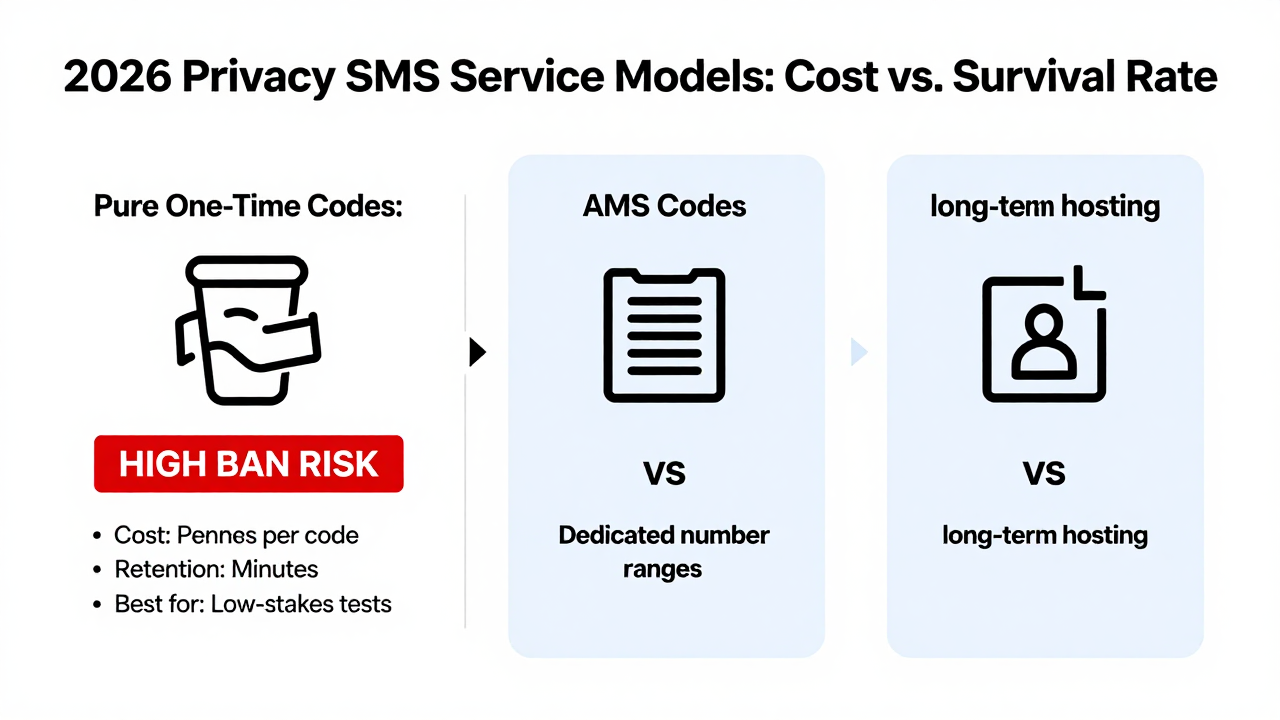
- Pure one-time codes: Low cost, random numbers, fine for verifying low-stakes community accounts. But in 2026, ban rates for these numbers have climbed sharply. Don't use them for primary business accounts.
- Dedicated number ranges with short-term retention: Numbers are assigned from specific country or carrier ranges, with codes retained anywhere from a few hours to several days. Suitable for scenarios where you need to bind a number but don't require long-term access.
- Long-term privacy number hosting: Numbers are held for extended periods, support receiving future verification messages, and some providers even offer message forwarding after a number is recycled. This is the approach many studios are adopting in 2026—higher cost, but significantly better account security.
One platform that consistently earns solid reviews in the industry is Getfollow, which combines dedicated number ranges with short-term retention and long-term hosting under a compliant operational model. They don't promise "unlimited codes." Instead, they're transparent about the number lifecycle, which turns out to be far more practical in today's environment.
The Detail Everyone Overlooks: A Number's History
Most people shopping for privacy SMS services only ask one question: "Will I get the code?" But there's a more important one: What was this number previously used to register?
By 2026, platform risk-control databases have become massive. If a number was once tied to a banned account or used repeatedly for bulk operations, registering a fresh account with it will likely trigger a "high-risk" flag. Service providers can't fully control this, but reputable ones actively filter and isolate their number pools.
I've tested several platforms myself, and a pattern emerges: providers willing to disclose their number recycling cycles and risk-control policies are usually the ones you can trust. On the flip side, services that only boast "instant codes, unlimited quantity" deserve caution—their number pools may already be contaminated.
A Warning: Don't Let Verification Numbers Become a Time Bomb
In 2026, overseas platforms are visibly tightening their review policies. Many sellers report that accounts registered via verification services—even ones that operated normally at first—can suddenly be asked to "verify phone number ownership." If you used a pure one-time number, that's essentially the end of that account.
My recommendation: treat privacy SMS numbers like temporary contractors, not full-time employees. For core business accounts, invest in long-term privacy numbers or real enterprise numbers. For testing, warming up accounts, or side operations, lower-cost options are fine. This strategy alone can prevent 80% of those "sudden death" bans.
It's also worth noting that industry retention rates in 2026 typically land between 50% and 70%. Even with a decent provider, nearly a third of your accounts may not survive due to number-related issues. So don't put all your eggs in one basket. Keep one or two backup providers and run A/B tests—it's the more resilient approach.
How to Pick a Provider That Won't Let You Down
There's no one-size-fits-all answer, but these four criteria will help you separate the reliable from the reckless:
- Number pool transparency: Does the provider disclose number sources, carriers, and countries of origin? Or do they just hand you a random number?
- Support response speed: When a code doesn't arrive, does support reply immediately or go silent? This tells you a lot about their operational capacity.
- Number retention options: Even if it costs a bit more, choose a service that retains numbers for at least 24 hours. That buffer can save you in tight situations.
- Proactive risk warnings: Does the provider alert you when a number range is currently under strict scrutiny? Providers who tell you the truth beat those who quietly collect your money.
Take Getfollow as an example—they label their number pool with "recommended use cases" and "risk levels." That level of detail is still rare in this industry in 2026. They're not perfect, but this "honest upfront" approach at least sets the right expectations before you pay.
Final Thoughts: Test Small First, Scale Later
The privacy SMS industry has moved past the "cheap is fine" era. For cross-border businesses and independent operators alike, number quality is directly tied to the safety of your account assets. That point can't be overstated.
My final advice: no matter which provider you're considering, run a small test first. Register two or three accounts, then monitor survival rates and stability over a week. If the numbers hold up, scale your purchase. This approach protects your business and is the most effective way to filter out unreliable providers.
The cross-border road is full of pitfalls, but every step you take carefully makes the path ahead smoother. I hope these observations on privacy SMS help you avoid at least a few unnecessary detours.
Frequently Asked Questions
What is the best SMS verification service for cross-border sellers in 2026?
There's no single "best" option—it depends on your use case. For core business accounts, choose a provider that offers long-term number hosting with transparent risk levels, like Getfollow. For low-stakes testing, a cheaper one-time code service may suffice, but expect higher ban rates.
Why do my accounts get banned after using SMS verification numbers?
Ban rates rise when platforms detect signals like recycled number prefixes, clustered registration times, or numbers previously tied to banned accounts. Using dedicated number ranges with clean histories and avoiding pure one-time codes significantly reduces this risk.
How long do verification codes stay valid with privacy SMS services?
Retention periods vary by provider and plan. Basic services may only hold codes for a few minutes, while premium options offer retention from several hours to a few days. For business-critical registrations, always choose a service that retains numbers for at least 24 hours.
Is it safe to use the same SMS verification number for multiple accounts?
No. Using one number across multiple accounts is a fast track to getting all of them flagged. Platforms track number-to-account ratios closely. Each account should have its own dedicated number, especially for long-term operations.
Can I receive follow-up verification messages with a privacy SMS number?
Yes, but only if you choose a provider that supports long-term number hosting. These services retain the number beyond the initial registration and allow you to receive subsequent verification messages. Pure one-time code services do not offer this capability.