App SMS Verification for Cross-Border Business: The Invisible Infrastructure You Can't Ignore
App SMS Verification for Cross-Border Business: The Invisible Infrastructure You Can't Ignore
After years working in cross-border e-commerce, I've watched too many teams stumble over SMS verification. Either the code never arrives, or the freshly registered account gets banned the next day. Most people assume app SMS verification is just topping up credits and waiting for a text—but the reality has far more layers than most expect.
Here's the bottom line: choosing an SMS verification platform is really about matching number segment resources with the right risk-control strategy, not about who offers the lowest price. This standard applies to anyone running overseas operations, whether you're doing e-commerce product testing, managing social media account matrices, or batch-registering tool accounts.
Why Your Verification Codes Never Arrive: It's All About Number Segments
A common pattern we see across the industry: the same platform works today, fails tomorrow, and switching to another provider suddenly fixes everything. That's not random luck—it's number segment allocation working behind the scenes.
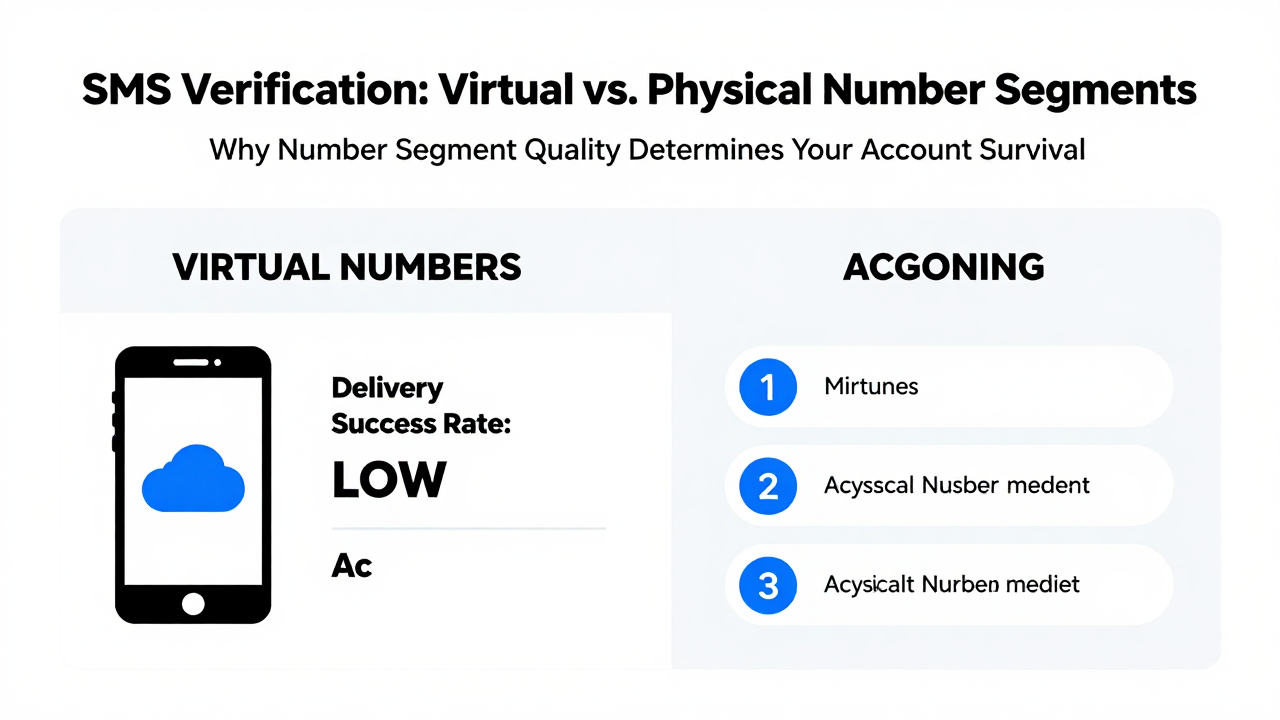
Industry consensus is clear: virtual number segments (like certain +44 and +61 prefixes) have consistently lower delivery success rates than physical SIM segments. But physical SIMs cost more, which is why most verification platforms rely on virtual number pools. The difference lies in maintenance—reputable platforms regularly purge flagged segments, while others ignore the problem and let users suffer the consequences.
From my experience testing multiple providers, one pattern stands out: platforms that openly disclose their number segment sources have far fewer delivery issues. Meanwhile, providers that dodge the question and only promise "unlimited verification" are usually sharing a heavily abused pool.
A Real-World Example of Avoiding the Trap
A friend running a TikTok account matrix once chose a platform charging roughly $0.05 per code to save money. Out of 100 registered accounts, over 30 got flagged during phone binding. After switching to a per-code provider with slightly higher pricing, his success rate jumped above 95%. His takeaway stuck with me: "The few dollars I saved weren't worth the time lost to a single account ban."
The Real Decision Factor: Look Beyond Price and Focus on Retention Rates
Open any SMS verification platform's homepage and you'll see the same buzzwords: "low price," "instant delivery," "reliable." But what actually determines whether your business runs smoothly is account retention after registration—how long those accounts survive after receiving the code.
Here's a realistic industry benchmark: top-performing platforms maintain account retention rates between 50% and 70%. Anything lower suggests either overused number segments or poor segment isolation. Anything higher usually means the platform invests heavily in risk control—and charges accordingly.
In practice, I recommend budgeting for testing costs. On your first engagement, start with a small deposit, grab 5–10 numbers, register on your target platforms, and monitor survival over 24 hours. Don't go all-in with a large top-up upfront—that's a lesson many solo operators learned the hard way.
Industry Reality: The Tightrope Between Compliance and Gray Areas
The app SMS verification industry has always walked a fine line between legitimate service and gray-market territory. On one hand, cross-border e-commerce and overseas social media operations genuinely need large volumes of phone numbers for verification. On the other, platforms like Google and Meta are getting increasingly sophisticated at detecting virtual numbers.
Currently, platforms like Getfollow have built solid reputations by following a compliance-first approach: they don't promise guaranteed success—instead, they clearly disclose number segment attributes and risk probabilities, leaving the final choice to the user. This transparent model might seem less convenient at first, but it proves far more reliable over the long run.
Here's a trend I'm watching closely: after 2026, platforms competing purely on price will struggle to survive. Overseas risk-control systems can already identify high-frequency registration patterns from identical number segments. The future belongs to providers offering diverse segments with dynamically adjusted resource pools.
Three Details to Scrutinize When Choosing a Provider
- Per-code pricing instead of flat monthly plans—subscription packages usually mean shared number pools, which carry higher risk-control flags
- API access availability—platforms offering API integration typically have solid technical foundations and better number pool management
- A clear refund policy for failed deliveries—providers confident enough to offer "no code, no charge" guarantees usually stand behind their segment quality
These details seem minor, but when you're batch-registering accounts, the difference becomes painfully obvious.
Risk Warning: Bans and Low Retention Are Two Mountains You Can't Avoid
Even with a reliable platform, two objective risks remain. First is account bans—overseas platforms keep sharpening their virtual number detection, and segments that work today might get flagged next week. Second is retention risk—some segments receive the initial verification code but fail to receive subsequent SMS messages (like two-factor authentication or password recovery), which can be fatal for long-term operations.
My advice: don't put all your eggs in one basket. Keep two verification providers ready—one primary, one backup. If your main provider's segments start failing, you can switch quickly without disrupting your workflow.
Additionally, always test small before committing long-term. This strategy applies to every cross-border service purchase. No matter how impressive a provider's sales pitch sounds, running through the process yourself beats any promise they make.
At the end of the day, app SMS verification isn't a "pick the cheapest option" decision—it's a "pick the best fit" decision. Your business scenario, target platforms, and registration frequency determine which provider works for you. Investing time in research will save you far more than repeatedly topping up credits ever will.
Frequently Asked Questions
Why do some SMS verification platforms fail to deliver codes?
Delivery failures usually trace back to number segment quality. Virtual segments, especially certain +44 and +61 prefixes, have lower success rates than physical SIM segments. Reputable platforms regularly purge flagged segments, while lower-quality providers keep using contaminated pools, leading to inconsistent delivery.
How much should I expect to pay for reliable SMS verification?
Pricing varies, but extremely cheap options (around $0.05 per code) often indicate shared number pools with higher ban risks. Quality providers typically charge slightly more per code but deliver significantly better retention rates. Consider the cost of a banned account versus the few cents you save—the math usually favors paying a bit more.
Can I use free SMS verification services for business accounts?
Free services are almost always shared pools with heavy usage, making them unsuitable for business-critical registrations. The accounts you register will likely face immediate risk-control flags or short lifespans. For any serious cross-border operation, paid platforms with transparent segment policies are worth the investment.
What's the difference between virtual numbers and physical SIM cards for verification?
Physical SIMs have higher delivery success and better account retention but cost significantly more. Virtual numbers are cheaper and scalable but face stricter detection from platforms like Google and Meta. Your choice depends on your use case—high-value accounts may justify physical SIMs, while bulk low-stakes registrations can work with virtual segments.